LAST MEDICALLY REVIEWED:
November 2026 — Dr. Shaileshkumar Garge
Citi Vascular Hospital, KPHB Colony, Road No. 1, Hyderabad, Telangana 500072
1. Quick Answer — What Is IVC Filter Removal?
2. Why Does an IVC Filter Need to Be Removed?
3. When Is the Right Time to Remove an IVC Filter?
4. Who Can Have Their IVC Filter Removed?
5. How Is IVC Filter Removal Performed? (Step-by-Step)
6. What Makes Some Filter Removals Difficult?
7. Advanced Retrieval Techniques for Complex Cases
8. What Happens If the Filter Cannot Be Removed?
9. Risks of Leaving an IVC Filter In vs Removing It
10. What to Expect After IVC Filter Removal
11. Cost of IVC Filter Removal in Hyderabad
12. Why Choose Citi Vascular Centre?
13. Dr. Shailesh Kumar Garge — IVC Filter Retrieval Specialist
14. Frequently Asked Questions
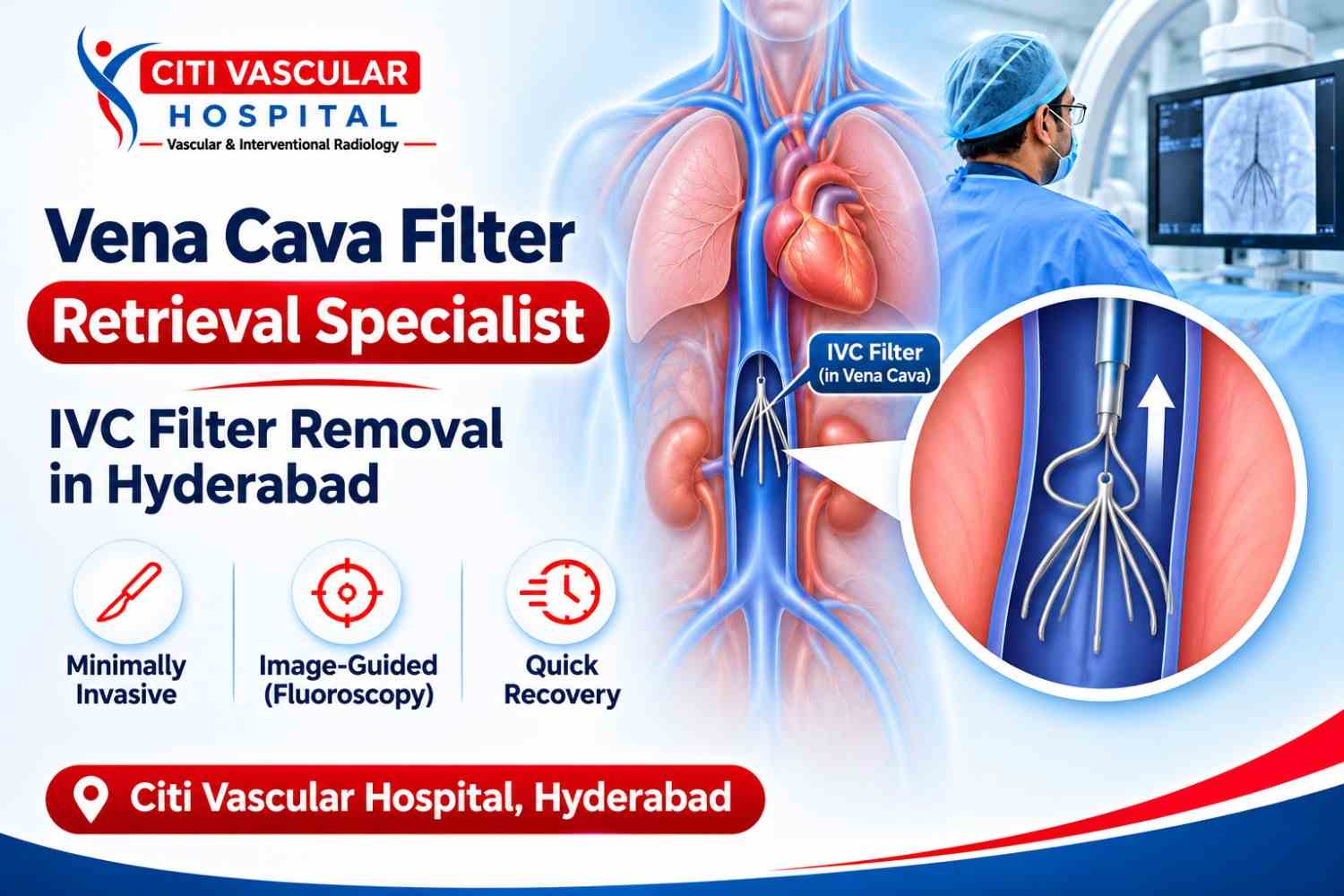
IVC filter removal (also called filter retrieval) is a minimally invasive procedure to take out a retrievable inferior vena cava filter that was placed earlier to prevent pulmonary embolism. Using a catheter introduced through the jugular vein in the neck, a specialised snare tool grabs the filter's retrieval hook and collapses it back into a sheath — the whole device is then withdrawn from the body.
The procedure takes approximately 30–60 minutes under local anaesthesia. Most patients are discharged the same day.
Retrieval is strongly recommended once the original reason for placing the filter — typically a temporary contraindication to blood thinners — has resolved. Leaving a retrievable filter permanently in the body significantly increases the risk of serious long-term complications including filter fracture, migration, and IVC thrombosis.
At Citi Vascular Centre, Hyderabad, IVC filter retrieval — including difficult, late-presentation, and complex cases — is performed by Dr. Shailesh Kumar Garge, Senior Interventional Radiologist.
When an IVC filter is placed, the goal is to provide temporary protection against pulmonary embolism during a period when blood-thinning treatment is not safe. Once that risk period has passed — once anticoagulation can be safely given, or once the acute DVT has been treated — the filter has served its purpose.
The critical point that many patients are not told clearly enough: a retrievable IVC filter is not designed to stay in the body permanently. It is engineered for temporary use, and leaving it in long-term carries compounding risks that increase the longer it remains.
What Happens When a Retrievable Filter Is Left in Too Long?
|
Time In Body |
What Changes Inside the Filter |
Clinical Risk |
|
0–3 months |
Filter is free-floating — retrieval hook is accessible and clean |
Standard retrieval — straightforward, high success rate |
|
3–6 months |
Mild tissue incorporation begins at the strut tips; hook may tilt slightly |
Retrieval usually still possible with standard technique |
|
6–12 months |
Moderate tissue ingrowth; struts may penetrate IVC wall (perforation); hook may embed |
Advanced retrieval techniques may be needed; risk of failed retrieval increases |
|
12+ months |
Significant tissue embedding; strut fracture risk rises; fragments may have already migrated |
Complex retrieval required; specialist intervention centre essential; permanent conversion may be necessary |
A landmark systematic review (Angel et al., JVIR 2011) found that IVC filter fracture rates increase significantly beyond 6–12 months of dwell time. Fractured struts can migrate to the right ventricle or pulmonary arteries — a potentially life-threatening complication. This is why timely retrieval is not optional but clinically essential.
The optimal window for IVC filter retrieval is generally 3–6 months after placement — but the decision is not based on time alone. It is based on whether the original indication for the filter has resolved.
|
Condition at Follow-Up |
Recommended Action |
|
Anticoagulation has been safely restarted and DVT is stable or resolving |
Plan filter retrieval — the filter has done its job and is no longer needed |
|
Surgery or bleeding risk has resolved — anticoagulation is now safe to give |
Start anticoagulation and plan retrieval within 4–8 weeks of restart |
|
Catheter-directed thrombolysis (CDT) is complete — clot successfully dissolved |
Retrieval should occur within days to weeks of CDT completion |
|
DVT is resolved; patient has completed full course of anticoagulation |
Filter can be retrieved; anticoagulation can be stopped after retrieval |
|
Patient has had no recurrent DVT or PE; anticoagulation is ongoing |
Filter retrieval is still appropriate — ongoing anticoagulation makes the filter redundant |
|
Patient still unable to take anticoagulants long-term (e.g. ongoing cancer, recurrent bleeding) |
Filter may need to remain — discuss permanent filter options with your specialist |
There is no absolute upper time limit for attempting retrieval. Even filters placed over 12 months ago can often be successfully removed with advanced techniques. If your filter was never retrieved, it is worth seeking a specialist consultation — do not assume it is too late.
Not every patient with an IVC filter is an automatic candidate for retrieval. The treating interventional radiologist will assess the following before proceeding:
Factors That Favour Retrieval
The original indication for the filter has resolved (anticoagulation is now safe, bleeding has stopped, surgery is complete)
A retrievable filter was placed (not all filters are designed for removal)
No large thrombus is trapped within the filter — a clot-laden filter may shed clot during retrieval
The filter is not excessively tilted (> 15° tilt can complicate snare access to the hook)
No evidence of strut perforation through the aorta, bowel wall, or other adjacent structures
Factors That Complicate or Delay Retrieval
Large thrombus within the filter — patient may need anticoagulation first to allow clot to dissolve
Severely tilted or migrated filter — advanced retrieval tools required
Markedly embedded struts or retrieval hook — longer dwell time, requires advanced technique
Partial IVC thrombosis at or below the filter — may need treatment before retrieval
Who Should NOT Have the Filter Removed
Patients with a permanent (non-retrievable) filter — these are not designed for removal
Patients with ongoing, unresolved contraindication to anticoagulation where PE risk remains high
Patients where the retrieval risk (e.g. significant co-morbidities) outweighs the long-term complication risk
Standard IVC filter retrieval is performed using a technique called snare-assisted retrieval. It is a catheter-based procedure carried out in a catheterisation laboratory under real-time X-ray (fluoroscopy) guidance. Here is exactly what happens:
|
Step |
Stage |
What Happens |
|
1 |
Pre-procedure imaging |
CT scan or fluoroscopic venogram reviews the filter position, degree of tilt, presence of thrombus within the filter, and IVC diameter. This determines whether standard or advanced retrieval tools are needed. |
|
2 |
Venous access |
Local anaesthetic is injected at the right internal jugular vein (neck). An ultrasound-guided needle puncture is made and a guidewire is advanced down through the superior vena cava into the IVC. The jugular approach is preferred for retrieval — it approaches from above, with the retrieval hook visible and accessible at the top of the filter. |
|
3 |
Venogram |
Contrast dye is injected to confirm the filter's exact position, check the IVC above and below the filter for thrombus, and assess the retrieval hook position. Any clot trapped in the filter is documented. |
|
4 |
Snare placement |
A retrieval catheter (sheath) with a loop snare is advanced toward the filter. The snare loop is opened and carefully positioned around the filter's apex (retrieval hook). Real-time fluoroscopy allows precise positioning. |
|
5 |
Hook engagement |
The snare loop is tightened around the retrieval hook, capturing the apex of the filter. The filter begins to collapse as the snare is advanced into the retrieval sheath. |
|
6 |
Filter collapse and withdrawal |
As the filter is retracted into the sheath, its struts collapse inward and disengage from the IVC wall. The entire collapsed filter, within the sheath, is then withdrawn through the jugular vein and removed from the body. |
|
7 |
Completion venogram |
A final venogram confirms the IVC is patent (open), no residual filter fragments remain, and no injury to the vein wall has occurred. The sheath is removed and a pressure dressing is applied to the neck access site. |
Duration: 30–60 minutes | Anaesthesia: Local (± mild sedation) | Discharge: Same day or next morning
Not all filter retrievals are straightforward. Several factors can make the procedure technically challenging — this is why complex retrieval should always be performed at a centre with an experienced interventional radiologist and access to advanced retrieval tools.
|
Challenge |
What It Means Clinically |
How It Is Addressed |
|
Embedded retrieval hook |
The filter tip is buried in the IVC wall — the snare cannot easily engage it |
Hook manipulation catheter, loop snare with upward force, or forceps technique |
|
Severely tilted filter |
A tilt > 15° makes the hook inaccessible to a standard snare |
Rigid sheath technique, tip-deflecting wire, or balloon-assisted tilt correction |
|
Clot within the filter |
Thrombus on filter struts — retrieval risks showering clots into the lungs |
Pre-retrieval anticoagulation to dissolve clot; pharmacomechanical thrombus treatment if large |
|
Strut perforation through IVC wall |
Struts have penetrated the wall — forced removal could tear the vein |
Staged technique; piecemeal strut release; conversion to permanent in extreme cases |
|
Very long dwell time (> 12 months) |
Multiple challenges combined — embedding, tilt, potential fracture, intimal ingrowth |
Advanced retrieval suite with multiple tool types; staged procedure over two sessions if needed |
|
Previously failed retrieval attempt |
Prior manipulation may have damaged the hook or caused scarring |
Specialist referral; fresh imaging assessment; different technique combination |
When standard snare retrieval fails or is anticipated to be insufficient, interventional radiologists trained in advanced filter retrieval can use a range of specialised techniques. These are not available at every hospital — they require specific tools, expertise, and a fully equipped cath lab.
Commonly Used Advanced Techniques
Hook manipulation / loop technique — a curved tip catheter is used to free or reposition an embedded hook before snare engagement
Rigid sheath technique — a stiff outer sheath straightens the filter's tilt enough to allow hook capture
Balloon-assisted filter straightening — a small balloon catheter is inflated to push against the filter and reduce its tilt angle
Endobronchial forceps (alligator forceps) — micro-forceps passed through the retrieval sheath grip the embedded hook directly
Laser sheath technique — a laser-tipped sheath is used to cut through tissue that has grown around the filter struts, freeing them
Piecemeal strut release — where individual struts have embedded, each is freed sequentially before the whole filter is collapsed
Two-catheter technique — two separate catheters from femoral and jugular access approach the filter simultaneously to stabilise it during retrieval
At Citi Vascular Centre, Hyderabad, Dr. Shailesh Kumar Garge is experienced in advanced filter retrieval techniques for difficult cases — including late presentations, embedded filters, and previously failed retrieval attempts. If you have been told your IVC filter cannot be removed, it is worth seeking a specialist second opinion.
In a small percentage of cases — particularly those with very long dwell times, severe embedding, or significant structural changes — filter retrieval may not be safely achievable. In this situation, several management options exist:
The filter is left in place and treated as a permanent implant — regular follow-up imaging to monitor for filter-related complications
Conversion to a permanent filter posture — some retrievable filters, if no longer retrievable, can be formally reclassified as permanent devices in the patient's records
Fractured strut management — if struts have already fractured and migrated, their location is documented and monitored; percutaneous retrieval of cardiac or pulmonary strut fragments can be performed by experienced teams if symptomatic
Long-term anticoagulation may be prescribed to reduce IVC thrombosis risk from the indwelling filter
A filter that cannot be removed is not automatically dangerous — but it does require structured, long-term follow-up with an interventional radiologist. Patients with permanent or non-retrievable filters should have annual or biennial imaging to screen for filter complications.
One of the most common questions patients ask is: is it riskier to remove the filter or to leave it in? The evidence is clear — for retrievable filters placed for temporary indications, the risks of long-term retention significantly outweigh the procedural risks of retrieval.
|
Risk Category |
Leaving the Filter In (Long-Term Retention) |
Removing the Filter (Retrieval Procedure) |
|
Filter fracture |
Struts break with time — fragments migrate to heart / lungs |
Not applicable — filter is removed |
|
IVC thrombosis |
Clot forms on the filter body, blocking the main vein |
Not a concern after retrieval |
|
Filter migration |
Filter moves from original position — may travel toward heart |
Small risk during retrieval; managed with expertise |
|
IVC perforation |
Struts penetrate IVC wall — adjacent organ injury (rare but serious) |
Completion venogram confirms no wall injury |
|
Post-thrombotic syndrome |
Chronic IVC obstruction worsens leg swelling and venous disease |
Retrieval restores normal IVC flow |
|
Procedure-related risk |
None immediately — but long-term cumulative risk rises |
Access site bruising 2–4%; contrast reaction < 1%; filter dislodgement very rare |
|
Overall outcome |
Significantly worse long-term outcomes with retained retrievable filters (PREPIC2, Angel 2011) |
Clinical data strongly supports retrieval when feasible |
Recovery from IVC filter removal is typically smooth and rapid. Because the procedure is performed via a small puncture in the neck vein with no incision, there is very little downtime.
Immediately after the procedure
The neck access site is monitored for 2–4 hours — a small pressure dressing is in place
Blood pressure, heart rate, and oxygen saturation are monitored
A chest X-ray may be taken to confirm no filter fragments were left behind
Most patients feel normal within 1–2 hours; some experience mild neck stiffness
At home — first week
Mild bruising or tenderness at the neck access site is normal and resolves within 5–7 days
No heavy lifting or vigorous exercise for 48 hours
Blood-thinning medication should be continued as prescribed — the filter's removal does not reduce the need for anticoagulation in a patient with active DVT
Contact the clinic immediately if you notice swelling of the neck, difficulty swallowing, new chest pain, or breathlessness
Ongoing management after retrieval
Continue anticoagulation as prescribed — your haematologist or vascular physician will advise on duration based on your DVT history
Your DVT follow-up continues on its own schedule — removing the filter does not end DVT treatment
No follow-up imaging is typically required after a straightforward retrieval; a check venogram is performed at the time of the procedure
Annual clinical review is advisable if you have had a DVT to monitor for post-thrombotic syndrome
The cost of IVC filter retrieval varies depending on the complexity of the case — a straightforward standard retrieval has a different cost profile to an advanced complex retrieval requiring specialist tools and potentially a longer procedure.
|
Procedure Type |
Approximate Cost (Hyderabad) |
|
Standard IVC filter retrieval (straightforward, within 6 months of placement) |
₹60,000 – ₹1,20,000 |
|
Complex IVC filter retrieval (long dwell time, tilted, embedded hook) |
₹1,00,000 – ₹2,00,000 |
|
Advanced retrieval (laser sheath, forceps technique, multi-session) |
₹1,50,000 – ₹2,50,000 |
|
Pre-retrieval CT or venogram imaging (if not already available) |
₹5,000 – ₹15,000 |
|
Post-retrieval anticoagulation management (follow-up consultation) |
₹500 – ₹1,500 per visit |
What is included in the cost at Citi Vascular Centre:
• Pre-procedure imaging review and clinical consultation
• Retrieval catheter, snare tools, and procedure consumables
• Procedure in a dedicated cath lab with fluoroscopy and digital subtraction angiography
• Contrast media and venogram
• Post-procedure monitoring and discharge planning
• Completion venogram confirming successful retrieval
Insurance: IVC filter removal is covered under most cashless health insurance policies as a cardiovascular / vascular intervention. Pre-authorisation documentation (procedure request, filter placement records, clinical indication for retrieval) is required. Our billing team will assist with all insurance paperwork.
|
✅ |
Advanced Retrieval Capability |
Skilled in complex, late-presentation retrievals — including previously failed attempts at other hospitals |
|
✅ |
Dedicated Cath Lab |
Full digital angiography and fluoroscopy suite — the same environment as a tertiary interventional centre |
|
✅ |
Pre-Retrieval Planning |
CT or fluoroscopic imaging review before every retrieval to choose the right technique and tools — no surprises mid-procedure |
|
✅ |
Ultrasound-Guided Access |
Jugular vein access under real-time ultrasound minimises access-site complications |
|
✅ |
Retrieval-First Philosophy |
Every patient placed at our centre receives a retrieval plan at time of filter insertion — most retrievals happen on schedule |
|
✅ |
Coordinated DVT Care |
Removal is integrated with ongoing DVT and anticoagulation management — not treated as an isolated procedure |
|
✅ |
Transparent Pricing |
Fixed package costs quoted upfront; insurance documentation provided on the same day |
Dr. Shailesh Kumar Garge is the Director and Chief Vascular & Interventional Radiologist at Citi Vascular Centre, KPHB Colony, Hyderabad.
15+ years of experience in interventional radiology and minimally invasive vascular procedures
Specialist in IVC filter placement, retrieval, and management of filter-related complications
Experienced in advanced retrieval techniques for difficult and late-presentation cases
Fully equipped catheterisation laboratory with digital subtraction angiography (DSA) capability
Consultations available in Telugu, Hindi, and English
Conveniently located at KPHB Colony — accessible from Kukatpally, Miyapur, Balanagar, Kompally, and central Hyderabad
Book a Consultation — IVC Filter Removal, Hyderabad
Citi Vascular Centre | KPHB Colony, Hyderabad — 500072
+91 73375 83901
www.citivascular.com
Dr. Shailesh Kumar Garge | Senior Interventional Radiologist
Bring to your consultation: Original IVC filter placement report / filter card · Current imaging (CT / Doppler) · Medication list · Insurance card
If you were told your filter cannot be retrieved — seek a second opinion. Advanced techniques can often achieve retrieval even after several years.
1Q: How is an IVC filter removed from the body?
A: IVC filter removal is a minimally invasive catheter procedure. A thin tube (sheath) is introduced through the internal jugular vein in the neck. A loop snare is advanced through the sheath to capture the filter's retrieval hook. As the snare is tightened and retracted into the sheath, the filter's struts collapse inward, releasing from the IVC wall. The collapsed filter is then withdrawn through the sheath and removed from the body. The whole procedure takes 30–60 minutes under local anaesthesia.
2Q: How long does IVC filter removal take?
A: A straightforward retrieval typically takes 30–60 minutes in the catheterisation laboratory. Complex retrievals — where the filter is tilted, embedded, or has been in place for a long time — may take 60–90 minutes. Most patients are discharged the same day or the following morning. There is no general anaesthesia required in most cases.
3Q: Is IVC filter removal painful?
A: No — the procedure is performed under local anaesthesia at the neck access site. Most patients feel only mild pressure. Mild neck stiffness or soreness at the access site is common for 1–2 days after the procedure. This resolves on its own and does not require more than paracetamol.
4Q: How long can an IVC filter stay in the body?
A: Retrievable IVC filters are designed for temporary use — ideally retrieved within 3–6 months. The longer they remain, the higher the risk of complications including filter fracture, migration, IVC perforation, and IVC thrombosis. However, there is no absolute maximum dwell time — filters can often be retrieved even after 12–24 months or more with advanced techniques. If your filter has been in place for a long time, do not assume retrieval is no longer possible — seek a specialist assessment.
5Q: What if my IVC filter has been in place for years — can it still be removed?
A: Often yes — even with extended dwell times. While long-term filters are more technically challenging to retrieve, advanced techniques including hook manipulation, rigid sheaths, endobronchial forceps, and in some cases laser sheaths can achieve retrieval even when standard snare techniques have failed. At Citi Vascular Centre, we evaluate every case individually on imaging before advising that retrieval is not feasible.
6Q: What happens if the IVC filter cannot be removed?
A: In a small number of cases, retrieval is not safely achievable — particularly when struts have deeply perforated through the IVC wall or when fracture fragments are present. In these situations, the filter is managed as a permanent device with regular surveillance imaging (CT or abdominal X-ray) to monitor for complications. Long-term anticoagulation is often recommended to reduce the risk of filter-related IVC thrombosis.
7Q: Do I still need blood thinners after my IVC filter is removed?
A: This depends on your underlying condition. If your IVC filter was placed because anticoagulation was temporarily contraindicated (e.g. recent surgery), and your DVT has since resolved, your treating physician may decide that anticoagulation can be stopped after filter removal. However, if you still have active DVT or a high-risk thrombophilia, anticoagulation must continue. The filter removal does not replace or end DVT treatment — these are separate decisions.
8Q: What is the success rate of IVC filter retrieval?
A: For standard retrievals performed within 3–6 months of placement, success rates exceed 90–95%. For complex retrievals — tilted, embedded, or longer-dwell filters — success rates with advanced techniques remain high at specialised centres (75–90%), but are significantly lower at non-specialist hospitals. This is why specialist referral matters for difficult cases.
9Q: What are the risks of IVC filter removal?
A: IVC filter retrieval is a safe procedure with a low complication rate. Procedural risks include access-site bruising or haematoma (2–4%), mild contrast reaction (< 1%), filter dislodgement during retrieval (very rare with experienced operators), and venous injury (extremely rare). These risks are substantially lower than the long-term risks of leaving a retrievable filter permanently in the body.
10Q: What is the cost of IVC filter removal in Hyderabad?
A: At Citi Vascular Centre, Hyderabad, IVC filter retrieval costs between ₹60,000 and ₹1,20,000 for a standard case, and ₹1,00,000 to ₹2,50,000 for a complex or advanced retrieval. This is an all-inclusive package covering the cath lab procedure, retrieval tools, fluoroscopy, contrast venogram, and post-procedure monitoring. Most health insurance policies cover this procedure. Contact us on +91 73375 83901 for a personalised cost estimate.
|
✅ Retrievable IVC filters are designed for temporary use — they should be removed once the original indication has resolved. ✅ The ideal retrieval window is 3–6 months after placement, but late retrieval is often still possible. ✅ Standard retrieval takes 30–60 minutes under local anaesthesia; most patients go home the same day. ✅ Long-term filter retention significantly increases risk of fracture, migration, IVC thrombosis, and perforation. ✅ Complex/late-presentation retrievals are possible using advanced techniques — do not assume it is too late. ✅ After retrieval, continue anticoagulation as prescribed — the filter's removal does not replace DVT treatment. ✅ Success rates exceed 90–95% for standard retrievals; 75–90% for complex cases at specialist centres. ✅ Cost at Citi Vascular Centre: ₹60,000–₹2,50,000 depending on complexity. Insurance covered. |
|
|
Reference |
|
1 |
Angel LF, et al. Systematic review of the use of retrievable inferior vena cava filters. Journal of Vascular and Interventional Radiology 2011;22(11):1522–30. — Demonstrated rising filter fracture and complication rates with extended dwell times; foundational evidence for timely retrieval. |
|
2 |
Mismetti P, et al. (PREPIC2). Effect of a retrievable inferior vena cava filter plus anticoagulation vs anticoagulation alone on risk of recurrent pulmonary embolism: a randomised clinical trial. JAMA 2015;313(16):1627–35. — Key RCT confirming that retrievable filters should be removed once anticoagulation is established. |
|
3 |
Kaufman JA, et al. Guidelines for the use of retrievable and convertible vena cava filters. Society of Interventional Radiology multidisciplinary consensus conference. JVIR 2006. — Defines retrieval criteria, timing, and advanced technique indications. |
|
4 |
Kuo WT, et al. Complex retrieval of fractured, embedded, and penetrating inferior vena cava filters: a prospective study with cryo-mechanical and forceps techniques. JVIR 2012;23(11):1377–85. — Largest published series of advanced IVC filter retrieval techniques; supports specialist referral for complex cases. |