Fine Needle Aspiration Cytology (FNAC) is a diagnostic procedure used to collect cells from a lump for examination.
Procedure Duration: Timing varies depending on the site and clinical requirements.
Aftercare: Discharge and recovery instructions depend on the patient's condition.
Citi Vascular Centre, KPHB, Hyderabad, provides information about FNAC testing and breast lump evaluation. The appropriate diagnostic approach depends on clinical assessment

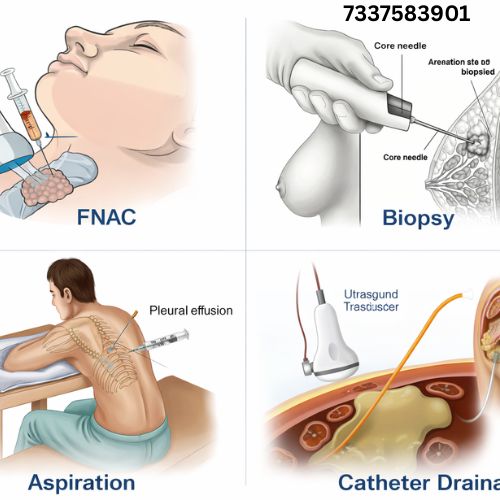
Fine Needle Aspiration Cytology (FNAC) is a diagnostic procedure that uses a thin needle to collect cells or fluid from a lump for laboratory examination. It may help evaluate certain abnormalities and determine whether further testing is required.
FNAC may be used to assess selected conditions involving the:
Breast
Thyroid
Lymph nodes
Liver
Kidney
Lung
The appropriate sampling method depends on the location and characteristics of the abnormality.
A biopsy involves collecting a tissue sample for examination under a microscope. It may be recommended to investigate abnormal tissue and help assess conditions such as tumours, inflammation or infection.
Depending on the clinical indication, biopsy procedures may involve the:
Breast
Liver
Kidney
Lymph nodes
Lung
Bone
Skin
Thyroid
The type of biopsy depends on the affected area, imaging findings and the clinician's assessment.
Aspiration involves removing fluid or other material from a body cavity, cyst or collection using a needle or suitable drainage device. Imaging guidance may be used to help position the needle when required.
Aspiration may be considered for selected conditions, including:
Abscesses
Fluid-filled cysts
Pleural fluid collections
Ascitic fluid collections
Other accessible fluid collections
The procedure and its suitability depend on the type, size and location of the collection.
Image-guided percutaneous catheter drainage involves inserting a thin tube through the skin to drain an abscess or fluid collection. Ultrasound or CT guidance may be used, depending on the location and clinical requirements.
Catheter drainage may be considered for selected conditions, including:
Liver abscesses
Abdominal fluid collections
Pleural fluid collections
Other accessible abscesses or fluid collections
The choice between needle aspiration, catheter drainage and other treatments depends on the collection's characteristics and the patient's clinical condition.
Citi Vascular Centre, KPHB, Hyderabad, provides information about diagnostic sampling and image-guided procedures. The appropriate procedure depends on clinical assessment, imaging findings and the diagnostic or treatment requirements of each patient.
FNAC and biopsy tests are commonly used to evaluate suspicious lumps or tissue abnormalities, including possible cancer. They may also help diagnose infections, inflammation and other medical conditions, depending on clinical findings.
The estimated cost of image-guided FNAC, biopsy, aspiration or catheter drainage ranges from Rs 3,000 to Rs 30,000, subject to current pricing and individual clinical requirements.
The cost may depend on:
Imaging Guidance: Ultrasound-guided, CT-guided or fluoroscopy-guided procedures.
Procedure Type: FNAC, biopsy, aspiration or catheter drainage.
Target Area: The organ or body part being evaluated, such as the liver, kidney, lung, breast or lymph node.
Technique and Equipment: The method and equipment required for the procedure.
A personalised cost estimate can be provided after clinical evaluation and review of the required procedure. For enquiries, contact Citi Vascular Centre, Hyderabad, at 7337583901.
Citi Vascular Centre provides information about image-guided FNAC, biopsy, aspiration and catheter drainage, depending on clinical requirements and service availability.
Diagnostic Tests and Medicines: Availability and charges depend on the procedure and treatment plan.
Hospital Stay and Recovery: Discharge timing and recovery vary according to the procedure and individual condition.
Note: Facilities, charges and payment options may differ for surgical and non-surgical procedures. Confirm the applicable details with the centre.
Clinical Experience: Published procedure statistics should be verified before inclusion.
Insurance Assistance: Coverage depends on policy terms and insurer approval.
Payment Options: Enquire about current payment facilities and eligibility.
Patient Support: Assistance with appointments and relevant documentation may be available.
Minimally Invasive Procedures: Small skin entry points may be used, depending on the technique.
Medical Technology: Equipment and regulatory claims should be verified before publication.
Note: Facilities, charges and payment options may differ for surgical and non-surgical procedures. Confirm the applicable details with the centre