LAST MEDICALLY REVIEWED:
September 2026 — Dr. Shaileshkumar Garge
Citi Vascular Hospital, KPHB Colony, Road No. 1, Hyderabad, Telangana 500072
QUICK ANSWER
What Is Internal Pudendal Artery Angioplasty and Who Does It Help?
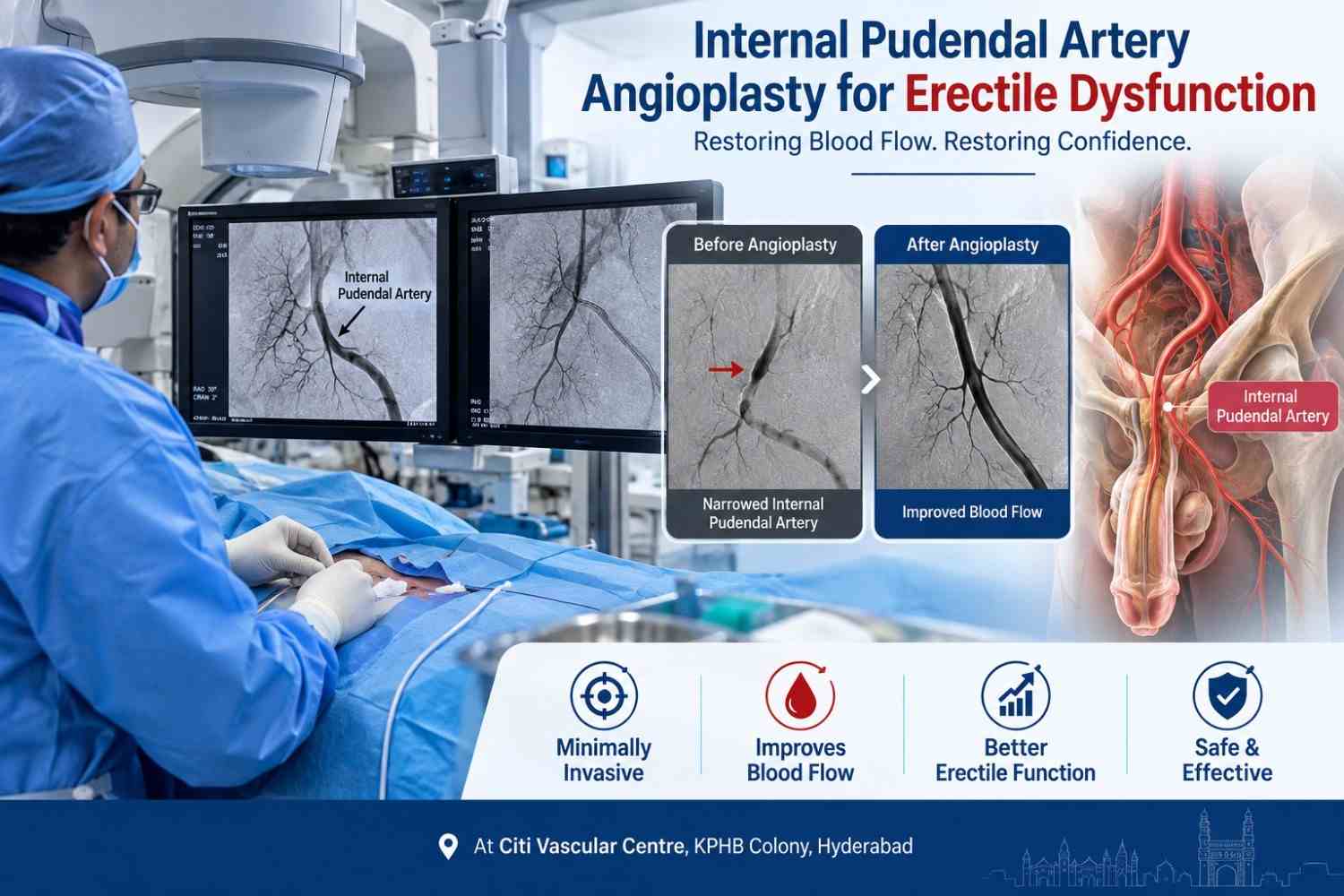
Internal pudendal artery angioplasty is a minimally invasive, fluoroscopy-guided catheter procedure that treats arterial erectile dysfunction directly by opening stenosed segments of the internal pudendal artery — the primary blood supply to the penis. A balloon catheter restores normal arterial lumen diameter and blood flow. Suitability for internal pudendal artery angioplasty depends on individual clinical assessment, vascular imaging findings, the underlying cause of erectile dysfunction, previous treatment response and other relevant health factors. Published outcomes should be interpreted in the context of the specific study population, outcome measures and follow-up period; improvement cannot be guaranteed.. Dr. Garge FRCR (UK) | Citi Vascular Centre, KPHB, Hyderabad |Call +91-73375 83901 |
Internal pudendal artery angioplasty occupies a specific and important position in erectile dysfunction management —Internal pudendal artery angioplasty is an endovascular procedure that may be considered in selected patients with erectile dysfunction associated with a demonstrable arterial narrowing. Its suitability depends on the clinical findings and available evidence.. When the internal pudendal artery — the principal blood supply to the erectile tissue — is narrowed by atherosclerosis, fibromuscular disease, or post-traumatic scarring, the result is inadequate arterial inflow into the corpus cavernosum and erectile dysfunction that medications alone cannot fully overcome.
The principle of the procedure is identical to coronary or peripheral angioplasty: a balloon catheter is guided to the stenosis, inflated to compress the obstructing plaque and restore the arterial lumen, and withdrawn — leaving behind a patent vessel capable of delivering normal inflow. In the penile arterial territory, this restored inflow translates directly into improved erectile function by providing the arterial pressure gradient that cavernous smooth muscle relaxation requires.
Book your Appointment here:
|| Appoinment: || Call +91-7032508468 || Whatsapp:+91-7337583901 || Citi Vascular Hospital, KPHB Colony, Hyderabad.||
|
Feature |
Detail |
|
Procedure Type |
Minimally invasive catheter-based balloon angioplasty ± stenting of internal pudendal artery — no open surgery |
|
Target Vessel |
Internal pudendal artery — terminal branch of internal iliac (hypogastric) artery — primary penile blood supply |
|
Indication |
Arterial insufficiency erectile dysfunction — PSV < 25 cm/s on pharmacological penile Doppler | Focal stenosis on CTA/MRA | Failed PDE5 inhibitor trial |
|
Ideal Candidate |
Patient suitability is determined through specialist assessment, relevant investigations, the underlying cause of erectile dysfunction, associated medical conditions, and an evaluation of the potential benefits and risks of treatment. |
|
Access Route |
Transfemoral arterial approach — right common femoral artery → aorta → internal iliac → pudendal artery |
|
Procedure Duration |
60–120 minutes — depending on bilateral assessment, anatomy complexity, and whether stenting is required |
|
Anaesthesia |
Local anaesthesia at femoral access site + IV sedation. General anaesthesia not required. |
|
Success Rate |
Clinical outcomes vary depending on patient selection, the underlying cause of erectile dysfunction, the severity of arterial disease, and the available clinical evidence. |
|
Hospital Stay |
Recovery and Observation: The duration of observation and timing of discharge depend on the type of procedure performed, the condition of the access site, the patient's clinical status, and the treating team's assessment. |
To understand why pudendal artery angioplasty works and which men benefit from it, it helps to understand the arterial supply to the penis. The internal pudendal artery is the terminal branch of the anterior division of the internal iliac (hypogastric) artery. It passes through the pudendal canal (Alcock's canal) in the perineum and gives rise to:
Perineal artery — supplies the perineal muscles and scrotal/labial skin
Penile bulbourethral artery — supplies the bulb of the corpus spongiosum
Deep artery (cavernous artery) — the principal artery of erection, running within the corpus cavernosum and giving off the helicine arteries
Dorsal artery — runs on the dorsum of the penis and supplies the glans and erectile tissue
The cavernous artery — the deep artery of the penis — is the vessel measured in pharmacological penile Doppler. Its PSV reflects the inflow pressure and volume available for corpus cavernosum filling. Stenosis anywhere along the pudendal artery chain — from the internal iliac origin to the cavernous artery — reduces the PSV measured at the level of the cavernous artery and produces the haemodynamic signature of arterial insufficiency.
Common sites of stenosis amenable to angioplasty include: the proximal internal pudendal artery as it curves around the ischial spine; the mid-pudendal segment in Alcock's canal (particularly from perineal trauma or chronic bicycle-related compression); and the internal iliac origin — where systemic atherosclerosis first affects the pudendal supply. Bilateral disease is common and both sides may require treatment.
Favourable Patient Profile
Age ideally < 60 years | PSV < 25 cm/s on pharmacological penile Doppler | Focal or segmental stenosis on CTA/MRA | Failed or inadequate response to PDE5 inhibitors (at adequate doses and duration) | No dominant venous leak | No significant neurogenic component | Post-traumatic or post-radiation arterial ED — particularly favourable | Motivated patient who understands realistic expectations
Less Favourable / Not Suitable
Severe diffuse generalised atherosclerosis affecting entire pelvic arterial tree — no focal lesion amenable to angioplasty | Dominant neurogenic ED — arterial revascularisation cannot compensate for absent autonomic innervation | Very small-calibre vessels not suitable for catheter access | Active untreated infection | Coagulopathy not correctable | Dominant venous leak without arterial component — treat the venous mechanism first or in combination
Post-traumatic arterial ED — a particularly strong indication: Young men who develop arterial ED after perineal trauma (straddle injury, pelvic fracture, cycling injury, or post-surgical injury to pudendal territory) often have a single focal stenosis in the pudendal artery at the point of injury. A focal arterial narrowing following pelvic or perineal trauma may be considered for specialist evaluation. The potential benefits of angioplasty depend on the location and severity of the lesion, associated vascular conditions and other causes of erectile dysfunction. Individual outcomes may vary.A qualified specialist can assess the symptoms, investigation findings and available treatment options to determine whether further evaluation is appropriate.. Call +91-73375 83901
|
1 |
Comprehensive Sexual History and ED Severity The IIEF (International Index of Erectile Function) questionnaire documents baseline erectile function across five domains (erection, orgasm, desire, satisfaction, overall satisfaction). The pattern of ED — onset, gradual vs sudden, morning erections, situational vs universal, PDE5i response — is documented. Current medications, cardiovascular history, diabetes, hypertension, smoking, and previous pelvic surgery or trauma are reviewed. |
|
2 |
Hormonal Assessment Testosterone (total and free), LH, prolactin, thyroid function — to exclude hormonal causes before attributing ED to vascular disease. Hypogonadism should be corrected before endovascular assessment, as testosterone deficiency independently impairs erectile function and can produce low PSV on Doppler. |
|
3 |
Pharmacological Penile Doppler Ultrasound The key investigation for patient selection. After intracavernosal injection of 10–20 micrograms of prostaglandin E1, cavernous artery PSV, EDV, and RI are measured at 5–10–15 minutes. PSV < 25 cm/s confirms arterial insufficiency. EDV and RI are assessed simultaneously to identify any coexisting venous leak. Bilateral cavernous artery assessment is performed. |
|
4 |
CTA or MRA of Pelvic Arteries CT angiography with 3D reconstruction or MR angiography maps the internal iliac and pudendal artery anatomy — identifying the location, extent, and severity of stenosis. This imaging is the procedure planning tool: it defines the specific segment(s) requiring angioplasty, the calibre of vessels involved, the collateral anatomy, and any variant anatomy that affects the approach. |
|
5 |
Consent and Expectation Setting The patient is clearly counselled: pudendal artery angioplasty restores arterial inflow — it does not guarantee complete resolution of ED, as other contributing factors (neurogenic, hormonal, psychological overlay, venous leak) may persist. Success rates of 60–80% in appropriately selected patients are discussed alongside the risk profile. Written consent is obtained. |
|
1 |
Femoral Arterial Access Under local anaesthesia in the right groin, the right common femoral artery is accessed with a small-bore puncture and a vascular sheath is inserted. This is identical to any other peripheral artery catheter procedure. The patient is awake and sedated. Heparin anticoagulation is administered to prevent clot formation on the catheter during the procedure. |
|
2 |
Pelvic Aortography and Internal Iliac Assessment A flush catheter is positioned in the distal aorta and a pelvic aortogram performed. This provides a complete picture of the internal iliac arteries bilaterally — identifying any proximal disease, the pudendal artery origins, and confirming the anatomy planned on pre-procedure CTA. Selective internal iliac artery injections may be performed at this stage. |
|
3 |
Selective Pudendal Artery Catheterisation and Angiography A shaped catheter is advanced selectively into the internal iliac artery on the side of planned angioplasty. The anterior division and then the internal pudendal artery are selectively catheterised. Contrast injection with digital subtraction angiography (DSA) maps the full pudendal artery — identifying the stenosis location, length, and severity. Pressure gradient measurement may be performed across the stenosis using a pressure wire to confirm functional significance. |
|
4 |
Balloon Angioplasty The balloon is inflated according to the lesion characteristics and procedural requirements to widen the narrowed segment. Angiography is then used to assess the result and identify any residual narrowing or complications.. |
|
5 |
Assessment of Result — Stenting if Required Post-angioplasty DSA assesses the treated segment for residual stenosis, elastic recoil, or flow-limiting dissection. If the result is suboptimal — significant residual stenosis > 30% or flow-limiting dissection — a self-expanding or balloon-expandable stent is deployed at the same session. Stenting in the pudendal artery is technically more demanding than balloon angioplasty alone and requires specific expertise. |
|
6 |
Contralateral Pudendal Assessment If the pre-procedure Doppler or CTA showed bilateral disease, the contralateral pudendal artery is assessed at the same session. Using a contralateral catheter configuration from the same right femoral access, the left internal iliac and pudendal arteries are catheterised, angiographed, and treated if a significant stenosis is confirmed. When both sides are affected, the decision to treat one or both arteries during the same session or in separate sessions depends on the patient's clinical condition, vascular anatomy, procedural considerations and the treating specialist's assessment. |
|
7 |
Femoral Closure and Post-Procedure Observation The catheter and sheath are removed. Femoral haemostasis is achieved by manual pressure (typically 15–20 minutes) or vascular closure device. The groin is observed until haemostasis is confirmed. Vital signs are monitored for 4–6 hours. Most patients are discharged the same day or the following morning. A written prescription for antiplatelet medication (aspirin 75–100mg daily) is provided to maintain vessel patency. |
Book your Appointment here:
|| Appoinment: || Call +91-7032508468 || Whatsapp:+91-7337583901 || Citi Vascular Hospital, KPHB Colony, Hyderabad.||
Research on endovascular treatment for arterial erectile dysfunction includes studies of varying designs and sizes. The strength of the available evidence and the applicability of individual findings should be evaluated when discussing treatment options.Published studies have examined changes in erectile function following endovascular treatment in selected patients with arterial disease. Outcomes should be interpreted in light of study design, patient characteristics, follow-up duration and the limitations of the available evidence.
|
Evidence Source |
Key Finding |
|
Levine LA et al. J Urol. 2021. |
Prospective series — pudendal artery angioplasty in men with PSV < 25 cm/s and focal stenosis. 60–80% reported improvement in IIEF-5 scores at 6 months. Best outcomes in post-traumatic and younger patients. |
|
Guimarães M et al. JACC Cardiovasc Interv. 2015. |
Angioplasty and stenting of pudendal arteries in men with arteriogenic ED. Significant improvement in peak systolic velocity on post-procedure Doppler correlating with IIEF improvement. Confirms haemodynamic rationale. |
|
Baten E et al. Eur Urol Focus. 2023 Systematic Review. |
Systematic review of endovascular approaches for vascular ED. Confirmed improvement across multiple series. Authors identify patient selection (focal stenosis, younger age, post-traumatic) as the primary predictor of outcome. |
|
EAU Guidelines 2024 — ED Chapter. |
Positions pudendal artery angioplasty as a treatment option for arteriogenic ED in selected patients within the management algorithm — after PDE5 inhibitor trial and before penile prosthesis. |
Honest expectation:Changes in erectile function scores do not necessarily mean complete restoration of erectile function. Patients should be counselled about the potential benefits, uncertainties, limitations and risks of treatment, based on the evidence applicable to their clinical circumstances.better PDE5 inhibitor response — but complete return to pre-ED function is not guaranteed in every case. Many successful patients can then respond to PDE5 inhibitors at doses and frequencies that were previously ineffective. The key is appropriate patient selection — and that requires the Doppler and CTA assessment to be completed first.
|
Complication |
Frequency |
Clinical Notes |
|
Femoral access site haematoma |
Uncommon — 2–5% |
Standard vascular access complication. Managed with additional manual pressure. Rarely requires intervention. Vascular closure device reduces risk. |
|
Arterial spasm during procedure |
Uncommon |
The pudendal artery is small-calibre and may spasm during catheter manipulation. Managed with intra-arterial nitroglycerin or calcium channel blocker. Usually resolves without clinical consequence. |
|
Dissection at angioplasty site |
Uncommon — managed at procedure |
Flow-limiting dissection after balloon inflation — managed by stenting at the same session. Non-flow-limiting dissection may heal spontaneously on antiplatelet therapy. |
|
Restenosis — return of stenosis over months |
Possible — 10–20% at 1 year |
Like any peripheral artery angioplasty, restenosis is possible as the vessel heals. Stenting reduces but does not eliminate restenosis risk. Repeat angioplasty is feasible if restenosis occurs and symptoms return. |
|
Penile artery embolism — distal occlusion |
Rare — < 1% with experienced operator |
Distal embolisation of plaque material during angioplasty could occlude smaller penile artery branches. Experienced operators take precautions to minimise embolic risk. Anticoagulation during procedure is standard. |
|
No improvement — procedure failure |
20–40% of cases |
Angioplasty does not always improve erectile function even with successful vessel opening — other contributing mechanisms (neurogenic, venous, psychogenic overlay) may limit functional improvement. A proportion of men will not respond despite technically successful revascularisation. |
|
Timeframe |
What to Expect |
|
Day of Procedure |
4–6 hours observation after the procedure. Groin dressing check. Vital signs monitored. Most patients are discharged the same day with antiplatelet medication and written aftercare instructions. |
|
Day 1–3 |
Mild groin soreness and bruising at the femoral access site — expected and resolves within 5–7 days. Paracetamol adequate for pain management. Avoid strenuous activity, heavy lifting, and sexual activity for the first 5 days. |
|
Week 1–2 |
Return to desk work and light activities Day 3–5. No driving for 24 hours post-sedation. Antiplatelet therapy (aspirin 75–100mg daily) continued — important to maintain vessel patency in the treated segment. |
|
Month 1–3 |
The erectile function improvement timeline is gradual — not immediate. Most men notice improvement beginning 4–8 weeks after the procedure as the revascularised vessels establish normal flow patterns. A PDE5 inhibitor trial at this stage, if not already done, may show enhanced response. |
|
Month 3–6 |
Peak functional improvement typically assessed at 3–6 months post-procedure. IIEF questionnaire repeated to formally document improvement from baseline. Post-procedure penile Doppler at 3 months confirms vessel patency and improved PSV. |
|
Long-term — antiplatelet |
Aspirin 75–100mg daily continued long-term to maintain patency and reduce stent restenosis risk if stenting was performed. Review with Dr. Garge at 6 months and annually thereafter. |
For men who are considering their options beyond failed PDE5 inhibitor treatment, the comparison between pudendal artery angioplasty (endovascular, minimally invasive) and penile prosthesis implantation (surgical, definitive) is the most clinically relevant choice discussion.
|
Feature |
Pudendal Artery Angioplasty |
Inflatable Penile Prosthesis |
|
Invasiveness |
Minimally invasive — catheter via groin, local anaesthesia |
Open surgery — general/spinal anaesthesia, penile incision |
|
Natural function preserved? |
Yes — natural erection mechanism intact |
No — natural erectile tissue permanently altered |
|
Reversible? |
Yes — vessel remains, can be re-treated |
No — permanent device implanted |
|
Success Rate |
60–80% meaningful improvement |
> 90% patient satisfaction — most reliable of all ED treatments |
|
Who Should Choose? |
Younger men (< 60) | Focal arterial stenosis | Failed PDE5i | Want to preserve natural function | Post-traumatic ED |
All ages | PDE5i + angioplasty + injection therapy all failed | Want guaranteed reliable function | No desire for further attempts at natural erection |
|
Correct sequence |
PDE5 inhibitors → Angioplasty (if arterial) → Implant if needed |
Final step in the management algorithm |
Q1: What is internal pudendal artery angioplasty?
A: Internal pudendal artery angioplasty is a minimally invasive catheter procedure that opens narrowed segments of the internal pudendal artery — the primary blood supply to the penis — using a balloon catheter under fluoroscopic guidance.The procedure uses a balloon catheter to widen a narrowed artery that supplies the erectile tissues. It may be considered in selected patients with documented arterial disease, although improvement in erectile function is not guaranteed.
Q2: How do I know if I have arterial erectile dysfunction?
A: The key diagnostic test is pharmacological penile Doppler ultrasound. After an injection into the corpus cavernosum induces an erection, the cavernous artery PSV (peak systolic velocity) is measured. PSV < 25 cm/s indicates arterial insufficiency. Clinical features supporting arterial ED include: gradual onset ED, absent morning erections, poor response to PDE5 inhibitors, and cardiovascular risk factors (diabetes, hypertension, smoking). CT angiography confirms the specific arterial lesion.
Q3: Can pudendal artery angioplasty cure ED permanently?
A: Not guaranteed — but meaningful improvement is achievable. The procedure cannot be guaranteed to cure erectile dysfunction permanently. Its potential effect on erectile function depends on the underlying vascular condition, other contributing factors and the clinical evidence relevant to the individual patient.. Many men can then achieve adequate erections with or without PDE5 inhibitors that were previously ineffective. Restenosis can occur over months to years — like any peripheral artery angioplasty. Aspirin helps maintain patency. Repeat angioplasty is feasible if needed. The goal is a meaningful, durable improvement — not necessarily a permanent guarantee.
Q4: What is the recovery time after pudendal artery angioplasty?
A: Physical recovery from the procedure itself is fast — most men return to desk work within 3–5 days and resume sexual activity within 1–2 weeks. The improvement in erectile function, however, is gradual — Recovery from the catheter procedure and improvement in erectile function are different outcomes. Recovery instructions and follow-up assessments depend on the procedure performed, the patient's condition and the treating specialist's advice. The timing and degree of functional improvement vary.. A post-procedure penile Doppler at 3 months confirms improved PSV and vessel patency.
Q5: Is general anaesthesia required?
A: No — pudendal artery angioplasty is performed under local anaesthesia at the groin access site and IV sedation. The patient is awake and comfortable throughout. No intubation or general anaesthesia is required.The anaesthesia or sedation used depends on the planned procedure and the patient's clinical condition. The care team should explain the proposed anaesthesia, relevant risks and available alternatives before treatment.
Q6: What medications are needed after angioplasty?
A: Aspirin 75–100mg daily is started before or at the procedure and continued long-term after pudendal artery angioplasty — to reduce platelet aggregation and maintain vessel patency, particularly if stenting was performed. Statins (if not already prescribed for cardiovascular risk) reduce restenosis risk. PDE5 inhibitors may be prescribed alongside aspirin to enhance the functional response once arterial inflow is restored.
Q7: What is the success rate of pudendal artery angioplasty?
A: There is no single outcome figure that applies to every patient. Published results should be discussed only after verifying the relevant studies, patient selection criteria, outcome measures and duration of follow-up. Individual results may differ. in appropriately selected patients — defined as men with PSV < 25 cm/s, focal pudendal artery stenosis on imaging, and failed PDE5 inhibitor trials. The strongest predictors of good outcome are: younger age (< 60), post-traumatic aetiology, focal rather than diffuse disease, and no significant neurogenic component. Results in unselected mixed populations are less favourable.
Q8: Can both sides be treated at the same procedure?
A: Yes — bilateral pudendal artery angioplasty is technically feasible and preferred in one session when imaging shows bilateral disease. Using a contralateral catheter configuration from the right femoral access, both internal pudendal arteries can be selectively catheterised and treated. Bilateral treatment at one session avoids two separate procedures and two femoral access events.
Q9: What if angioplasty does not improve my erections?
A: If pudendal artery angioplasty does not produce functional improvement despite successful vessel revascularisation confirmed on post-procedure Doppler and CTA, the most likely explanation is a significant co-existing mechanism — venous leak, neurogenic ED, or psychogenic overlay — that angioplasty alone cannot address.If erectile function does not improve, further evaluation may be required to identify other contributing causes. Subsequent management depends on the clinical findings and may include medical treatment, other appropriate interventions or discussion of penile prosthesis implantation with a qualified specialist.
Q10: Who performs pudendal artery angioplasty in Hyderabad?
A: Citi Vascular Centre, KPHB Colony, Hyderabad, provides information about vascular conditions and their assessment and management. Doctor profiles should list verified qualifications, professional registration details and current roles in accordance with applicable professional requirements. Availability of a particular procedure should be confirmed directly with the centre.. Pharmacological penile Doppler, CTA pelvic angiography, and pudendal artery angioplasty are all available under one specialist. All consultations are strictly confidential. Call +91-73375 83901 or WhatsApp 73375 83901.
|
Reference |
Key Finding |
|
Levine LA et al. Internal pudendal artery angioplasty for arteriogenic ED. J Urol. 2021. |
Prospective series — 60–80% IIEF improvement in PSV < 25 cm/s patients with focal pudendal stenosis. Best outcomes in post-traumatic younger men. |
|
Guimarães M et al. Pudendal artery angioplasty and stenting. JACC Cardiovasc Interv. 2015. |
Haemodynamic confirmation — improved post-procedure PSV correlates with clinical IIEF improvement. Provides angiographic evidence base for the revascularisation rationale. |
|
Baten E et al. Endovascular treatment of ED — systematic review. Eur Urol Focus. 2023. |
Systematic review of 14 studies on endovascular ED treatment. Confirms angioplasty efficacy in selected patients. Patient selection identified as the primary outcome predictor. |
|
EAU Guidelines on Erectile Dysfunction. 2024. |
Positions pudendal artery angioplasty as a valid option for arteriogenic ED after PDE5 inhibitor trial — within the evidence-based management algorithm. |
Angioplasty aims to widen a narrowed artery and improve blood flow in selected patients with documented arterial disease. The effect on erectile function varies, and other causes of erectile dysfunction may require separate assessment and management.
Internal pudendal artery angioplasty is an endovascular procedure intended to widen narrowed arterial segments. Its potential role in erectile dysfunction depends on the underlying vascular condition, appropriate patient selection and the strength of the available clinical evidence. Patients should understand the potential benefits, limitations, risks and alternative treatments before making a decision.. For younger men with focal pudendal artery stenosis confirmed on pharmacological penile Doppler (PSV < 25 cm/s) and CTA, who have failed adequate PDE5 inhibitor trials, angioplasty offers a clinically meaningful chance of improved erectile function without surgery or implant. Post-traumatic arterial ED in young men represents the strongest indication.
The honest expectation is 60–80% improvement in erectile function scores in appropriately selected patients — not guaranteed complete restoration of natural erections in every case. Restenosis is possible and repeat angioplasty is feasible. For men where angioplasty is insufficient, pelvic venous embolisation addresses the venous leak mechanism, and penile prosthesis remains the definitive option when all endovascular approaches have been exhausted.Citi Vascular Centre, KPHB Colony, Hyderabad, provides information about the evaluation and management of vascular conditions. The appropriate investigations and treatment options for erectile dysfunction depend on individual clinical findings. Patient information is handled in accordance with applicable confidentiality and data-protection requirements.
Book your Appointment here:
|| Appoinment: || Call +91-7032508468 || Whatsapp:+91-7337583901 || Citi Vascular Hospital, KPHB Colony, Hyderabad.||