LAST MEDICALLY REVIEWED:
September 2026 — Dr. Shaileshkumar Garge
MBBS, MD (Mumbai), DNB (Delhi), FRCR (UK), FNVIR (CMC Vellore), EBIR (Spain)
Director & Chief Vascular Physician | Sr Consultant Vascular Interventional Radiologist
Citi Vascular Hospital, KPHB Colony, Road No. 1, Hyderabad, Telangana 500072
Fibroid embolisation (UFE) in Hyderabad costs between ₹1,20,000 and ₹3,50,000, with most patients discharged within 24 hours — no uterus removal, no major surgery. UFE works by blocking blood flow to fibroids through a tiny wrist or groin puncture, causing them to shrink naturally. Performed by sr Interventional Radiologist Dr. Shaileshkumar Garge at Citi Vascular Hospital, KPHB, this is Hyderabad's most advanced non-surgical fibroid treatment — with over 12 years of vascular expertise and same-day discharge in most cases.
Women searching for uterine fibroid treatment cost in Hyderabad often want clarity about UFE, surgery alternatives, recovery time, insurance coverage, and long-term outcomes.
What Are Uterine Fibroids?
Common Symptoms of Uterine Fibroids
Causes and Risk Factors
When Is Fibroid Treatment Needed?
Who Is the Best Candidate for UFE Treatment?
Types of Uterine Fibroid Treatments
Minimally Invasive Fibroid Treatment Options
What Is Uterine Fibroid Embolisation (UFE)?
Step-by-Step UFE procedure
UFE vs Myomectomy vs Hysterectomy — Which Fibroid Treatment Is Right for You?
Why Many Women Prefer UFE Over Surgery?
What Happens on the Day of UFE Treatment?
Recovery After Fibroid Treatment
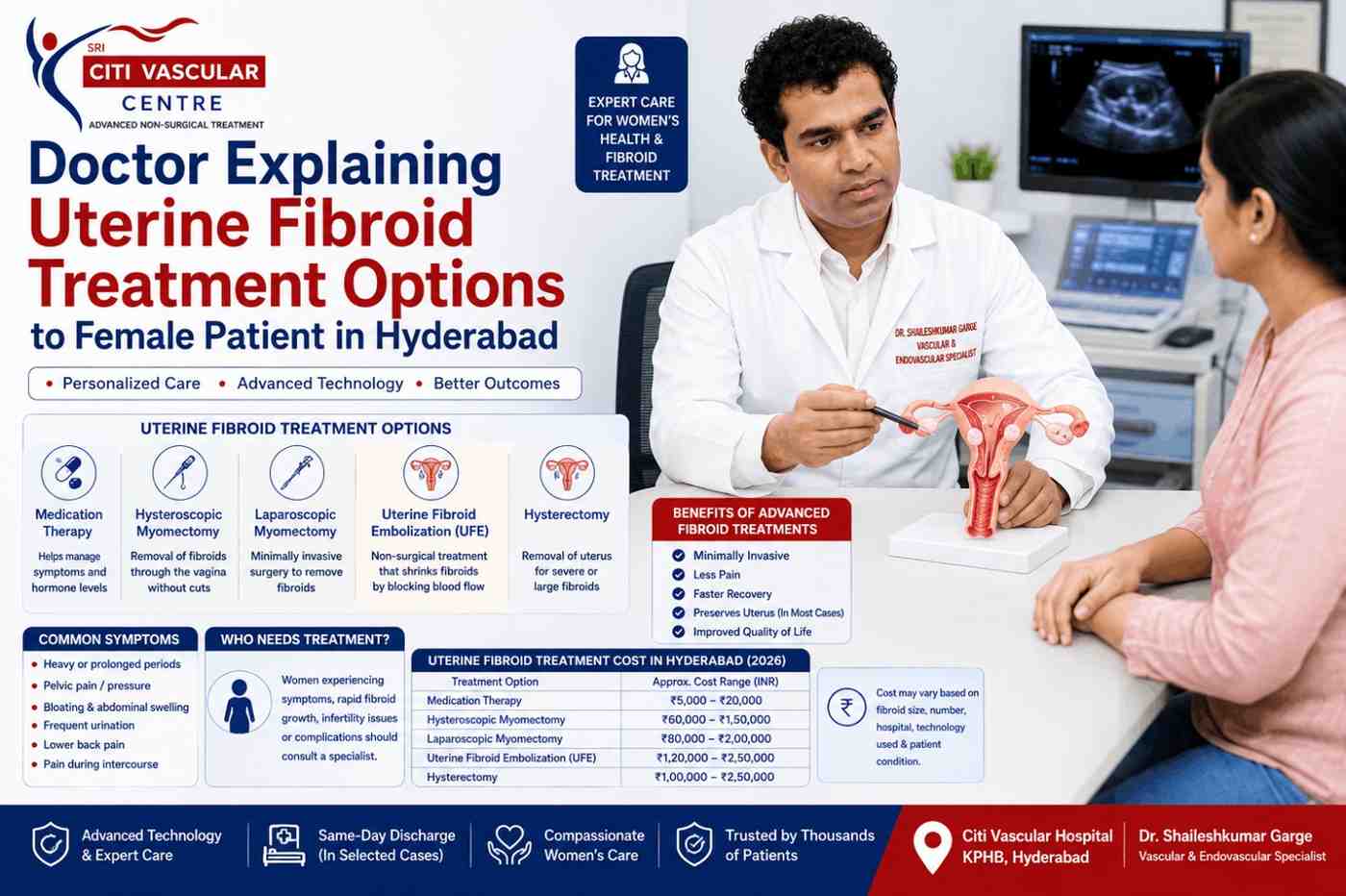
Uterine Fibroid Treatment Cost in Hyderabad (2026)
Is UFE covered by insurance in hyderabad?
Factors Affecting Fibroid Treatment Cost
Benefits of Early Fibroid Treatment
Why Choose Dr. Shaileshkumar Garge — Citi Vascular Hospital, KPHB, Hyderabad
Medically Reviewed By
Expert Tips
Frequently Asked Questions (FAQs)
Final Thoughts
Uterine fibroids are abnormal growths made of muscle and fibrous tissue that develop inside or around the uterus. They are also called:
Leiomyomas
Myomas
Fibromyomas
Fibroids vary in:
Size
Number
Location
Some women may have tiny fibroids, while others develop multiple large fibroids causing significant symptoms. Uterine fibroids affect up to 70-80% of women by age 50.
Many women with fibroids experience no symptoms. However, larger fibroids can cause:
Common Symptoms:
Heavy menstrual bleeding (menorrhagia)
Prolonged periods
Pelvic pain or pressure
Lower back pain
Frequent urination
Constipation
Abdominal bloating
Pain during intercourse
Fertility issues
If left untreated, fibroids can sometimes lead to anemia and severe discomfort.
The exact cause of uterine fibroids is not fully known, but several factors increase risk.
Common Risk Factors:
Hormonal imbalance
Family history
Obesity
Delayed pregnancy
High estrogen levels
Age between 30–50 years
Fibroids are more common during reproductive years.
|
Step |
Question / Check |
YES → Next Step |
NO → Action |
|---|---|---|---|
|
1 |
Do you have heavy periods, pelvic pain, or bloating? |
Go to Step 2 |
Monitor annually |
|
2 |
Have symptoms lasted more than 3 months? |
Go to Step 3 |
Wait & watch, recheck in 3 months |
|
3 |
Has an ultrasound confirmed fibroids? |
Go to Step 4 |
Get ultrasound first at Citi Vascular |
|
4 |
Are fibroids larger than 3 cm or causing anemia? |
Go to Step 5 |
Medication management possible |
|
5 |
Do you want to preserve your uterus / fertility? |
UFE is recommended |
Discuss hysterectomy with specialist |
|
6 |
Are you a suitable UFE candidate (no pregnancy, no active infection)? |
Book UFE consultation |
Other minimally invasive options |
If you experience heavy periods soaking more than one pad per hour, severe pelvic pain, or symptoms of anemia (fatigue, dizziness, breathlessness) — do not delay. Untreated fibroids can worsen and reduce fertility options. Early UFE treatment delivers better outcomes
UFE may be suitable for women with:
Menorrhagia - heavy periods
Multiple fibroids
Large fibroids
Pelvic pressure symptoms
Frequent urination
Painful fibroids
Desire to avoid hysterectomy
Need for faster recovery
1. Medication Therapy
Medicines may help control symptoms temporarily.
Used For:
Pain relief
Reducing bleeding
Hormonal control
2. Myomectomy
A surgical procedure that removes fibroids while preserving the uterus.
Laparoscopic myomectomy
Open surgery
Hysteroscopic myomectomy
3. Hysterectomy
Complete removal of the uterus for severe cases.
Usually recommended for women who do not plan future pregnancies.
4. Uterine Fibroid Embolisation (UFE)
A minimally invasive procedure that blocks blood supply to fibroids using the embolic microsphere particles, causing them to shrink.
Modern women increasingly prefer minimally invasive procedures because they offer:
Smaller incisions
Less pain
Faster recovery
Minimal hospital stay
Better cosmetic outcomes
Popular Options:
Laparoscopic surgery
Hysteroscopy
UFE procedure
Uterine Fibroid Embolization (UFE) is an advanced non-surgical treatment performed by an intervention radiologist. UFE has a clinical success rate of over 85% in controlling fibroid symptoms. (source RSNA/SIR guidelines)
How It Works:
A small catheter is inserted through the groin or wrist artery
Tiny embolic particles (microspheres) block blood flow to fibroids
Fibroids shrink gradually over time
Benefits of UFE:
No major surgery
Uterus preservation
Faster recovery
Short hospital stay
Reduced bleeding and pain
|
Steps |
Step Title |
Detailed Description |
|---|---|---|
|
Step 1 |
Initial Consultation & History |
Visit Dr. Shaileshkumar Garge at Citi Vascular, KPHB. Share your symptoms, menstrual history, and any prior scans for an accurate initial assessment. |
|
Step 2 |
Ultrasound or MRI Imaging |
A pelvic ultrasound or MRI is performed to map fibroid size, number, and location — essential for UFE planning and insurance pre-authorisation. |
|
Step 3 |
Fibroid Evaluation & UFE Planning |
The interventional radiology team evaluates imaging findings and confirms whether UFE is appropriate. A personalised treatment plan is prepared. |
|
Step 4 |
Pre-Procedure Preparation |
Arrive at Citi Vascular a few hours before the procedure. Blood tests, IV access, and light sedation preparation are completed by the nursing team. |
|
Step 5 |
UFE Procedure (30–60 Minutes) |
A tiny catheter is inserted through the wrist or groin artery under local anaesthesia. Embolic particles are guided by live X-ray to block fibroid blood supply. |
|
Step 6 |
Post-Procedure Monitoring |
You rest for 4–6 hours post-procedure. Mild cramping is normal. Pain management, hydration, and vital monitoring are provided by the care team. |
|
Step 7 |
Discharge (Usually Within 1 day) |
Most patients are discharged the same day or next morning with oral medications, dietary advice, and a follow-up appointment scheduled. |
|
Step 8 |
Fibroid Shrinkage & Symptom Relief |
Over 3–6 months, fibroids shrink progressively. Bleeding reduces, pain improves, and quality of life returns — confirmed at follow-up imaging. |
|
Feature |
UFE / Fibroid Embolization |
Laparoscopic Myomectomy |
Open Myomectomy |
Hysterectomy |
|---|---|---|---|---|
|
Major Surgery |
❌ No |
✅ Yes (minimal) |
✅ Yes |
✅ Yes |
|
Uterus Preserved |
✅ Yes |
✅ Yes |
✅ Yes |
❌ No |
|
Anaesthesia |
Local |
General |
General |
General |
|
Hospital Stay |
1 day |
2–3 days |
3–5 days |
5–7 days |
|
Recovery Time |
2–5 days |
2–3 weeks |
4–6 weeks |
6–8 weeks |
|
Scarring |
Tiny puncture only |
3–4 small cuts |
Large incision |
Large incision |
|
Blood Loss |
Minimal |
Moderate |
Higher |
Highest |
|
Fertility Possible? |
Usually yes |
Usually yes |
Usually yes |
❌ No |
|
Fibroid Recurrence |
Possible (rare) |
Possible |
Possible |
❌ Not possible |
|
Cost in Hyderabad |
₹1,20,000–₹3,50,000 |
₹1,00,000–₹2,00,000 |
₹80,000–₹1,60,000 |
₹80,000–₹2,00,000 |
|
Return to Work |
2–5 days |
2–3 weeks |
4–6 weeks |
6–8 weeks |
|
Best For |
Multiple/large fibroids, uterus preservation |
Single fibroid, fertility needed |
Very large fibroids |
Severe cases, no future pregnancy |
Same-day / next-day discharge
No uterus removal
Minimal pain procedure
Advanced Cath Lab facility
Expert Interventional Radiology care
Call / WhatsApp: +91-73375 83901
Quick answer: Many women prefer UFE over surgery because it preserves the uterus, avoids major incisions, shortens hospital stay, and allows faster recovery with minimal downtime.
On the day of UFE treatment, patients usually arrive a few hours before the procedure for admission, imaging review, and preparation. The procedure is performed by an Interventional Radiologist under local anesthesia and conscious sedation.
A tiny catheter is inserted through a small puncture near the wrist or groin artery. Using real-time imaging guidance, the specialist delivers embolic particles to block blood supply to the fibroids, causing them to shrink gradually.
Most UFE procedures take about 30–60 minutes.
After the procedure:
Patients are monitored for a few hours
Mild cramping may occur temporarily
Walking is encouraged early
Most patients are discharged within 24 hours
Recovery is usually faster than major surgery
Quick Answer: Most women resume routine activities within 2-5 days after UFE treatment, while recovery after major fibroid surgery may take several weeks.
Recovery depends on the treatment type.
General Recovery Tips:
Avoid heavy lifting
Stay hydrated
Take medications properly
Attend follow-up visits
Walk regularly
Eat iron-rich foods
Most minimally invasive procedures allow faster return to daily activities.
Quick Answer: Fibroid embolisation treatment cost in Hyderabad generally ranges from ₹1,20,000 to ₹3,50,000 depending on fibroid size, hospital infrastructure, imaging technology, and whether single or multiple fibroids are treated.
The uterine fibroid treatment cost in Hyderabad also varies depending on:
Fibroid size and number
Hospital facilities
Procedure type
Surgeon expertise
Hospital stay duration
Estimated Cost Range:
|
Treatment Type |
Approximate Cost |
|
Medication Management |
₹5,000 – ₹20,000 |
|
Laparoscopic Myomectomy |
₹1,00,000 – ₹2,00,000 |
|
Hysterectomy |
₹1,00,000 – ₹2,50,000 |
|
Uterine Fibroid Embolisation (UFE) |
₹1,20,000 – ₹3,50,000 |
Costs may vary depending on individual patient needs.
Many insurance providers may cover Uterine Fibroid Embolization (UFE) when fibroids cause symptoms such as heavy bleeding, pelvic pain, anemia, or pressure symptoms. Coverage depends on medical necessity, imaging findings, hospital policy, and insurance terms.
Some insurers may require:
Ultrasound or MRI reports
Doctor recommendation
Pre-authorisation approval
Citi Vascular Hospital assists eligible patients with insurance documentation and treatment planning.
Major Factors Include:
Diagnostic scans
MRI or ultrasound
Hospital room category
Complexity of surgery
Multiple fibroids
Specialist fees
Post-treatment care
Early treatment helps:
Prevent severe anemia
Reduce pain
Preserve fertility
Avoid large surgeries
Improve quality of life
Reduce complications
Timely diagnosis can significantly improve treatment success.
|
Hospital |
Dedicated Cath Lab & Interventional Radiology Suite |
|
Doctor |
12+ Years Vascular Expertise | MBBS,MD, DNB,FRCR (UK),FNVIR (CMC, Vellore), EBIR (Spain) |
|
⏱️ Procedure |
30–60 Min Procedure | 24-Hour Discharge |
|
Pricing |
Transparent Pricing | No Hidden Charges | EMI Available |
|
Insurance |
Insurance Coordination Assistance Available |
"Dr. Garge has performed 12,000 of minimally invasive vascular procedures across KPHB, Kukatpally, Hyderabad, India — helping patients avoid major surgery and return to normal life within days."
Extensive Vascular Expertise
Over 12 years of dedicated experience performing image-guided vascular procedures. Dr. Garge has treated thousands of fibroid patients across KPHB, Kukatpally, Miyapur, Ameerpet, Secunderabad, and greater Hyderabad using all available minimally invasive techniques
Ultrasound and Fluoro Guided Precision
All UFE procedures are guided by fluoro, ensuring accurate mapping of fibroid, safe catheter placement, and treatment of every fibroid
Advanced Infrastructure
A dedicated Cath Lab, high-resolution colour Doppler ultrasound, and fluoroscopy — enabling the full spectrum of vascular interventions under one roof. Most patients are assessed, treated, and discharged on the same day.
Transparent Pricing
All costs — including Doppler, procedure, compression stockings, medications, and follow-up review — are discussed in advance. No hidden charges after treatment.
|
Credential |
Detail |
|---|---|
|
Full Name |
Dr. Shaileshkumar Garge |
|
Qualifications |
MBBS | MD — Mumbai | DNB — Delhi | FRCR — UK | FNVIR — CMC Vellore | EBIR — Spain/Europe |
|
Role |
Director & Chief Vascular Physician | Senior Consultant Interventional Radiologist |
|
Hospital |
Citi Vascular Hospital, KPHB Colony, Road No. 1, Hyderabad, Telangana 500072 |
|
Experience |
12+ years dedicated image-guided vascular interventions |
|
Specialisation |
UFE, Embolisation, Varicose Veins, PAD, DVT, Vascular Malformations, etc |
|
Technology |
Dedicated Cath Lab | Duplex Ultrasound | Fluoroscopy Guidance |
|
Serving Areas |
KPHB, Kukatpally, Miyapur, Ameerpet, Secunderabad, Hyderabad & Telangana |
|
Contact |
+91-73375 83901 | www.citivascularcentre.com |
Helpful Lifestyle Tips:
Maintain healthy body weight
Eat iron-rich foods
Exercise regularly
Avoid excessive processed foods
Monitor menstrual changes
Get regular gynecological checkups
Seek treatment early for abnormal bleeding
Healthy lifestyle habits support better recovery and symptom control.
Q1: What is the cost of fibroid embolization (UFE) in Hyderabad in 2026?
UFE fibroid embolisation in Hyderabad typically costs between ₹1,20,000 and ₹3,50,000, while medication management starts from ₹5,000. Costs vary based on fibroid size and number, hospital infrastructure, imaging requirements, anaesthesia type, and specialist expertise. At Citi Vascular Hospital, KPHB, all costs including imaging, procedure, and post-care are discussed transparently before treatment begins.
Q2: Can uterine fibroids be treated without surgery in Hyderabad?
Yes. Uterine Fibroid Embolisation (UFE) treats fibroids without any surgical incision or uterus removal. A trained Interventional Radiologist inserts a tiny catheter through the wrist or groin, blocks blood flow to fibroids, and causes them to shrink naturally. UFE is performed at Citi Vascular, KPHB, with same-day or next-day discharge.
Q3: What is Uterine Fibroid Embolisation (UFE) and how does it work?
UFE is a minimally invasive procedure where tiny embolic particles are injected through an artery to block blood supply to uterine fibroids, causing them to shrink gradually over 3–6 months. Performed under local anaesthesia, it takes 45–90 minutes. No major surgery, no uterus removal, and recovery takes just 3–5 days.
Q4: Is UFE better than hysterectomy for fibroid treatment?
For most women who want to preserve their uterus, UFE is a safer, faster-recovery alternative to hysterectomy. UFE avoids general anaesthesia, major surgery, and permanent uterus removal. Recovery is 3–5 days versus 6–8 weeks after hysterectomy. However, hysterectomy remains appropriate for very severe cases or when fertility is not a concern.
Q5: How long is recovery after UFE fibroid treatment?
Most women return to routine activities within 2–5 days after UFE. Mild cramping may occur for 24–48 hours, which is managed with prescribed medications. Full fibroid shrinkage takes 3–6 months, during which symptoms like heavy bleeding and pelvic pain progressively reduce. This is significantly faster than recovery after open myomectomy (4–6 weeks) or hysterectomy (6–8 weeks).