LAST MEDICALLY REVIEWED:
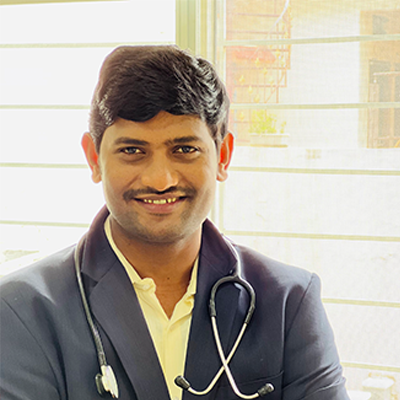
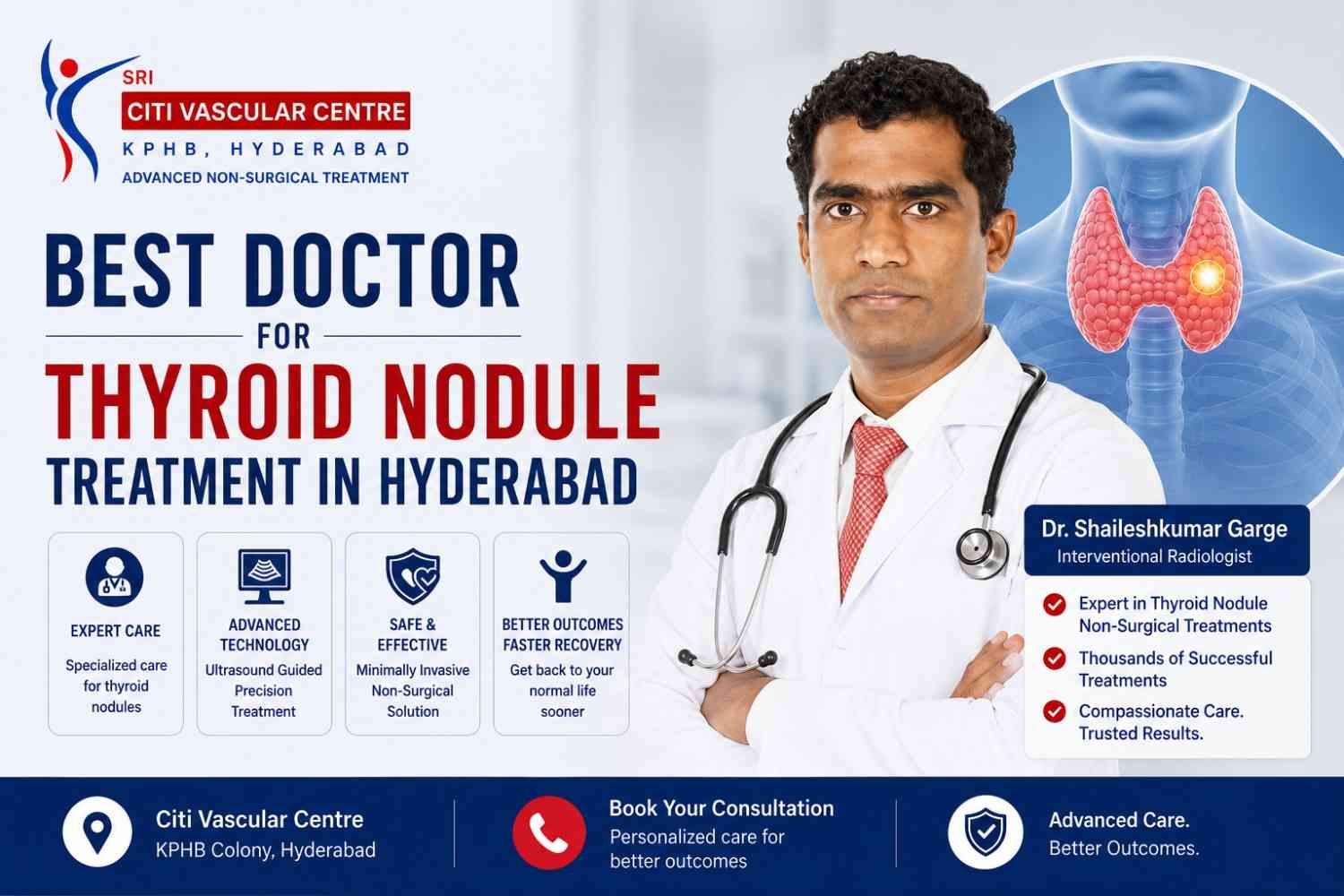
July 2026 — Dr. Shaileshkumar Garge
Citi Vascular Hospital, KPHB Colony, Road No. 1, Hyderabad, Telangana 500072
|
QUICK ANSWER Looking for an experienced thyroid nodule specialist in Hyderabad? Dr. Shaileshkumar Garge is an Interventional Radiologist with international qualifications (FRCR UK, FNVIR, EBIR) who evaluates and treats benign thyroid nodules using image-guided techniques, including ultrasound-guided FNAC and microwave thermal ablation. 12+ years, 15,000+ procedures. Call +91-73375 83901 or WhatsApp 73375 83901. |
Finding out that you have a thyroid nodule is, for many people, the start of an anxious search — not just for information about what a thyroid nodule is, but for someone who can tell them specifically what their nodule means, whether it needs treatment, and if so, what that treatment should be. The specialist you choose at this stage matters more than most patients realise. The same thyroid nodule can be appropriately managed with observation by one experienced specialist, recommended for minimally invasive ablation by another, or sent for surgical excision by a third — and all three recommendations might be defensible depending on the clinical picture. But the difference between a well-informed, imaging-guided specialist recommendation and a reflexive protocol applied to every patient with a neck lump is the difference between the right treatment for you and the default treatment for anyone with a thyroid finding.
This guide helps you understand which specialist type is most appropriate for your situation, what credentials and experience to look for, what a well-equipped thyroid treatment centre should be able to offer, the questions to ask before you commit, and why thousands of patients from across Hyderabad and Telangana choose Citi Vascular Centre, KPHB Colony, for thyroid nodule assessment and treatment.
Thyroid Nodule Consultation — Citi Vascular Centre, KPHB, Hyderabad
Call +91-73375 83901 | WhatsApp 73375 83901 | citivascularcentre.com | Mon–Sat 9AM–6PM
|
Question |
Quick Answer |
|
Which doctor treats thyroid nodules? |
Depending on the clinical need: interventional radiologist, endocrine surgeon, endocrinologist, or ENT surgeon. The right choice depends on whether ablation, surgery, or medical management is indicated. |
|
Who performs thyroid nodule ablation? |
Interventional Radiologists — specialists with specific training in image-guided catheter and needle-based procedures. Not general radiologists. |
|
Does every thyroid nodule need surgery? |
No. Most benign thyroid nodules are managed with observation. Symptomatic benign nodules may be treated with minimally invasive ablation. Surgery is needed for cancer and selected cases. |
|
Can the thyroid be preserved without surgery? |
Yes — in selected patients with confirmed benign nodules, image-guided microwave ablation treats the nodule while leaving the thyroid gland intact |
|
Should I see an endocrinologist or surgeon first? |
For confirmed benign nodules where ablation may be appropriate, an Interventional Radiologist is the most appropriate first specialist. For suspicious or malignant nodules, an endocrine surgeon is the right referral. |
|
What reports should I bring? |
Thyroid ultrasound (disc + report), FNAC result (Bethesda classification), thyroid function tests (TSH, T3, T4), and any previous thyroid letters or scans |
|
Is one specialist appointment enough? |
For straightforward benign symptomatic nodules — often yes. For complex cases, indeterminate cytology, or multiple pathologies, multidisciplinary discussion (IR + endocrinologist + surgeon) gives the most complete recommendation. |
A thyroid nodule is not a diagnosis — it is a finding that requires interpretation. The same nodule in different patients, or even the same nodule reviewed by specialists with different training backgrounds, can lead to very different treatment recommendations. Understanding why the specialist choice matters so much helps explain why patients increasingly research this question before their first appointment.
|
What the Right Specialist Gets Right |
Clinical Consequence of the Right (or Wrong) Recommendation |
|
Correct interpretation of thyroid ultrasound (TIRADS) |
TIRADS classification determines which nodules need FNAC and which can be safely observed. Miscategorisation leads to unnecessary biopsy or — worse — missed suspicious features. |
|
Accurate FNAC technique and sample adequacy |
USG-guided FNAC with real-time needle visualisation produces a diagnostic sample on the first attempt. Palpation-guided FNAC misses a significant proportion of target nodules — leading to inadequate results and repeat procedures. |
|
Correct Bethesda interpretation and next-step recommendation |
A Bethesda III or IV result requires careful risk stratification — not automatic surgery. An experienced thyroid specialist navigates the grey area between observation, repeat biopsy, molecular markers, and surgery. An inexperienced one defaults to an operation. |
|
Knowledge of minimally invasive ablation as a treatment option |
Many patients are never told that ablation is available — because their doctor does not perform it. A specialist unfamiliar with ablation will recommend surgery for patients who are excellent ablation candidates. |
|
Honest discussion of when NOT to treat |
An experienced specialist tells patients clearly when their nodule does not need intervention — avoiding unnecessary procedures, anxiety, and expense for nodules that are best left alone. |
|
Follow-up planning and long-term surveillance |
Thyroid nodule management is often long-term — not a single treatment decision. The right specialist establishes a follow-up schedule matched to the risk level of the nodule and the treatment chosen. |
Thyroid nodule management does not belong to a single medical specialty. Depending on what the nodule is and what treatment it requires, different specialists are involved — and the ideal first specialist for any given patient depends on the clinical situation, not on who happens to be available or who was referred to first.
|
Specialist Type |
Primary Training |
What They Offer for Thyroid Nodules |
Best First Choice When... |
|
Interventional Radiologist |
Radiology + image-guided procedures |
High-resolution USG | USG-guided FNAC | Core biopsy | Thermal ablation (RFA, MWA) | Ethanol ablation |
Confirmed benign nodule needing FNAC or ablation | First evaluation of any thyroid nodule |
|
Endocrine Surgeon |
Surgery of thyroid, parathyroid, adrenal |
Thyroid lobectomy | Total thyroidectomy | Parathyroid surgery | Surgical management of thyroid cancer |
Suspected or confirmed malignancy | Very large nodule | Substernal extension | Indeterminate cytology requiring surgical biopsy |
|
Endocrinologist |
Hormonal disorders including thyroid disease |
Medical management | Thyroid hormone management | Graves' disease | Post-treatment hormone replacement | Thyroid cancer surveillance |
Thyroid function problems | Post-surgery hormone management | Thyroid cancer surveillance | Long-term medical follow-up |
|
ENT Surgeon |
Ear, nose, throat — includes thyroid in selected centres |
Thyroid surgery at certain centres | Parathyroid surgery | Voice and airway involvement |
Selected referrals — depends on centre structure and ENT surgeon's specific thyroid experience |
A practical note for patients in Hyderabad: If your primary concern is a thyroid nodule that has been confirmed (or appears) benign on ultrasound, and you want to know whether it needs treatment and whether ablation is an option — an Interventional Radiologist with thyroid-specific experience is the most appropriate first specialist. They can complete the USG assessment, FNAC, and ablation planning in one centre. If malignancy is suspected, the right first call is an endocrine surgeon or oncologist.
This is the question patients most commonly ask when they have a confirmed benign thyroid nodule that is symptomatic and appears to need treatment beyond observation. Both specialists can help — but they offer fundamentally different treatment pathways, and understanding the difference helps patients arrive at the consultation with a clearer picture of what they are looking for.
|
Feature |
Endocrine Surgeon |
Interventional Radiologist |
|
Primary treatment offered |
Thyroid surgery — lobectomy or total thyroidectomy under general anaesthesia |
USG-guided FNAC, core biopsy, and microwave/RFA thermal ablation under local anaesthesia |
|
Anaesthesia used |
General anaesthesia — always required for thyroid surgery |
Local anaesthesia only for most procedures |
|
Hospital stay |
2–4 nights ward admission for surgery |
Same-day discharge for FNAC and ablation |
|
Thyroid gland preserved? |
Partially (lobectomy) or completely removed (thyroidectomy) |
Yes — thyroid fully preserved. Only the nodule is treated. |
|
Provides histological diagnosis |
Yes — surgical specimen sent for full histopathology |
FNAC provides cytology (Bethesda) | Core biopsy provides histology | Ablation treats without removing tissue |
|
Suitable for benign nodule — ablation candidate |
Can offer surgery. Will not offer ablation — not their specialty. |
Best specialist — can assess, FNAC, and ablate in the same centre |
|
Suitable for suspected cancer |
Yes — surgery is the correct standard treatment for thyroid malignancy |
No — ablation is not appropriate for thyroid cancer. Will refer to endocrine surgeon. |
|
Right for you when... |
Suspicious/malignant cytology | Indeterminate biopsy needing histology | Very large nodule (> 6cm) | Substernal extension | Patient preference for surgical removal |
Confirmed benign nodule | Symptomatic | Wants to avoid surgery or general anaesthesia | Thyroid preservation priority | Faster recovery needed |
The credentials on a doctor's certificate are a starting point — not the complete answer. A good thyroid nodule specialist combines formal qualifications with specific procedural experience, a patient-centred approach to counselling, and the intellectual honesty to tell patients when treatment is not needed and when a different specialty would serve them better.
|
Quality |
What It Means in Practice for Thyroid Nodule Patients |
|
Dedicated thyroid procedure experience |
The specialist performs thyroid USG evaluation and FNAC regularly — not as an occasional add-on to other radiology work. High-volume operators have better sample adequacy rates and fewer inadequate FNACs. |
|
Personal ultrasound expertise |
The doctor who assesses you should be the one operating the ultrasound — or in close collaborative practice with the same image. Separating the imaging from the clinical assessment loses critical real-time information. |
|
Knowledge of current guidelines (TIRADS, Bethesda) |
TIRADS classification systems (ACR TIRADS, KTRADS) and Bethesda cytological classification should be used and understood. Outdated or non-standardised classification creates unnecessary uncertainty. |
|
Honest recommendation when treatment is NOT needed |
A good thyroid specialist tells patients clearly when observation is the right management — not every patient who presents with a nodule should leave with a procedure scheduled |
|
Awareness of all treatment options including ablation |
A specialist unfamiliar with thermal ablation can only offer what they know — which typically means surgery or observation only. A complete specialist presents all appropriate options. |
|
Evidence-based practice |
Recommendations based on published international guidelines (KSThR, MITT, ETA) and the published evidence base for ablation outcomes — not personal preference or habit |
|
Long-term follow-up commitment |
Thyroid nodule management is often a years-long relationship. A specialist who performs the treatment and disappears is not providing complete care. Result review, follow-up imaging, and re-assessment planning should all be included. |
|
Willingness to refer when appropriate |
A good thyroid ablation specialist refers promptly to an endocrine surgeon when the clinical picture indicates surgery is more appropriate — without trying to ablate nodules that are not suitable for ablation |
Choosing the right doctor and choosing the right centre are two linked but separate decisions. The doctor's skills can only be fully expressed through the technology and infrastructure the centre provides. A highly trained thyroid ablation specialist working with inadequate ultrasound equipment or without FNAC cytopathology support cannot deliver the outcomes their training prepares them for. Here is what to look for when evaluating a thyroid nodule treatment centre.
|
What the Centre Should Have |
Why It Matters for Your Thyroid Nodule |
|
High-resolution ultrasound with colour Doppler |
Necessary for TIRADS classification of small nodules, vascularity assessment, lymph node evaluation, and precise FNAC needle placement. Standard-quality ultrasound misses small nodules and underestimates complexity. |
|
USG-guided FNAC capability |
Ultrasound-guided FNAC is significantly more accurate than palpation-guided — particularly for nodules < 2cm, posterior nodules, and predominantly cystic lesions. Centres offering only palpation guidance should not be managing complex thyroid disease. |
|
Access to core needle biopsy |
For Bethesda III–IV indeterminate cytology, core needle biopsy provides additional histological information that may resolve the diagnosis without surgery. Centres without this capability will default to surgical referral for all indeterminate cases. |
|
Experienced cytopathology or histopathology partner |
The best FNAC technique produces unreliable results if the pathology laboratory lacks thyroid cytology expertise. Bethesda classification should be explicitly used and documented in every FNAC report. |
|
Thermal ablation equipment (RFA or MWA) |
A centre offering 'thyroid nodule treatment' without thermal ablation can only offer observation or surgical referral. If the centre cannot ablate, patients who are good ablation candidates will be operated on unnecessarily. |
|
Surgical referral pathway |
A comprehensive centre should have an established, coordinated referral pathway to experienced thyroid surgeons for cases that require surgery — not leave patients to navigate independently after a biopsy result indicates malignancy |
|
Thyroid function testing |
TSH, T3, T4 testing to confirm thyroid function status is essential before any intervention and at follow-up to monitor post-treatment thyroid health |
|
Follow-up imaging protocol |
Structured 6-week, 3-month, 6-month, and 12-month ultrasound follow-up is the standard after thyroid ablation — and 6–12 monthly imaging for observed nodules. A centre without a clear follow-up protocol is not providing complete care. |
|
Patient counselling and informed consent |
Patients should receive a clear explanation of their nodule, all management options, what each involves, and honest information about expected outcomes before committing to any procedure |
Asking the right questions at — or before — your first consultation with a thyroid specialist is not impolite or presumptuous. It is a completely appropriate part of making an informed healthcare decision. A good specialist welcomes these questions. Here are the ones that matter most.
|
Question to Ask |
Why the Answer Matters |
|
Are you an Interventional Radiologist specifically trained in thyroid ablation? |
Not all radiologists perform thyroid ablation. Confirm the specialist has specific ablation training — not general radiology experience with occasional thyroid procedures. |
|
How many thyroid FNAC and ablation procedures do you perform annually? |
High-volume operators have better adequacy rates, lower complication rates, and more refined technique. Asking directly is entirely reasonable — experienced specialists will answer without hesitation. |
|
Am I a suitable candidate for ablation — or is surgery more appropriate for my nodule? |
A good specialist gives you an honest answer based on your specific ultrasound and FNAC findings — not a default recommendation that applies to every patient. |
|
Can my thyroid gland be preserved through treatment? |
If the specialist only offers surgery, thyroid preservation is not on the table. This question quickly reveals whether the specialist is familiar with ablation. |
|
What follow-up will I need after treatment — and is it included? |
Structured follow-up is essential for both ablation and observation management. A centre without a clear follow-up plan is not providing complete long-term care. |
|
Will I need to see a different doctor for the FNAC and the ablation, or can you do both? |
Fragmented care across multiple centres and specialists adds time, cost, and complexity. A one-stop centre reduces all of these. |
|
If my FNAC suggests something suspicious, will you refer me to the right surgeon? |
A thyroid ablation specialist who tries to ablate suspicious nodules rather than referring for surgery is not operating in the patient's best interest. This question tests clinical integrity. |
|
What is the cost and is insurance assistance available? |
Transparent pricing and insurance assistance are markers of a patient-centred practice. See our Thyroid Ablation Cost in Hyderabad page for full pricing detail. |
The quality and specificity of advice you receive at your first thyroid nodule consultation depends directly on the quality of information you bring. The more complete your clinical picture when you arrive, the more specific Dr. Garge's recommendation can be — and the more efficiently a management plan can be made in a single appointment.
|
Report / Document |
What It Provides |
Priority |
|
Thyroid ultrasound — disc AND written report |
The actual scan images allow Dr. Garge to review nodule characteristics (TIRADS), size, vascularity, and lymph nodes himself — not rely on another radiologist's description |
HIGHEST PRIORITY — always bring the disc |
|
FNAC report — if already done |
Bethesda classification tells Dr. Garge whether ablation is appropriate (Bethesda II) or whether further evaluation or surgery is needed (Bethesda III–VI) |
Essential if completed |
|
Thyroid function tests — TSH, T3, T4 |
Confirms whether the gland is functioning normally, overactive, or underactive — affects treatment planning and suitability assessment |
Important — bring if done |
|
Previous thyroid specialist letters or reports |
Context on prior management, previous surveillance results, and any previous treatments (surgery, radioiodine) |
Bring if available |
|
Any other relevant imaging — CT, MRI of neck |
Occasionally requested before large thyroid assessments — particularly for substernal extension or compressive symptoms |
Bring if available |
|
Medication list |
Particularly relevant: thyroxine (levothyroxine), antithyroid drugs (carbimazole), blood thinners (aspirin, warfarin, NOACs) |
Always bring |
|
⚠ |
Offers only one treatment option |
A centre that offers only surgery — or only observation — cannot make the right recommendation for every patient. Comprehensive thyroid nodule care requires all three pathways: observation, ablation, and surgical referral. |
|
⚠ |
Performs FNAC without real-time ultrasound guidance |
Palpation-guided FNAC is acceptable for very large, superficial, easily palpated nodules — but inadequate for most clinical indications in 2026. If a centre uses only palpation guidance, diagnostic accuracy is significantly reduced. |
|
⚠ |
Recommends surgery without providing FNAC first |
Surgery for a thyroid nodule without prior FNAC (unless clinical red flags strongly indicate malignancy on ultrasound) means operating without a tissue diagnosis. Most benign nodules can be confirmed non-surgical before any intervention. |
|
⚠ |
Does not explain all treatment options at consultation |
If your specialist does not mention that thermal ablation is an option for benign symptomatic nodules, ask directly. A specialist unfamiliar with ablation cannot offer it — but they should at minimum acknowledge it exists and refer appropriately. |
|
⚠ |
Cannot tell you the Bethesda category of your FNAC |
Bethesda classification (I–VI) is the international standard for thyroid cytology reporting. Any centre reporting thyroid FNAC results without Bethesda classification is using an outdated reporting system. |
|
⚠ |
No structured follow-up after treatment |
Discharging a patient after thyroid ablation without a clear follow-up ultrasound schedule (6 weeks, 3 months, 6 months, 12 months) represents incomplete care. Outcome monitoring is a non-optional component of the procedure. |
|
⚠ |
No written cost estimate before the procedure |
Any centre that cannot provide a written itemised estimate before a procedure is not operating transparently. See our Thyroid Ablation Cost in Hyderabad page for full pricing guidance. |
|
11. WHY DR. SHAILESHKUMAR GARGE FOR THYROID NODULE TREATMENT IN HYDERABAD? |
Dr. Shaileshkumar Garge is one of a very small number of practitioners in Hyderabad who holds all three of the following international Interventional Radiology credentials simultaneously: FRCR (UK), FNVIR (CMC Vellore), and EBIR (Spain). Each independently represents the highest standard of IR training assessed against international standards. Together — for thyroid nodule patients — they represent a level of verified, internationally benchmarked procedural expertise that is exceptionally uncommon in Hyderabad.
|
Credential / Expertise |
Relevance to Thyroid Nodule Management |
|
FRCR (UK) — Fellow, Royal College of Radiologists |
Highest UK postgraduate radiology standard — covers both expert diagnostic ultrasound interpretation (TIRADS classification) and interventional procedures including thyroid FNAC and ablation |
|
FNVIR (CMC Vellore) |
India's most prestigious Interventional Radiology fellowship — training specifically in image-guided needle procedures including thyroid FNAC, core biopsy, and thermal ablation |
|
EBIR (Spain/Europe) |
European Board of Interventional Radiology certification — CIRSE, which publishes the principal European guidelines for thyroid thermal ablation, is the certifying body. Holding EBIR means Dr. Garge is certified by the organisation that sets European thyroid ablation standards. |
|
Personal ultrasound operation |
Dr. Garge operates the high-resolution ultrasound during every thyroid evaluation, FNAC, and ablation procedure himself — not delegated to a technician. The specialist assessing your nodule is the same one treating it. |
|
One-stop thyroid nodule service |
Clinical examination + TIRADS ultrasound + FNAC + ablation planning + ablation + follow-up scans — all at the same centre, with the same specialist. No fragmented care across multiple departments. |
|
Honest FNAC-first approach |
Every patient with a symptomatic benign nodule is assessed individually — Dr. Garge does not schedule ablation before confirming benign cytology, and he refers promptly to endocrine surgeons when the clinical picture indicates surgery is more appropriate |
|
12+ years, 15,000+ procedures |
High-volume dedicated IR practice — not occasional thyroid procedures added to a diagnostic radiology workload. Procedural volume and dedicated focus translate directly to better outcomes. |
|
Credential |
Detail |
|
Name |
Dr. Shaileshkumar Garge | MBBS | MD (Mumbai) | DNB (Delhi) | FRCR (UK) | FNVIR (CMC Vellore) | EBIR (Spain) | Fellowship (North Carolina, USA) |
|
Role |
Director and Chief Vascular Physician | Senior Consultant Vascular and Interventional Radiologist |
|
Centre |
Citi Vascular Centre, KPHB Colony, Road No. 1, Hyderabad, Telangana 500072 |
|
Experience |
12+ years dedicated interventional radiology | 15,000+ minimally invasive image-guided diagnostic and therapeutic procedures |
|
What Citi Vascular Provides |
Why It Matters for Thyroid Nodule Patients |
|
High-resolution USG with colour and power Doppler |
State-of-the-art imaging for TIRADS classification, small nodule detection, vascularity mapping, and real-time FNAC needle guidance — operated personally by Dr. Garge |
|
USG-guided FNAC with real-time needle visualisation |
Bethesda system reporting from experienced cytopathology partners — sample adequacy check before you leave. Result in 2–5 days. |
|
Core needle biopsy capability |
For Bethesda III–IV indeterminate cytology — additional tissue for histological evaluation before committing to surgery |
|
Microwave thermal ablation (MWA) |
For confirmed benign symptomatic nodules — moving-shot technique with hydrodissection for nerve protection as standard. 60–80% nodule volume reduction at 12 months. |
|
Ethanol ablation for cystic nodules |
Highly effective one or two-session treatment for predominantly cystic thyroid nodules — significantly less expensive than MWA |
|
Coordinated surgical referral |
When surgery is the right recommendation, Dr. Garge coordinates referral to experienced thyroid surgeons — not left to the patient to navigate |
|
Same-day procedures for FNAC and ablation |
No separate pre-procedure appointment in most cases. FNAC completed in the same visit as the initial ultrasound assessment. Ablation scheduled efficiently after benign result confirmed. |
|
Structured follow-up included |
6-week review + 3-month + 6-month + 12-month ultrasound — all with Dr. Garge. Outcome measured against baseline scan. |
|
Insurance assistance and transparent pricing |
Pre-auth documentation prepared at no extra charge. Written itemised cost estimate before any procedure. 0% EMI for eligible patients. |
|
Send your thyroid ultrasound before you book WhatsApp your thyroid USG disc / report + FNAC result for Dr. Garge's initial advice before committing to an appointment. WhatsApp: 73375 83901 |
Book your thyroid nodule consultation Ultrasound evaluation + FNAC + management discussion + written cost estimate in one appointment. Call +91-73375 83901 |
|
▼ |
Neck lump, neck swelling, or difficulty swallowing noticed — or thyroid nodule found incidentally on scan ordered for another reason |
|
▼ |
Consultation with Dr. Garge + high-resolution ultrasound with colour Doppler: nodule size, composition, TIRADS classification, lymph node assessment |
|
▼ |
TIRADS 1–3 with no suspicious features: observation with follow-up ultrasound at 6–12 months if asymptomatic and < 2cm |
|
▼ |
TIRADS 4–5 or patient symptomatic / nodule growing: USG-guided FNAC. Bethesda classification reported within 2–5 days. |
|
? |
FNAC result — Bethesda II (Benign)? |
|
YES |
Benign confirmed → Is the patient symptomatic, growing, or has cosmetic concern? → If YES: discuss ablation vs observation → Ablation scheduled → 1 week recovery → Follow-up scans at 6 weeks, 3, 6, 12 months |
|
NO |
Bethesda III–IV (Indeterminate) → Core needle biopsy or repeat FNAC → molecular markers where available → Endocrine surgery referral if still indeterminate |
|
NO |
Bethesda V–VI (Suspicious / Malignant) → Prompt referral to endocrine surgeon. Staging investigations. MDT discussion. Surgical planning. |
|
▼ |
All patients: result reviewed with Dr. Garge at follow-up consultation. Report explained alongside imaging. Next steps — ablation, observation, or surgical referral — specifically recommended. |
|
Myth |
Fact |
|
|
1 |
Every thyroid nodule needs surgery. |
Most thyroid nodules are benign and the majority never require treatment. Small, asymptomatic, confirmed-benign nodules (Bethesda II) are safely monitored with periodic ultrasound. |
|
2 |
The thyroid always has to be removed. |
Microwave thermal ablation treats the nodule while leaving the thyroid gland fully intact. Most ablation patients maintain normal thyroid function without any hormone replacement medication. |
|
3 |
Any radiologist can perform thyroid ablation. |
Thyroid ablation requires specific training in minimally invasive interventional radiology — not general diagnostic radiology. It should be performed by a specialist with dedicated ablation training and high procedure volume. |
|
4 |
I should see a surgeon first because surgery is the standard treatment. |
For confirmed benign nodules, an Interventional Radiologist experienced in thyroid evaluation is often the most appropriate first specialist — they can assess, biopsy, and ablate in one centre. |
|
5 |
If the ultrasound shows a nodule, it must be biopsied. |
FNAC is indicated based on nodule size, TIRADS category, and clinical features — not simply the presence of any nodule. Many small low-risk nodules can be safely observed without immediate biopsy. |
|
6 |
A nodule found on ultrasound is almost certainly cancer. |
More than 85–90% of thyroid nodules detected on high-resolution ultrasound are benign. The vast majority of patients who discover they have a thyroid nodule will never need treatment for malignancy. |
|
7 |
After thyroid surgery, no further follow-up is needed. |
Whether the treatment is surgery, ablation, or observation, long-term follow-up ultrasound is required to monitor the remaining thyroid tissue for new nodule development over time. |
Q1: Who is the best doctor for thyroid nodule treatment in Hyderabad?
Dr. Shaileshkumar Garge — FRCR (UK), FNVIR (CMC Vellore), EBIR (Spain), Fellowship (USA) — Director and Chief Vascular Physician at Citi Vascular Centre, KPHB Colony, Hyderabad, is one of the most internationally credentialled interventional radiologists for thyroid nodule evaluation, USG-guided FNAC, and image-guided thermal ablation. With 12+ years of dedicated experience and 15,000+ image-guided procedures, he provides a complete one-stop thyroid nodule service. Call +91-73375 83901 or WhatsApp 73375 83901.
Q2: Which is the best hospital for thyroid nodule treatment in Hyderabad?
Citi Vascular Centre, KPHB Colony, Road No. 1, Hyderabad, is one of the most credentialled centres for thyroid nodule management in the city. Led by Dr. Shaileshkumar Garge — FRCR (UK), FNVIR (CMC Vellore), EBIR (Spain) — the centre provides high-resolution USG evaluation, USG-guided FNAC, core needle biopsy, microwave thermal ablation, and coordinated surgical referral — all in one centre, with same-day discharge for eligible patients. Call +91-73375 83901 or WhatsApp 73375 83901.
Q3: Which doctor should I see for a thyroid nodule — endocrinologist, surgeon, or radiologist?
For a confirmed or suspected benign thyroid nodule where FNAC and possible ablation are being considered, an Interventional Radiologist with thyroid-specific experience is the most appropriate first specialist — they can assess, biopsy, and treat in one centre. For suspected or confirmed thyroid cancer or indeterminate biopsy requiring histological diagnosis, an endocrine surgeon is the right referral. An endocrinologist manages medical thyroid conditions and post-treatment hormone follow-up.
Q4: Who performs microwave thyroid nodule ablation in Hyderabad?
Microwave thyroid nodule ablation is performed by Interventional Radiologists with specific training in image-guided thermal ablation — not general radiologists who occasionally perform FNAC. At Citi Vascular Centre, KPHB, thyroid ablation is performed by Dr. Shaileshkumar Garge — FRCR (UK), FNVIR (CMC Vellore), EBIR (Spain) — using the moving-shot technique with hydrodissection for nerve protection as standard practice. Call +91-73375 83901.
Q5: How do I choose the right thyroid specialist?
Five key factors for choosing a thyroid nodule specialist: (1) Interventional Radiologist with dedicated thyroid ablation training — not occasional ablation added to diagnostic radiology work. (2) High-resolution ultrasound operated personally by the specialist. (3) Uses TIRADS and Bethesda classification systems. (4) Offers all three management pathways: observation, ablation, and surgical referral. (5) Provides structured follow-up imaging after any intervention. Citi Vascular Centre, KPHB, provides all five. Call +91-73375 83901.
Q6: Can a thyroid nodule be treated without surgery in Hyderabad?
Yes — for confirmed benign thyroid nodules (Bethesda II on FNAC) that are symptomatic, growing, or causing cosmetic concern, microwave thermal ablation treats the nodule while preserving the thyroid gland completely. No general anaesthesia, no surgical scar, and same-day discharge. Ablation is available at Citi Vascular Centre, KPHB, performed by Dr. Garge FRCR (UK). Malignancy must be excluded by FNAC before ablation is considered. Call +91-73375 83901.
Q7: What reports should I bring to my thyroid nodule consultation?
The most important document is your thyroid ultrasound disc — not just the written report. The actual scan images allow Dr. Garge to review nodule characteristics himself under TIRADS classification. Also bring: your FNAC result (Bethesda category if done), thyroid function tests (TSH, T3, T4), any previous thyroid specialist letters or surgery records, and a complete medication list including blood thinners and any thyroid-related drugs. WhatsApp 73375 83901 for any queries before your appointment.
Q8: Does every thyroid nodule need a biopsy (FNAC)?
No — FNAC is indicated based on nodule size, TIRADS category, and clinical features — not the mere presence of any nodule. Small (< 1cm) nodules with entirely benign ultrasound features (TIRADS 2) do not routinely require FNAC. Nodules with intermediate or suspicious features (TIRADS 4–5), nodules > 1–1.5cm, or nodules in patients with risk factors are the standard indications. Dr. Garge determines FNAC indication at your ultrasound assessment.
Q9: How many procedures should an experienced thyroid ablation specialist have performed?
Volume is a meaningful proxy for experience in minimally invasive procedures. Published international guidelines suggest that thyroid ablation should be performed by specialists who perform the procedure regularly — not as an occasional addition to a diagnostic radiology caseload. At Citi Vascular Centre, KPHB, Dr. Garge performs thyroid evaluation, FNAC, and ablation as part of a high-volume dedicated IR practice with 15,000+ image-guided procedures across 12+ years. Call +91-73375 83901.
Q10: Should I get a second opinion before thyroid nodule treatment?
Yes — a second opinion is always reasonable before committing to any thyroid procedure, particularly if you have been recommended surgery for a nodule and are uncertain whether minimally invasive ablation might be appropriate. Bring your ultrasound disc and FNAC report to a consultation with Dr. Garge at Citi Vascular Centre, KPHB. He will review your imaging, confirm whether ablation is an appropriate option for your specific nodule, and provide an honest recommendation. Call +91-73375 83901 or WhatsApp 73375 83901.
Q11: How often do I need follow-up after thyroid nodule treatment?
Follow-up schedule depends on the management path. After thermal ablation: ultrasound at 6 weeks, 3 months, 6 months, and 12 months with Dr. Garge — then annually if the result is stable. For observed benign nodules: ultrasound every 6–12 months for 2–3 years, then at longer intervals if size and appearance are stable. For post-surgical patients: thyroid function tests and ultrasound per endocrine surgeon or endocrinologist's protocol. Dr. Garge provides a clear follow-up schedule at consultation.
Q12: What is the benefit of a one-stop thyroid nodule centre?
A one-stop thyroid nodule centre — where the same specialist performs the ultrasound assessment, FNAC, and ablation with the same imaging equipment and follows up the result — reduces the delays, miscommunications, and redundant appointments that arise when care is fragmented across multiple departments or institutions. Citi Vascular Centre, KPHB, provides complete one-stop thyroid nodule evaluation, FNAC, ablation, and follow-up under one roof with Dr. Garge. Call +91-73375 83901 or WhatsApp 73375 83901.
Citi Vascular Centre, KPHB Colony, Road No. 1, Hyderabad — thyroid nodule evaluation, FNAC, and ablation available for patients from:
Kukatpally and KPHB — 5 min
Miyapur and Bachupally — 10 min
Hitech City, Madhapur and Ameerpet — 20 min
Gachibowli, Kondapur and Banjara Hills — 25 min
Secunderabad and Begumpet — 25 min
Kompally, Medchal and Alwal — 20–25 min
Telangana and Andhra Pradesh — outstation patients welcome
|
Centre |
Contact |
Hours |
|
Citi Vascular Centre |
+91-73375 83901 |
KPHB Colony, Road No. 1, Hyderabad, Telangana 500072 | Mon–Sat 9AM–6PM |
|
|
73375 83901 |
Send thyroid ultrasound disc for initial assessment before booking | Same-week appointments available |
Choosing the right specialist for your thyroid nodule is as important as choosing the right treatment — because the right treatment recommendation can only come from a specialist who knows what all the options are, has the technology to evaluate your nodule properly, and has the procedural capability and training to deliver the treatment that is genuinely most appropriate for your specific situation. An endocrine surgeon who only offers surgery will recommend surgery. A radiologist without ablation training will recommend observation or surgical referral. An Interventional Radiologist with specific thyroid evaluation and ablation training — and a comprehensive centre behind them — can complete the full diagnostic and therapeutic pathway from the first ultrasound to the final follow-up scan.
At Citi Vascular Centre, KPHB Colony, Hyderabad, Dr. Shaileshkumar Garge provides exactly this: TIRADS ultrasound, USG-guided FNAC with Bethesda reporting, core biopsy when needed, microwave thermal ablation for confirmed benign symptomatic nodules, ethanol ablation for cystic nodules, and coordinated surgical referral for cases that require it. All in one centre, with one specialist, from the first appointment to the final follow-up. If you have a thyroid nodule and want an honest, informed, patient-specific recommendation — bring your ultrasound disc, FNAC report, and thyroid function tests to a consultation. Call +91-73375 83901 or WhatsApp 73375 83901.
Choose the Right Specialist. Get the Right Diagnosis. Keep Your Thyroid.
USG Evaluation | FNAC | Core Biopsy | Thermal Ablation | Surgical Referral | Citi Vascular Centre, KPHB
Dr. Shaileshkumar Garge | FRCR (UK) | FNVIR (CMC Vellore) | EBIR (Spain) | 12+ Years | 15,000+ Procedures
Call +91-73375 83901 | WhatsApp 73375 83901 | citivascularcentre.com
Same-Week Appointments | One-Stop Assessment | Insurance Assisted | 0% EMI | KPHB Colony, Hyderabad | Mon–Sat 9AM–6PM