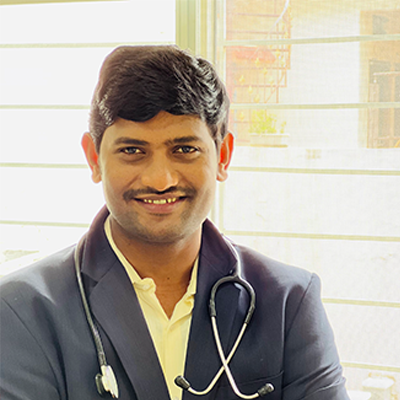
When it comes to treating complex vascular conditions, nobody wants long hospital stays or painful surgeries. That’s where advanced interventional radiology treatment in Hyderabad is changing the game. At Citi Vascular Hospital, KPHB, patients now have access to minimally invasive, highly precise procedures led by Dr Shaileshkumar Garge, a trusted name in vascular care.
So, what makes interventional radiology so popular? Why are patients in Hyderabad choosing this modern approach? And how safe is it really? Let’s break it all down.
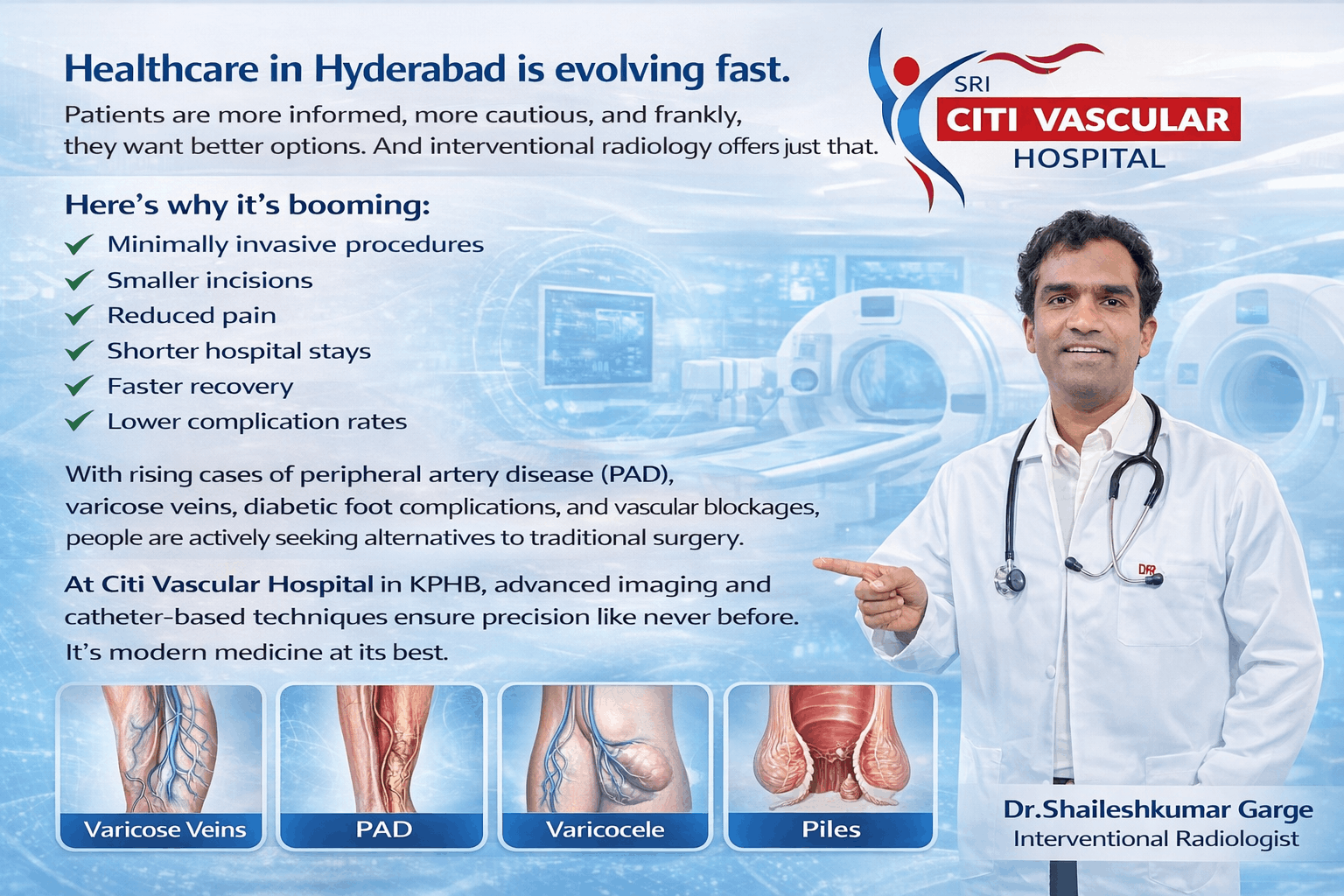
Healthcare in Hyderabad is evolving fast. Patients are more informed, more cautious, and frankly, they want better options. And interventional radiology offers just that.
Here’s why it’s booming:
✔ Minimally invasive procedures
✔ Smaller incisions
✔ Reduced pain
✔ Shorter hospital stays
✔ Faster recovery
✔ Lower complication rates
With rising cases of peripheral artery disease (PAD), varicose veins, diabetic foot complications, and vascular blockages, people are actively seeking alternatives to traditional surgery.
At Citi Vascular Hospital in KPHB, advanced imaging and catheter-based techniques ensure precision like never before. It’s modern medicine at its best.
Interventional Radiology (IR) uses imaging techniques like:
Ultrasound
CT scans
Fluoroscopy
MRI guidance
These tools help doctors treat diseases from inside the body using tiny catheters instead of large surgical incisions.
Thrombectomy for Blood Clots
Simply put, instead of “open surgery,” a small needle entry is used. Sounds simple? Well, it’s sophisticated—but patient-friendly.
Dr Shaileshkumar Garge evaluates symptoms, medical history, and imaging reports.
Advanced imaging identifies the exact location of the problem.
Most procedures require only local anesthesia.
A thin catheter is inserted through a small incision.
Balloon angioplasty, laser therapy, or embolization is performed.
Most patients go home the same day or within 24 hours.
No major stitches. No large scars.
Recovery? Much faster than traditional surgery.
Costs vary depending on the condition and procedure type.
|
Treatment Type |
Estimated Cost in Hyderabad (INR) |
|
Peripheral Angioplasty |
₹1,20,000 – ₹2,50,000 |
|
Varicose Vein Laser Treatment |
₹60,000 – ₹1,20,000 |
|
Uterine Fibroid Embolization |
₹1,50,000 – ₹3,00,000 |
|
Dialysis Access Procedure |
₹40,000 – ₹90,000 |
|
Varicocele Embolization |
₹1,50,000 – ₹3,00,000 |
Note: Costs may vary based on complexity, hospital stay, and medical condition. Many insurance providers cover these treatments.
Let’s be honest—no medical procedure is 100% risk-free. However, advanced interventional radiology is considered safer compared to open surgery.
Minor bleeding
Infection
Allergic reaction to contrast dye
Rare complications depending on the condition
Smaller incision = Lower infection risk
Local anesthesia = Safer for elderly patients
Reduced blood loss
Quick discharge
Under experienced specialists like Dr Shaileshkumar Garge, complication rates are significantly minimized.
Choosing the right specialist makes all the difference.
Here’s why patients trust him:
Extensive experience in vascular and interventional radiology
Advanced imaging-guided procedures
Personalized patient care
State-of-the-art infrastructure at Citi Vascular Hospital
High success rates
Located in KPHB, Hyderabad, the hospital is easily accessible and equipped with modern catheterization labs.
Location Advantage: KPHB is easily accessible from Kukatpally, Miyapur, Hitech City, and surrounding areas.
|
Feature |
Traditional Surgery |
Interventional Radiology |
|
Incision Size |
Large |
Tiny (needle-sized) |
|
Anesthesia |
General |
Mostly Local |
|
Hospital Stay |
3–7 Days |
Same Day / 24 Hours |
|
Recovery Time |
Weeks |
Days |
|
Pain Level |
Moderate to High |
Minimal |
|
Risk of Infection |
Higher |
Lower |
Are you experiencing symptoms like leg pain, swelling, non-healing wounds, or abnormal bleeding?
⬇
Have you tried medications without improvement?
⬇
Imaging confirms vascular blockage or abnormality?
⬇
✔ Yes → Consult Interventional Radiologist
❌ No → Continue conservative treatment
⬇
Eligible for minimally invasive procedure?
⬇
Proceed with Advanced Interventional Radiology Treatment
Want optimal outcomes? Keep these tips in mind:
Don’t ignore early symptoms.
Manage diabetes and blood pressure.
Quit smoking immediately.
Follow post-procedure instructions strictly.
Attend regular follow-ups.
Early intervention = Better recovery.
Most procedures are done under local anesthesia, so discomfort is minimal.
Many patients resume normal activities within a few days.
Yes, especially since most procedures avoid general anesthesia.
Most major health insurance policies provide coverage.
If you have vascular symptoms like leg pain, swelling, or non-healing ulcers, consult a specialist for evaluation.