LAST MEDICALLY REVIEWED:
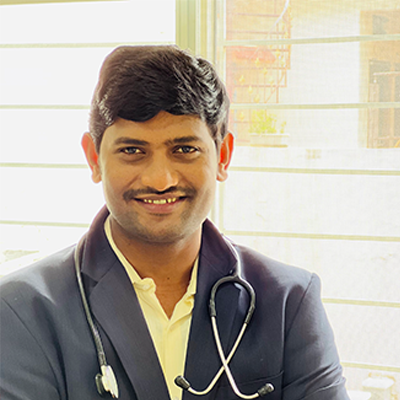
June 2026 — Dr. Shaileshkumar Garge
Citi Vascular Hospital, KPHB Colony, Road No. 1, Hyderabad, Telangana 500072
|
QUICK ANSWER I Have a Thyroid Nodule — What Should I Do First? Do not panic. Most thyroid nodules are benign and many never need treatment. The first step is a proper thyroid ultrasound with TIRADS classification. Depending on the size, ultrasound features, and any symptoms, your specialist may recommend observation, FNAC, thermal ablation, or surgery — but simply having a thyroid nodule does not mean any of these are automatically necessary. Dr. Garge FRCR (UK) | Citi Vascular Centre, KPHB, Hyderabad. Call +91-73375 83901. |
Every year, thousands of people in Hyderabad discover they have a thyroid nodule — usually during an ultrasound ordered for an entirely different reason, or during a routine health check. The first reaction is almost universally the same: is this cancer? Followed immediately by a cascade of further questions that can feel overwhelming before you have spoken to a specialist. This FAQ guide brings together the most common questions patients ask during thyroid consultations at Citi Vascular Centre, KPHB, and answers them clearly and honestly — based on current international clinical guidelines and the clinical experience of Dr. Shaileshkumar Garge FRCR (UK), FNVIR (CMC Vellore), EBIR (Spain). The questions are organised into 11 sections so you can navigate directly to the topic you need.
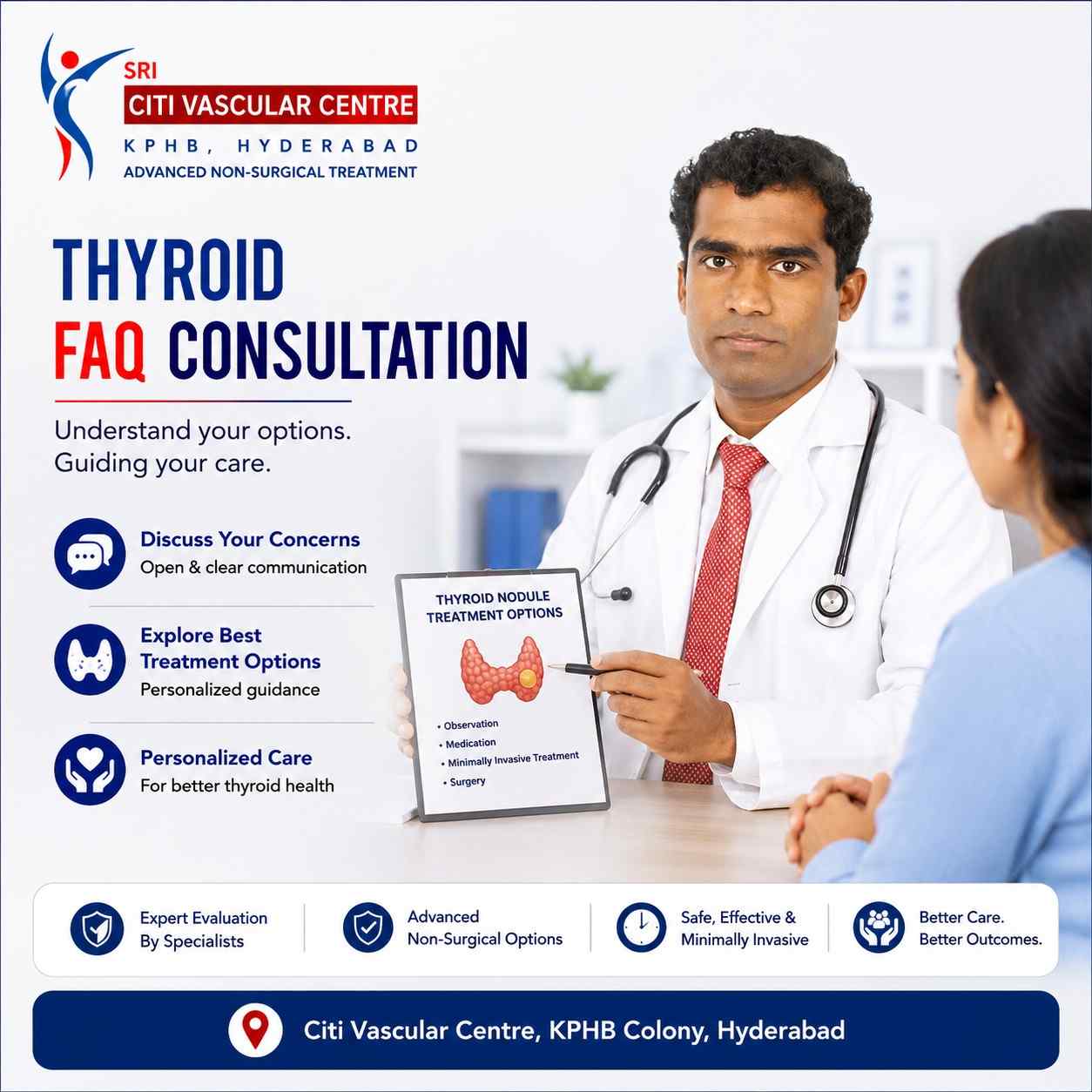
Thyroid Nodule Consultation — Citi Vascular Centre, KPHB, Hyderabad
Call +91-73375 83901 | WhatsApp 73375 83901 | citivascularcentre.com | Mon–Sat 9AM–6PM
|
Question |
Quick Answer |
|
Are most thyroid nodules cancerous? |
No. More than 85–90% of thyroid nodules found on ultrasound are benign. Most people with a thyroid nodule will never develop thyroid cancer. |
|
Does every thyroid nodule need an FNAC? |
No. FNAC is recommended based on TIRADS ultrasound classification, nodule size, and clinical features — not the mere presence of a nodule. |
|
Does every thyroid nodule need surgery? |
No. Many benign nodules are safely observed with periodic ultrasound. Symptomatic benign nodules may be treated with thermal ablation rather than surgery. |
|
Can the thyroid gland be preserved? |
Yes — microwave thermal ablation treats the nodule while leaving the healthy thyroid gland completely intact. |
|
Is thyroid ablation available in Hyderabad? |
Yes — at Citi Vascular Centre, KPHB, Dr. Garge performs microwave thermal ablation for selected benign thyroid nodules. |
|
Is hospital admission required? |
Not for FNAC or ablation — both are same-day procedures. Surgery requires 2–4 nights ward admission. |
|
Which doctor treats thyroid nodules? |
Depending on the clinical need: Interventional Radiologist for FNAC and ablation | Endocrine Surgeon for surgery | Endocrinologist for medical hormone management. |
Q1: What is a thyroid nodule?
A thyroid nodule is a discrete growth — solid, cystic, or mixed — arising within the thyroid gland, the butterfly-shaped endocrine gland at the front of your neck. Nodules are extremely common, detected by high-resolution ultrasound in up to 50–60% of adults. The majority are entirely benign and many are discovered incidentally on scans performed for unrelated conditions.
Q2: What causes benign thyroid nodules?
The exact cause is not always identifiable. Known contributing factors include: age-related glandular changes (nodules become more common after age 40), iodine deficiency, thyroid adenoma (a benign follicular cell growth), thyroid cysts, Hashimoto's thyroiditis, family history of thyroid disease, and previous radiation exposure to the neck. Having one or more risk factors does not mean treatment will be required.
Q3: Are thyroid nodules common?
Yes — thyroid nodules are among the most common incidental findings in adult medicine. High-resolution ultrasound studies detect nodules in up to 50–60% of adults examined, most of whom have no awareness of them and experience no symptoms. Thyroid nodules are far more common than thyroid cancer, and the two should not be confused simply because both involve a growth within the thyroid.
Q4: Who gets thyroid nodules?
Anyone can develop a thyroid nodule, but they are 3–4 times more common in women than men. Risk increases with age — prevalence rises significantly after 40. Other risk groups include people with a family history of thyroid disease, previous thyroid conditions such as Hashimoto's thyroiditis, low iodine intake, multinodular goitre, or prior radiation therapy to the head and neck region.
Q5: Can young adults get thyroid nodules?
Yes, though thyroid nodules are less common in younger people. When they do occur in younger adults or teenagers, they tend to receive more thorough evaluation because the proportion of
malignant nodules is slightly higher in younger age groups compared to older adults. FNAC is generally recommended at smaller sizes in younger patients. Any persistent neck lump in a young person should be assessed by a specialist.
Q6: Are thyroid nodules hereditary?
There is a familial tendency for thyroid nodule development — first-degree relatives of people with thyroid nodules or thyroid disease have higher rates of nodule formation. However, most thyroid nodules occur without a specific identifiable hereditary cause. A family history of thyroid cancer (particularly medullary thyroid cancer or MEN syndromes) warrants earlier and more thorough evaluation.
Q7: Do thyroid nodules affect thyroid function?
Most thyroid nodules are hormonally inactive — the rest of the thyroid continues to function normally. A small minority of nodules are 'toxic' or 'hot' — they produce excess thyroid hormone, causing hyperthyroidism (palpitations, weight loss, heat intolerance). Thyroid function blood tests (TSH, T3, T4) confirm whether the gland is functioning normally and whether a nodule might be contributing to hormonal dysfunction.
Q8: What symptoms can thyroid nodules cause?
Most thyroid nodules cause no symptoms at all — discovered only on imaging. When symptoms develop, they are usually related to nodule size: visible neck swelling, a palpable lump, difficulty swallowing, throat pressure or tightness, mild neck discomfort, and occasionally cosmetic concern. Large nodules or multinodular goitre may cause more significant compressive symptoms affecting swallowing, breathing, or voice.
Q9: Can a thyroid nodule cause difficulty swallowing?
Yes — a large or posteriorly located thyroid nodule can compress the oesophagus and cause dysphagia (difficulty swallowing), particularly with solid foods. This is more common when the nodule is > 3–4cm or when multiple nodules have enlarged the overall gland. Swallowing difficulty caused by a thyroid nodule is a clinical indication for treatment — either thermal ablation (if benign) or surgery.
Q10: Can thyroid nodules cause voice change?
Significant, persistent voice change (hoarseness) caused by a benign thyroid nodule is uncommon. It occurs when a very large nodule compresses the recurrent laryngeal nerve — the nerve controlling the vocal cord. Voice change is more commonly associated with thyroid cancer than with benign nodules. Any unexplained persistent hoarseness in a patient with a known thyroid nodule warrants specialist assessment and repeat imaging.
Q11: Can thyroid nodules cause coughing or breathing difficulty?
Large thyroid nodules or multinodular goitre with tracheal compression can occasionally cause a chronic dry cough or a sensation of breathing difficulty — particularly when lying flat or turning the neck. Substernal (behind-the-sternum) extension of a large goitre is the most common cause of significant airway compression from thyroid disease. This requires prompt surgical evaluation and is not typically managed with ablation.
Q12 How are thyroid nodules diagnosed?
Thyroid nodules are diagnosed by: (1) Clinical examination — feeling the neck for swelling. (2) Thyroid ultrasound — first-line imaging that characterises nodule size, composition, and risk features using TIRADS classification. (3) FNAC — fine needle aspiration cytology for tissue sampling when indicated. (4) Thyroid function tests — blood tests confirming TSH, T3, T4 levels. Core needle biopsy is used for selected indeterminate cases.
Q13: What is TIRADS and why does it matter?
TIRADS (Thyroid Imaging Reporting and Data System) is an internationally standardised ultrasound scoring system that classifies thyroid nodules from TIRADS 1 (normal) to TIRADS 5 (highly suspicious for malignancy) based on their ultrasound features — shape, echogenicity, margins, composition, and calcification. TIRADS classification determines which nodules need FNAC and at what size, reducing unnecessary biopsies for clearly benign nodules and ensuring suspicious ones are evaluated promptly.
Q14: When is FNAC recommended for a thyroid nodule?
FNAC is recommended based on TIRADS category and nodule size — not the mere presence of a nodule. Broadly: TIRADS 2 (benign features) — no FNAC usually needed | TIRADS 3 — FNAC if > 2.5cm | TIRADS 4 — FNAC if > 1.5cm | TIRADS 5 (suspicious) — FNAC if > 1cm. Patients with risk factors (family history of thyroid cancer, prior neck radiation) may warrant FNAC at smaller sizes.
Q15: Is thyroid FNAC painful?
Thyroid FNAC is one of the least uncomfortable diagnostic procedures in medicine. Most patients compare it favourably to a standard blood test — the needle used for FNAC (21–25G) is actually finer than the needle used for most injections. Performed under real-time ultrasound guidance at Citi Vascular Centre, KPHB, with a topical anaesthetic option. The procedure takes 10–15 minutes. Results are available in 2–5 days.
Q16: What does a Bethesda result mean?
Bethesda is the internationally standardised classification system for thyroid FNAC cytology — it classifies results I to VI. Bethesda I = non-diagnostic (repeat required) | II = benign | III = atypia of undetermined significance (indeterminate) | IV = follicular neoplasm | V = suspicious for malignancy | VI = malignant. Bethesda II (benign) is the result that allows ablation to be planned. Bethesda V or VI warrants surgical evaluation.
Q17: What happens if FNAC is inconclusive?
An inconclusive or inadequate FNAC result (Bethesda I) occurs in 5–15% of procedures — more often with palpation-guided than with ultrasound-guided FNAC. The standard recommendation is to repeat the FNAC under real-time ultrasound guidance. If the repeat is also inconclusive, or if the result is Bethesda III–IV, core needle biopsy providing histological tissue is recommended before surgery is planned.
Q18: When is core needle biopsy needed instead of FNAC?
Core needle biopsy is recommended when FNAC returns an indeterminate result (Bethesda III–IV) that cannot be resolved by repeat aspiration, when lymphoma is suspected in a neck node, when FNAC has been repeatedly non-diagnostic, or when molecular marker testing requires a larger tissue volume than FNAC provides. Core biopsy provides tissue architecture (histology) rather than individual cells (cytology) — giving more diagnostic information in selected cases.
Q19: Is my thyroid nodule cancer?
The vast majority of thyroid nodules are not cancer. More than 85–90% of thyroid nodules found on high-resolution ultrasound are benign. Malignancy risk is stratified by ultrasound features (TIRADS classification) — not simply nodule size. The risk of cancer in a TIRADS 2 nodule is < 2%. FNAC provides cytological confirmation when the ultrasound features warrant it. A specialist assessment should always precede any anxiety about malignancy.
Q20: Can a benign thyroid nodule become cancerous later?
The risk of a confirmed benign thyroid nodule (Bethesda II on FNAC) subsequently developing into cancer is very low — estimated at under 1–3% over long-term follow-up in published series. Regular surveillance ultrasound detects any new concerning features early. If a previously benign-appearing nodule develops new suspicious characteristics (calcification, irregular margins, rapid growth) on follow-up, repeat FNAC or specialist reassessment is recommended.
Q21: What ultrasound features suggest a thyroid nodule might be cancer?
Ultrasound features associated with higher malignancy risk (TIRADS 4–5): marked hypoechogenicity (very dark appearance) | irregular or ill-defined margins | taller-than-wide shape | microcalcifications (tiny bright dots) | extra-thyroidal extension (growth beyond the gland capsule) | suspicious cervical lymph nodes. Conversely, a purely cystic nodule or one with a spongiform (Swiss-cheese) appearance carries very low malignancy risk.
Q22: Is thyroid cancer serious?
Most thyroid cancers are highly treatable. Papillary thyroid carcinoma — the most common type, accounting for approximately 80–85% of thyroid cancers — has an excellent prognosis with a 10-year survival rate exceeding 95% in most published series. Follicular, medullary, and anaplastic thyroid cancers have different treatment approaches and prognoses. Early detection and appropriate treatment are key. Thyroid cancer should be confirmed, staged, and treated by an experienced multidisciplinary team.
Q23: Does every thyroid nodule need treatment?
No. Many thyroid nodules — particularly small (< 2cm), asymptomatic, confirmed-benign nodules with stable ultrasound features — require only periodic surveillance ultrasound and no active treatment. Treatment is indicated when a nodule is growing, causing compressive or cosmetic symptoms, or is large enough to warrant intervention. The decision to treat is always based on the combination of clinical picture, FNAC result, and patient preferences.
Q24: Can thyroid nodules shrink naturally without treatment?
Predominantly cystic thyroid nodules may occasionally shrink spontaneously — particularly if there is natural decompression of a haemorrhagic cyst. Solid and mixed nodules rarely regress without intervention. Most stable benign nodules remain the same size for years rather than disappearing. Thyroid nodules do not shrink in response to dietary changes, iodine supplementation, or thyroid medication in most clinical situations.
Q25: When should treatment be considered for a benign thyroid nodule?
Treatment of a confirmed benign thyroid nodule is considered when: the nodule is causing difficulty swallowing or neck pressure | it is growing on serial ultrasound (> 20% increase in two dimensions) | it causes significant cosmetic concern | it is large enough (> 3–4cm solid) to warrant intervention | patient anxiety after thorough counselling is significant. Small, asymptomatic, stable benign nodules are safely observed without treatment.
Q26: Can a thyroid nodule be treated without surgery or removing the thyroid?
Yes — for confirmed benign symptomatic nodules, microwave thermal ablation treats the nodule while leaving the thyroid gland completely intact. Performed under local anaesthesia, no surgical incision, same-day discharge, and most patients maintain normal thyroid function without hormone replacement after ablation. For predominantly cystic nodules, ethanol (alcohol) ablation is a simpler alternative. Surgery is reserved for suspicious or malignant nodules and very large nodules beyond ablation's safe reach.
Q27: Can thyroid nodules recur or grow back after treatment?
After microwave ablation, the treated nodule continues to shrink and significant recurrence is uncommon — approximately 5–15% of patients require a second ablation session within 12 months for residual or regrown tissue. New nodules may develop in the untreated thyroid tissue over time — this is why long-term ultrasound follow-up is recommended. After surgery, removed tissue does not regrow, but new nodules can form in the remaining thyroid over years.
Q28: What is microwave thyroid nodule ablation?
Microwave thyroid ablation is a minimally invasive image-guided procedure in which a thin microwave antenna is inserted into a benign thyroid nodule under continuous real-time ultrasound and delivers controlled heat, destroying the nodule tissue in place. The body gradually reabsorbs the treated tissue over months — the nodule shrinks by 60–80% at 12 months. No surgery, no scar, no general anaesthesia, same-day discharge. See our detailed Thyroid Ablation Procedure page for the full 8-step guide.
Q29: Is microwave thyroid ablation painful?
Thyroid ablation is performed under local anaesthesia and is considerably less uncomfortable than most patients anticipate. The skin and thyroid capsule are numbed before the antenna is introduced. Most patients feel mild pressure or warmth during energy delivery — not sharp pain. Post-procedure neck soreness for 1–3 days is common and managed comfortably with paracetamol. Most patients rate the overall experience at 2–3 out of 10.
Q30: Who is suitable for thyroid nodule ablation?
Ablation is suitable for: confirmed benign FNAC result (Bethesda II) | symptomatic nodule causing swallowing difficulty or pressure | visible neck swelling causing cosmetic concern | growing nodule on serial ultrasound | patient wishing to avoid surgery or general anaesthesia | patient prioritising thyroid preservation. Ablation is NOT appropriate for: suspected or confirmed malignancy | indeterminate biopsy (Bethesda III–IV) | very large nodules (> 6cm) | substernal extension.
Q31: How long does thyroid ablation take and when can I go home?
The microwave ablation procedure itself takes 20–45 minutes depending on nodule size. Total clinic time — including preparation, local anaesthesia, the procedure, and 1–2 hours observation — is typically 3–4 hours. Most patients are discharged the same day, often by mid-afternoon for a morning procedure. Arrange a driver as a precaution. Most patients return to desk work within 1–2 days.
Q32: Will my thyroid be removed during ablation?
No — the thyroid gland is completely preserved during ablation. Only the nodule is treated. The healthy surrounding thyroid tissue continues to produce hormones normally after the procedure. This is the fundamental difference from surgery: ablation destroys the nodule in place, surgery removes the affected thyroid lobe or the entire gland. Most ablation patients do not require thyroid hormone replacement medication after the procedure.
Q33: How much will my nodule shrink after ablation?
Published studies consistently show 60–80% reduction in nodule volume at 12 months in well-selected patients. A nodule that was 4cm before ablation typically measures 1–1.5cm at 12-month follow-up. Improvement is gradual — approximately 20–30% reduction by Month 1, 40–60% by Month 3, and maximum reduction at 6–12 months. Symptoms typically improve in proportion to the volume reduction.
Q34: Does thyroid ablation leave a scar?
No visible scar. The microwave antenna is introduced through a 2mm needle puncture at the side of the neck — no scalpel, no stitches, no wound. This tiny entry point heals within 24–48 hours and leaves no visible mark in most patients. This is one of the most significant practical advantages of ablation over surgery, particularly for patients concerned about cosmetic appearance.
Q35: When is thyroid surgery necessary?
Surgery is necessary when: FNAC shows malignant or strongly suspicious cytology (Bethesda V–VI) | the nodule is very large (> 6cm) or has substernal extension | the biopsy result is indeterminate (Bethesda III–IV) and cannot be resolved without histopathological examination | the patient has Graves' disease or toxic goitre requiring glandular treatment | or when the patient prefers definitive surgical removal. For benign symptomatic nodules in eligible patients, surgery is one option — not the only option.
Q36: Will my whole thyroid be removed during surgery?
Not always. Thyroid lobectomy (removal of one lobe) is appropriate for benign nodules confined to one lobe and for many early thyroid cancers. Total thyroidectomy (removal of the entire gland) is recommended for bilateral disease, larger or more aggressive cancers, or when radioiodine ablation will be required after surgery. Which operation is appropriate depends on the nodule findings, any malignancy, and the clinical recommendations of your endocrine surgeon.
Q37: Will I need thyroid tablets for life after surgery?
After total thyroidectomy — always. The entire hormone-producing gland is removed, so lifelong levothyroxine (thyroid hormone) replacement is mandatory. After thyroid lobectomy — not always. Many patients maintain adequate thyroid function from the remaining lobe, but approximately 10–20% develop hypothyroidism over time and eventually require hormone replacement. After thermal ablation — usually not. The intact gland continues to produce normal hormone levels in most patients.
Q38: Can thyroid surgery affect my voice?
Thyroid surgery carries a small but defined risk of recurrent laryngeal nerve injury — the nerve controlling the vocal cord. Temporary voice hoarseness affects approximately 5–10% of patients and resolves within weeks in most cases. Permanent voice change (permanent paralysis of one vocal cord) occurs in approximately 0.5–2% of cases — varying with the extent of surgery and the surgeon's experience. Choosing a high-volume, experienced thyroid surgeon significantly reduces this risk.
Q39: How long is recovery after thyroid ablation?
Thyroid ablation recovery is fast. Mild neck soreness for 1–3 days — managed with paracetamol. Most patients return to desk or office work within 1–2 days. Full normal activities including light exercise resumable within 7–10 days. Avoid heavy lifting for 1 week. The nodule continues shrinking over 3–12 months while the patient lives normally — there is no prolonged activity restriction required beyond the first week.
Q40: How long is recovery after thyroid surgery?
Thyroid surgery recovery takes 2–4 weeks for most patients. Hospital stay: 2–4 nights. Return to desk work: 2–3 weeks. Full physical activity: 4–6 weeks. Wound care and scar management continue for several months. Thyroid hormone blood tests at 6 weeks to confirm function after lobectomy, or to adjust levothyroxine dose after total thyroidectomy. Vocal cord monitoring if any hoarseness persists beyond 2–3 weeks post-operatively.
Q41: When should I call my doctor after thyroid procedures?
Call Citi Vascular Centre (+91-73375 83901) immediately after ablation if you experience: significant neck swelling expanding after the procedure | pain not controlled by paracetamol | fever above 38.5°C | voice change persisting beyond 48–72 hours | difficulty breathing. After surgery, contact your surgeon for: rapidly expanding neck haematoma (emergency — airway risk) | low calcium symptoms (tingling around mouth or fingers — parathyroid warning) | fever or wound redness.
Q42: Can diet shrink thyroid nodules?
No specific diet has been proven to shrink established thyroid nodules in clinical studies. Adequate iodine intake is important for general thyroid health and may reduce the risk of new nodule formation in iodine-deficient populations — but does not reliably reduce nodules that have already formed. Foods sometimes claimed to affect thyroid function (cruciferous vegetables, soy) do not specifically affect thyroid nodule size. Do not delay specialist assessment in favour of dietary approaches.
Q43: Should I avoid iodine if I have a thyroid nodule?
Routine iodine avoidance is not recommended for most patients with benign thyroid nodules. Iodine deficiency can actually promote nodule growth over time. Excessive iodine supplementation (far above the recommended daily allowance) should be avoided. For patients with toxic (hyperfunctioning) thyroid nodules, the specialist may advise specific dietary adjustments. Always confirm with Dr. Garge if you are taking iodine supplements before your procedure.
Q44: Can stress cause thyroid nodules?
There is no direct causal link between psychological stress and thyroid nodule formation in clinical evidence. Chronic stress may affect thyroid hormone levels through the hypothalamic-pituitary-thyroid axis — but this does not translate to nodule formation. The established risk factors for thyroid nodule development are age, female sex, iodine deficiency, Hashimoto's thyroiditis, family history, and prior radiation exposure — not stress levels.
Q45: Can I exercise normally if I have a thyroid nodule?
Q46: How often should ultrasound be repeated for an observed thyroid nodule?
Follow-up frequency depends on the nodule's TIRADS category and size at baseline. General guidance: TIRADS 2 (very low risk) — repeat at 1 year, then every 1–2 years if stable | TIRADS 3 — at 1 year, then every 1–2 years | TIRADS 4 — at 6–12 months initially | TIRADS 5 — prompt FNAC rather than watchful waiting. After two or more stable scans, follow-up intervals can be extended. Dr. Garge provides a specific follow-up schedule at consultation.
Q47: Do all thyroid nodules grow over time?
No — most benign thyroid nodules remain stable in size for years. Some shrink slightly, some grow slowly, and many stay essentially unchanged on serial ultrasound over a decade of follow-up. Growth of > 20% in two linear dimensions on follow-up ultrasound is the threshold that typically warrants further evaluation (repeat FNAC or treatment consideration). Growth alone does not confirm malignancy — many benign nodules grow slowly over time.
Q48: How long should thyroid nodule follow-up continue?
For stable confirmed-benign nodules under observation, most guidelines recommend follow-up for 5 years of documented stability — after which the risk of significant change is low and follow-up intervals can be extended or surveillance can be concluded based on specialist assessment. After thyroid ablation, structured follow-up is recommended for at least 2–3 years. Patients with risk factors (prior neck radiation, family history of thyroid cancer) warrant longer surveillance.
Q49: Which doctor should I see for a thyroid nodule in Hyderabad?
For a confirmed or suspected benign thyroid nodule where FNAC and possible ablation are being considered, an Interventional Radiologist with thyroid-specific experience is the most appropriate first specialist. They can complete ultrasound assessment, FNAC, and ablation in one centre. For suspicious or malignant cytology, an endocrine surgeon is the right referral. At Citi Vascular Centre, KPHB, Dr. Garge provides complete one-stop thyroid nodule care. Call +91-73375 83901
Q50: Who is the best doctor for thyroid nodule ablation in Hyderabad?
Dr. Shaileshkumar Garge — FRCR (UK), FNVIR (CMC Vellore), EBIR (Spain) — Director and Chief Vascular Physician at Citi Vascular Centre, KPHB Colony, Hyderabad, is one of the most internationally credentialled interventional radiologists for thyroid nodule evaluation, USG-guided FNAC, and microwave thermal ablation in Hyderabad. With 12+ years of dedicated experience and 15,000+ image-guided procedures, he provides complete thyroid nodule assessment and treatment. Call +91-73375 83901.
Q51: Which is the best hospital for thyroid nodule treatment in Hyderabad?
Citi Vascular Centre, KPHB Colony, Road No. 1, Hyderabad, led by Dr. Shaileshkumar Garge — FRCR (UK), FNVIR (CMC Vellore), EBIR (Spain) — offers complete thyroid nodule management: high-resolution ultrasound with TIRADS classification, USG-guided FNAC, core needle biopsy, microwave thermal ablation, coordinated surgical referral, and structured follow-up imaging — all under one roof. Same-day procedures. Insurance assisted. Call +91-73375 83901 or WhatsApp 73375 83901.
Q52: Should I get a second opinion before thyroid treatment?
Yes — a second opinion is entirely reasonable before committing to thyroid treatment, particularly if you have been recommended surgery for a confirmed benign nodule and are uncertain whether ablation is an appropriate option. Bring your thyroid ultrasound disc and FNAC report to a consultation with Dr. Garge at Citi Vascular Centre, KPHB, for an independent assessment. A good specialist welcomes second-opinion consultations and provides an honest, imaging-based recommendation. Call +91-73375 83901.
|
Myth |
Fact |
|
|
1 |
Every thyroid nodule is cancer. |
More than 85–90% of thyroid nodules found on ultrasound are benign. Most people with a thyroid nodule will never develop thyroid cancer. |
|
2 |
Every thyroid nodule needs surgery. |
Many benign nodules require only observation. Symptomatic benign nodules may be treated with minimally invasive thermal ablation without any surgical incision. |
|
3 |
The thyroid gland must always be removed. |
Microwave thermal ablation treats the nodule while leaving the healthy thyroid gland fully intact. Most ablation patients maintain normal thyroid function without medication. |
|
4 |
FNAC (biopsy) spreads thyroid cancer. |
There is no credible clinical evidence that properly performed USG-guided FNAC spreads thyroid cancer. FNAC is a standard safe diagnostic procedure endorsed by all major thyroid medicine guidelines. |
|
5 |
Any radiologist can perform thyroid ablation. |
Thyroid ablation requires specific Interventional Radiology training — not general diagnostic radiology. It should be performed by a specialist experienced in image-guided thermal ablation. |
|
6 |
A large thyroid nodule is more likely to be cancer. |
Nodule size does not reliably predict malignancy. Small nodules can be cancerous and very large nodules can be entirely benign. Ultrasound features (TIRADS) and FNAC cytology — not size alone — determine malignancy risk. |
|
7 |
After thyroid surgery, no ongoing follow-up is needed. |
After surgery, the remaining thyroid tissue (if any) still requires ultrasound monitoring for new nodule development. After ablation, serial ultrasound confirms the treatment response and detects any regrowth. |
|
8 |
Diet and supplements can shrink thyroid nodules. |
No diet or supplement has clinical evidence for reliably shrinking established thyroid nodules. Specialist assessment and evidence-based treatment are the appropriate response to symptomatic or growing nodules. |
Citi Vascular Centre, KPHB Colony, Road No. 1, Hyderabad — thyroid nodule evaluation, FNAC, ablation, and follow-up for patients from:
Kukatpally and KPHB — 5 min
Miyapur and Bachupally — 10 min
Hitech City, Madhapur and Ameerpet — 20 min
Gachibowli and Banjara Hills — 25 min
Secunderabad and Begumpet — 25 min
Kompally, Medchal and Alwal — 20–25 min
Telangana and Andhra Pradesh — outstation patients welcome
|
Centre |
Contact |
Hours |
|
Citi Vascular Centre |
+91-73375 83901 |
KPHB Colony, Road No. 1, Hyderabad, Telangana 500072 | Mon–Sat 9AM–6PM |
|
|
73375 83901 |
Send thyroid USG disc + FNAC report for initial assessment before booking | Same-week appointments |
Most thyroid nodules are not cancer — and most people with a thyroid nodule will never need treatment beyond periodic observation with ultrasound. The key is accurate evaluation by an experienced specialist using high-resolution ultrasound with TIRADS classification and FNAC when indicated. Depending on the findings, management ranges from reassured observation to minimally invasive thermal ablation or surgery. The appropriate path depends on the specific nodule, not on a generic protocol.
If you have a thyroid nodule and want clear, honest answers specific to your situation, the most useful thing you can bring to a consultation is your thyroid ultrasound disc — not just the written report — together with any FNAC result and thyroid function tests. At Citi Vascular Centre, KPHB Colony, Hyderabad, Dr. Shaileshkumar Garge provides a complete one-stop thyroid assessment: ultrasound, FNAC, ablation, and coordinated surgical referral when that is the right recommendation. WhatsApp 73375 83901 or call +91-73375 83901.
Have More Questions? Speak to a Thyroid Nodule Specialist in Hyderabad
Bring: Thyroid Ultrasound Disc + FNAC Report (if done) + Thyroid Function Tests
Dr. Shaileshkumar Garge | FRCR (UK) | FNVIR (CMC Vellore) | EBIR (Spain) | 12+ Years | 15,000+ Procedures
Call +91-73375 83901 | WhatsApp 73375 83901 | citivascularcentre.com
USG Evaluation | FNAC | Ablation | Surgical Referral | Citi Vascular Centre, KPHB | Mon–Sat 9AM–6PM