LAST MEDICALLY REVIEWED:
September 2026 — Dr. Shaileshkumar Garge
Citi Vascular Hospital, KPHB Colony, Road No. 1, Hyderabad, Telangana 500072
QUICK ANSWER
What Is Postpartum Haemorrhage Embolisation and Can It Avoid Hysterectomy?
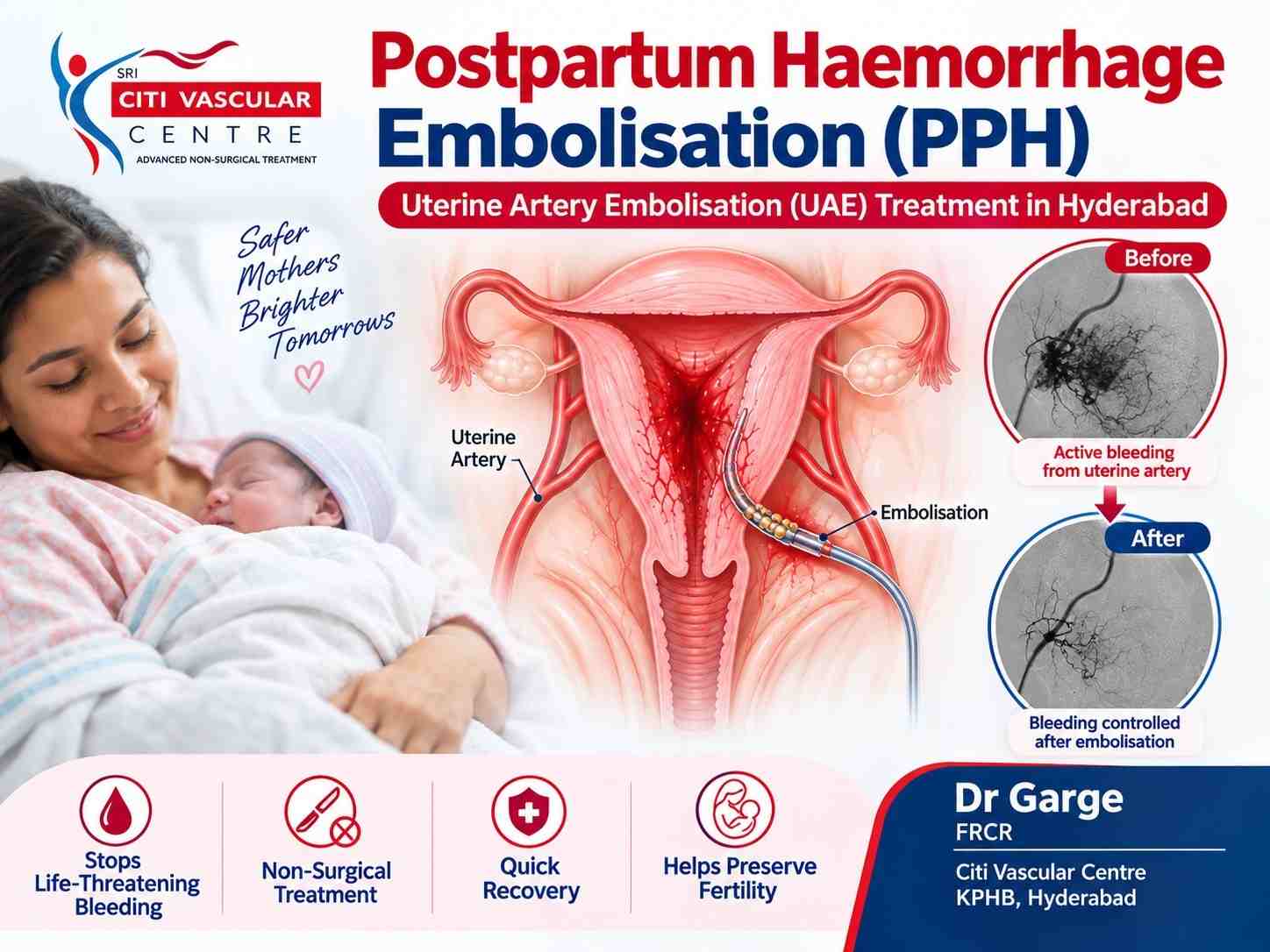
Postpartum haemorrhage (PPH) embolisation — uterine artery embolisation (UAE) — is a minimally invasive, catheter-based interventional radiology procedure that stops life-threatening bleeding after delivery by blocking the uterine arteries supplying the bleeding source. It is performed under fluoroscopic guidance without open surgery, preserves the uterus in most cases, and offers the realistic possibility of future pregnancy. It is the most important uterus-sparing intervention between failed medical management and emergency hysterectomy. Dr. Garge FRCR (UK) | Citi Vascular Centre, KPHB, Hyderabad | +91-73375 83901.
Every year in India, tens of thousands of women survive childbirth but face a terrifying complication in the hours that follow: uncontrolled bleeding that is not responding to the medications given to stop it. Postpartum haemorrhage — severe bleeding after delivery — is one of the leading causes of maternal death globally and one of the most devastating complications a family can face at what should be a moment of joy.
For many years, when medical treatments failed, the path was stark: emergency hysterectomy — removal of the uterus — to save the mother's life. This stopped the bleeding and saved lives, but it also permanently ended the woman's ability to have more children. For a young woman who had just experienced her first delivery, or for any woman who wanted more children, this was a devastating secondary loss on top of a traumatic delivery experience.Uterine artery embolisation (UAE) for PPH offers a different path between failed medical treatment and emergency hysterectomy — a minimally invasive catheter-based approach that blocks the blood supply to the bleeding source in the uterus, stops the haemorrhage in most cases, preserves the uterus, and allows the possibility of future pregnancy. This page explains how PPH embolisation works, who it can help, what the procedure involves, and what families should know about recovery and future fertility.
PPH Embolisation — Citi Vascular Centre, KPHB, Hyderabad
Emergency & Planned Referrals | Call +91-73375 83901 | WhatsApp 73375 83901 | citivascularcentre.com
Book your Appointment here: | Appoinment: |Call +91-7032508468| Whatsapp:+91-7337583901
|
Feature |
Detail |
|
Procedure Type |
Minimally invasive catheter-based uterine artery embolisation — no open surgery, no hysterectomy |
|
WHO Definition of PPH |
Blood loss ≥ 500mL after vaginal delivery | ≥ 1000mL after caesarean section | Any blood loss causing haemodynamic compromise |
|
When UAE Is Used |
Severe/refractory PPH not controlled by uterotonics (oxytocin, ergometrine, misoprostol) | Failure of surgical haemostatic techniques (B-Lynch suture, balloon tamponade) |
|
Success Rate |
85–97% haemostasis in published series — one of the most effective uterus-preserving interventions available for PPH |
|
Uterus Preserved |
In the majority of successful cases — the primary advantage over emergency hysterectomy |
|
Future Pregnancy |
Subsequent pregnancies reported after UAE for PPH — fertility preservation is realistic in most cases |
|
Guidance Used |
Fluoroscopy + digital subtraction angiography (DSA) — real-time imaging throughout |
|
Hospital Stay |
2–5 days typically after UAE for PPH — depending on overall clinical status and haemoglobin recovery |
Postpartum haemorrhage is defined by the World Health Organization as blood loss of 500mL or more within 24 hours of delivery (primary PPH), or blood loss of 1000mL or more after caesarean section. Secondary PPH refers to abnormal bleeding occurring between 24 hours and 12 weeks after delivery. While the numbers provide a clinical threshold, the clinical reality is more nuanced — a woman who is anaemic from the start of labour may be haemodynamically compromised with less blood loss than the definition implies, while a healthy woman with good reserves may compensate for considerably larger volumes before showing signs of shock.
The severity of PPH is best understood not just by volume but by the clinical picture: falling blood pressure, rising heart rate, reduced consciousness, cold peripheries, and reduced urine output — the signs of haemorrhagic shock as blood pressure falls and organs begin to be under-perfused. PPH is a leading cause of maternal mortality in India and globally. The key principle in management is speed — every minute of delay in haemostasis allows further blood loss, worsening coagulopathy, and harder-to-reverse physiological compromise.
|
T |
Name |
Clinical Description |
|
T1 |
TONE |
Uterine atony — the most common cause (accounts for 70–80% of PPH). The uterus fails to contract adequately after delivery, allowing the large placental bed vessels to continue bleeding. Normally, uterine contraction acts as a physiological ligature — when this fails, haemorrhage occurs. |
|
T2 |
TRAUMA |
Lacerations of the cervix, vagina, perineum, or uterus during delivery. Uterine rupture — rare but catastrophic. Episiotomy extensions. Surgical haematoma. |
|
T3 |
TISSUE |
Retained products of conception — retained placenta, membranes, or placental fragments that prevent the uterus from contracting. Placenta accreta spectrum (placenta accreta, increta, percreta) — abnormal placental invasion that prevents normal placental separation. |
|
T4 |
THROMBIN |
Coagulopathy — disseminated intravascular coagulation (DIC) or pre-existing clotting disorders. The coagulation system is overwhelmed by large blood loss, leading to a vicious cycle where ongoing haemorrhage worsens coagulopathy, which worsens haemorrhage. |
Uterine atony (T1) is by far the most common cause of PPH and is the primary target of UAE for PPH — because uterine artery embolisation reduces the blood supply to the uterus, giving the atonic myometrium time to contract and the coagulation system an opportunity to form stable clot in the absence of overwhelming flow. For placenta accreta spectrum (T3), UAE plays a particularly important role — these cases often require multidisciplinary planning with embolisation performed electively or as part of a structured caesarean hysterectomy pathway.
UAE for PPH occupies a specific and important position in the management algorithm — between the failure of medical and non-surgical treatments, and the decision to proceed to emergency hysterectomy. Understanding where UAE fits — and where it does not fit — helps families understand why not every PPH patient will have embolisation.
UAE Is Considered When:
Uterotonics (oxytocin, ergometrine, misoprostol, carboprost) have failed to control bleeding | Uterine balloon tamponade has failed | Surgical haemostatic sutures (B-Lynch) are not controlling bleeding | The patient is haemodynamically stable enough for the procedure | Uterus preservation is a priority | Interventional radiology is available immediately | Placenta accreta spectrum — planned/elective embolisation as part of a structured protocol
Proceed to Emergency Hysterectomy When:
UAE fails or is not immediately available | Patient is haemodynamically too unstable for the time required for angiographic assessment | Uterine rupture or large structural injury causing bleeding that cannot be controlled by arterial embolisation | Septic uterus requiring removal | Patient is in cardiac arrest or imminent cardiac arrest from haemorrhage
Haemodynamic stability is the critical gating criterion: UAE for PPH requires the patient to lie still on the angiography table for 30–60 minutes. A patient in severe haemorrhagic shock requiring aggressive resuscitation and at risk of cardiac arrest cannot safely wait for angiographic assessment. The clinical team's assessment of whether the patient is stable enough for UAE is one of the most important clinical decisions in PPH management. In India, where blood banking logistics and intensive care access may vary, this assessment is particularly critical.
Uterine artery embolisation for PPH is mechanistically similar to UAE for uterine fibroids — but the clinical context, urgency, and specific technical goals are very different. In both procedures, a catheter is advanced from the femoral artery to the uterine arteries, and embolic material is injected to block blood flow. But the goals differ critically:
UAE for PPH: The goal is temporary reduction of uterine artery flow to allow haemostasis and uterine contraction — using resorbable embolic material (gelatine sponge/Gelfoam) in most cases, allowing the arteries to reopen over weeks and uterine function and fertility to be preserved.
This distinction is clinically important for patients concerned about fertility. The use of temporary embolic agents (Gelfoam) in PPH UAE — as opposed to the permanent particles used for fibroid UAE — is specifically chosen to allow recanalization of the uterine arteries over 2–4 weeks. This preserves future uterine blood supply and menstrual function. Some cases require permanent embolic agents depending on the anatomy and bleeding pattern — this is decided during the procedure by the treating interventional radiologist.
The bilateral nature of the embolisation is also important: both uterine arteries are embolised in PPH UAE, because the uterus has bilateral blood supply and unilateral embolisation alone is usually insufficient for haemostasis. Ovarian artery contributions may need to be assessed if bleeding continues after bilateral uterine artery embolisation — the ovarian arteries provide collateral supply to the uterus that may sustain bleeding even after successful uterine artery occlusion.
1. Emergency Assessment and Stabilisation: While the obstetric team continues resuscitation — blood transfusion, uterotonics, balloon tamponade — the interventional radiology team is mobilised. Blood tests are reviewed: haemoglobin, platelets, coagulation (PT, APTT, fibrinogen), renal function. IV access (ideally two large-bore lines) is established. Blood products are prepared and available throughout. The decision that the patient is stable enough for UAE is made jointly between the obstetric and IR teams.
2. Patient Transfer and Positioning: The patient is transferred to the fluoroscopy suite. She is positioned on the angiography table in a sterile environment. Continuous monitoring of vital signs, oxygen saturation, and urine output throughout the procedure. Two clinicians are typically present — one managing the IR procedure and one monitoring the patient's haemodynamic status throughout.
3. Femoral Arterial Access:Under local anaesthetic at the right groin, a small puncture accesses the right common femoral artery. A vascular sheath is inserted. This is the standard IR access route. Both uterine arteries will be embolised through the same initial access site using a contralateral approach. Speed of access is important in the emergency setting — experienced operators complete femoral access in minutes.
4.Aortography and Uterine Artery Identification:A flush catheter is briefly positioned in the pelvic aorta. A rapid pelvic angiogram identifies the uterine artery origins — typically from the anterior division of the internal iliac (hypogastric) artery bilaterally. Active contrast extravasation (visible bleeding on fluoroscopy) may be seen — confirming the bleeding source. The uterine artery anatomy is assessed for size and tortuosity, which guides catheter selection.
5. Selective Catheterisation of Both Uterine Arteries: A shaped catheter is advanced into the right internal iliac artery and selectively into the right uterine artery. Position is confirmed by contrast injection — the characteristic 'cork-screw' pattern of the uterine artery on angiography is identified. The catheter tip is positioned in the main uterine artery — not so distal as to risk embolising the cervicovaginal branches. For the left side, a contralateral catheter configuration allows access from the same right-femoral sheath.
6. Embolisation — Both Uterine Arteries: Gelfoam pledgets (resorbable gelatine sponge) are mixed to a slurry and injected slowly through the catheter. The endpoint is near-stasis in the uterine artery — significantly reduced flow confirmed on repeat contrast injection. Complete occlusion is avoided to preserve collateral viability. The same process is repeated on the left uterine artery. Post-embolisation angiography confirms satisfactory bilateral occlusion. If bleeding continues after bilateral UAE, ovarian artery contributions are assessed and embolised if required.
7. Femoral Closure and Post-Procedure Monitoring: The catheter and sheath are removed and groin haemostasis achieved by manual pressure or vascular closure device. The patient is transferred back to the delivery unit or ICU for close observation. Vital signs, haemoglobin, coagulation, and urine output are monitored closely. Haemoglobin and coagulation are rechecked at 2–6 hours. Most patients experience a significant reduction in bleeding within 30–90 minutes of successful bilateral embolisation
Book your Appointment here: | Appoinment: |Call +91-7032508468| Whatsapp:+91-7337583901
|
Timeframe |
What to Expect |
|
Hours 0–12 |
Close haemodynamic monitoring — vital signs, urine output, haemoglobin, coagulation. Vaginal bleeding reduces significantly in most cases. IV fluid and blood product replacement continues as guided by lab results. ICU or high-dependency monitoring is standard for the first 12–24 hours. |
|
Day 1–3 |
Blood transfusion completed. Haemoglobin stabilises. Uterotonic medications continued (oxytocin infusion). Fever low-grade is possible — post-embolisation inflammatory response. Pain at groin access site and mild pelvic cramping — managed with analgesics. |
|
Day 3–5 |
Haemodynamic stability confirmed. Ambulation when clinically safe. Groin access site healing well. Breastfeeding typically not significantly affected by the procedure. Discharge planning begins when haemoglobin is adequate and bleeding has settled. |
|
Week 2–4 |
First menstrual cycle typically resumes within 4–8 weeks — confirming uterine function has been preserved after temporary Gelfoam embolisation. Recanalization of uterine arteries occurs progressively over 2–4 weeks as Gelfoam is absorbed. |
|
Month 1–3 |
Follow-up with obstetrician and IR for clinical assessment. Pelvic ultrasound to assess uterine size and vascularity. Most patients are functionally recovered within 6–8 weeks. Endometrial integrity and return of menstrual function are important markers of uterine preservation. |
One of the most important questions for any young woman who has undergone UAE for PPH is: 'Will I be able to have more children?' The honest evidence-based answer is: for most women, future pregnancy is possible after UAE for PPH — particularly when resorbable embolisation agents are used.
|
Fertility Outcome |
Evidence and Clinical Notes |
|
Menstrual return |
Most women (approximately 80–90%) resume normal menstruation within 4–8 weeks of UAE for PPH when resorbable embolic agents are used. Menstrual return indicates intact endometrial blood supply and functional myometrium. |
|
Subsequent pregnancy |
Published case series document successful pregnancies after UAE for PPH. Reported rates of subsequent conception and live birth in women who attempt conception are generally favourable — though data is limited compared with fertility UAE for fibroids literature. |
|
Risk in subsequent pregnancy |
Women who have had UAE for PPH — particularly for placenta accreta spectrum — have an elevated risk of recurrent PPH, abnormal placentation (accreta/increta/percreta), and should be managed in a specialist obstetric unit with IR backup available. |
|
Ischaemic endometrial damage (Asherman's syndrome) |
Rare but possible — if embolisation causes significant ischaemia of the endometrial lining. Presents as reduced or absent menstruation. Hysteroscopy to assess the endometrial cavity should be performed if menstruation does not return within 3 months. |
|
Breastfeeding |
UAE for PPH does not directly affect breastfeeding — the prolactin-pituitary axis is not affected by the procedure. However, the physiological stress of massive haemorrhage and subsequent recovery may affect milk production temporarily. |
Honest expectation: UAE for PPH with resorbable embolic agents provides the best chance of uterine preservation and future fertility among all interventions available when medical management fails. It is not a guarantee of future pregnancy — the severity of the original haemorrhage, the extent of ischaemia, and co-existing conditions all affect outcomes. A detailed discussion of fertility expectations specific to your case is an essential part of the post-procedure consultation. Call +91-73375 83901.
|
Feature |
UAE for PPH |
Emergency Obstetric Hysterectomy |
|
Approach |
Minimally invasive — catheter via groin |
Major open abdominal surgery |
|
Uterus Preserved |
Yes — in majority of successful cases |
No — permanent loss of uterus and fertility |
|
Future Pregnancy |
Possible — in most cases when resorbable agents used |
Not possible |
|
Blood Loss During Procedure |
Minimal — no additional surgical blood loss |
Significant additional blood loss from the hysterectomy itself |
|
Success Rate |
85–97% haemostasis in published series |
Definitive haemostasis — if technically successful |
|
Recovery |
2–5 days in hospital | Faster functional recovery |
5–10 days in hospital | Longer surgical recovery |
|
Role |
First-line when medical management fails and patient is stable enough for the procedure |
When UAE fails or patient too unstable | Uterine structural injury | UAE not available |
The decision between UAE and hysterectomy in the acute PPH setting is made by the clinical team based on haemodynamic stability, available resources, and the specific cause of haemorrhage. In many cases, particularly in smaller hospitals without IR capability, hysterectomy remains the only life-saving option available. The aspiration is to develop hospital networks and referral pathways that allow a period of haemodynamic stabilisation and urgent transfer to an IR-capable centre before irreversible surgical intervention — when this is clinically feasible.
|
Complication |
Frequency |
Clinical Notes |
|
Pelvic pain and cramping post-UAE |
Common — expected |
Post-embolisation ischaemic pain — managed with analgesics. Usually settles within 24–48 hours. Low-grade fever for 2–3 days is also expected. |
|
Groin haematoma at femoral access |
Uncommon |
Standard vascular access complication — managed with compression. Rarely requires intervention. |
|
Failed haemostasis — UAE does not stop bleeding |
3–15% of cases |
Proceed to emergency hysterectomy when UAE fails — having UAE does not prevent hysterectomy, it precedes it in the management cascade when haemostasis is not achieved. |
|
Uterine ischaemia — endometrial damage |
Uncommon — depends on embolic agent and technique |
More common when permanent embolic agents are used. Presents as secondary amenorrhoea. Assessed by MRI and hysteroscopy. Intrauterine adhesions (Asherman's syndrome) may require treatment. |
|
Ovarian failure |
Rare — more reported with fibroid UAE than PPH UAE |
If ovarian artery embolisation is required and is extensive, premature ovarian insufficiency is possible. More common in women over 45. Rare in the PPH setting where patients are typically younger. |
|
Non-target embolisation |
Rare with experienced operators |
Inadvertent embolisation of bladder, rectal, or vaginal vessels — avoided by selective catheterisation and careful injection technique. |
|
Post-partum sepsis at embolisation site |
Rare — < 1% |
Infection in the embolised uterine territory — more relevant in the context of retained products. Requires antibiotic treatment and gynaecological assessment. |
Uterine artery embolisation for postpartum haemorrhage is one of the most time-critical and technically demanding procedures in all of interventional radiology — because it is performed on a haemodynamically compromised patient in an emergency context, requiring the technical precision of selective bilateral uterine artery catheterisation with the clinical awareness to monitor and respond to rapidly changing patient status throughout.
|
Credential / Capability |
Relevance to PPH Embolisation |
|
FRCR (UK) |
The FRCR examination covers pelvic vascular anatomy and obstetric radiology — specific knowledge of internal iliac artery anatomy, uterine artery variants, and collateral supply pathways that is directly relevant to UAE for PPH. |
|
FNVIR (CMC Vellore) |
CMC Vellore is a high-volume obstetric centre with significant experience in UAE for PPH and placenta accreta spectrum management. IR fellowship training at CMC Vellore includes obstetric IR and uterine artery embolisation. |
|
EBIR (Spain/Europe) |
CIRSE publishes European standards and guidelines for uterine artery embolisation — both for fibroids and for obstetric haemorrhage. EBIR certification confirms alignment with these standards. |
|
Full DSA/fluoroscopy suite availability |
UAE for PPH requires immediate DSA capability — road-mapping for catheter guidance, selective angiography for uterine artery identification, post-embolisation confirmation. Citi Vascular Centre maintains this capability at all times. |
|
Emergency referral acceptance |
PPH does not follow office hours. The team at Citi Vascular Centre accepts emergency obstetric IR referrals and is equipped to mobilise for urgent UAE procedures. |
|
Resorbable embolic material — Gelfoam protocol |
The deliberate choice of Gelfoam over permanent embolic agents in PPH UAE — to preserve uterine artery patency after haemostasis and optimise fertility outcomes — reflects awareness of the clinical difference between PPH UAE and fibroid UAE. |
|
Credential |
Detail |
|
Name |
Dr. Shaileshkumar Garge | MBBS | MD (Mumbai) | DNB (Delhi) | FRCR (UK) | FNVIR (CMC Vellore) | EBIR (Spain) | Fellowship (North Carolina, USA) |
|
Role |
Director and Chief Vascular Physician | Senior Consultant Vascular and Interventional Radiologist |
|
Centre |
Citi Vascular Centre, KPHB Colony, Road No. 1, Hyderabad, Telangana 500072 |
|
Contact |
+91-73375 83901 | WhatsApp 73375 83901 | citivascularcentre.com | Emergency referrals accepted |
Q1: What is uterine artery embolisation for postpartum haemorrhage?
A: UAE for PPH is a minimally invasive catheter procedure that stops severe postpartum bleeding by blocking the uterine arteries feeding the bleeding source. A thin catheter is placed through the femoral artery (groin) and guided to both uterine arteries under fluoroscopic imaging. Embolic material (usually resorbable Gelfoam) is injected to arrest haemorrhage. No open surgery. The uterus is preserved in most cases. Published success rates are 85–97% for haemostasis.
Q2: Can UAE for PPH avoid hysterectomy?
A: Yes — in most cases. UAE for PPH achieves haemostasis in 85–97% of patients in published series, allowing hysterectomy to be avoided in the majority of women who are stable enough to undergo the procedure. When UAE fails, emergency hysterectomy remains the definitive option. UAE occupies the critical gap between failed medical management and irreversible surgery — giving the woman the best chance of keeping her uterus and future fertility intact.
Q3: Can I get pregnant after UAE for PPH?
A: Yes — subsequent pregnancies are reported after UAE for PPH, particularly when resorbable embolic agents (Gelfoam) are used. Gelfoam is absorbed within 2–4 weeks, allowing uterine artery recanalization and restoration of normal uterine blood supply. Published case series document successful pregnancies after PPH UAE. The severity of the original haemorrhage, the embolic agent used, and the degree of uterine ischaemia all affect fertility prognosis. Future pregnancies after PPH UAE should be planned with specialist obstetric care.
Q4: What is the difference between UAE for fibroids and UAE for PPH?
A: The anatomical approach is similar — both embolise the uterine arteries via femoral access — but the clinical goals and embolic agents differ critically. UAE for fibroids uses permanent particles to permanently reduce fibroid blood supply. UAE for PPH uses resorbable Gelfoam to temporarily stop bleeding while allowing the uterine arteries to reopen after haemostasis, preserving fertility. PPH UAE is also performed bilaterally as a priority, in an emergency context, often on a haemodynamically compromised patient.
Q5: What causes postpartum haemorrhage?
A: PPH is caused by the 4 T's: Tone (uterine atony — most common, 70–80% of cases), Trauma (lacerations, uterine rupture), Tissue (retained placenta or placenta accreta spectrum), and Thrombin (coagulopathy/DIC). Uterine atony is the primary target of UAE for PPH — embolisation reduces uterine artery blood flow, allowing the atonic uterus to contract and haemostasis to establish. Placenta accreta spectrum cases often require planned embolisation as part of a structured multidisciplinary delivery protocol.
Q6: When is UAE for PPH performed — immediately after delivery?
A: UAE for PPH is performed when medical treatment (oxytocin, ergometrine, misoprostol, carboprost) and first-line non-surgical measures (uterine balloon tamponade, B-Lynch suture) have failed to control bleeding. The patient must be haemodynamically stable enough to be transferred to the fluoroscopy suite and lie still for 30–60 minutes. In some high-risk cases (known placenta accreta), UAE may be planned electively before or at the time of caesarean delivery.
Q7: How long does UAE for PPH take?
A: UAE for PPH typically takes 30–90 minutes from femoral access to final angiographic check. The time varies based on the complexity of the uterine artery anatomy, how quickly bilateral catheterisation is achieved, and whether ovarian artery embolisation is also required. Emergency mobilisation of the IR team adds some additional time. Total time in the angiography suite including patient transfer and post-procedure assessment is typically 60–120 minutes.
Q8: What happens if UAE for PPH does not work?
A: If bilateral uterine artery embolisation does not achieve haemostasis, the next step is emergency hysterectomy — surgical removal of the uterus. UAE does not prevent or complicate subsequent hysterectomy. In some cases, ovarian artery embolisation may be attempted before proceeding to surgery if ovarian artery collateral supply is identified as a contributing source. The surgical team and IR team work in close coordination throughout, with emergency hysterectomy always immediately available.
Q9: Is there a risk of losing the uterus even after UAE?
A: Yes — in the 3–15% of cases where UAE does not achieve haemostasis, emergency hysterectomy becomes necessary. Even in successful UAE cases, severe uterine ischaemia from the embolisation itself can rarely cause uterine necrosis — though this is uncommon with appropriate embolic agent selection and technique. The overall probability of uterine preservation with UAE for PPH in stable, appropriately selected patients is substantially higher than with any other intervention at that point in the management algorithm.
Q10: What are the risks of UAE for PPH?
A: The main risks are: failure to control haemorrhage (3–15%) — requiring emergency hysterectomy; pelvic pain and low-grade fever after embolisation — expected and self-limiting; uterine ischaemia — endometrial damage causing secondary amenorrhoea (uncommon with Gelfoam); groin haematoma at the femoral access site; and very rarely, ovarian failure (if extensive ovarian artery embolisation was required). These risks are substantially lower than the risks of emergency hysterectomy in a haemodynamically compromised patient.
Q11: Can UAE for PPH be planned before delivery?
A: Yes — for women with known placenta accreta spectrum (placenta accreta, increta, or percreta), a planned elective approach is available at specialist centres. This involves: MRI to map the extent of placental invasion; multidisciplinary team planning between obstetrics, IR, urology, and blood bank; caesarean delivery with the IR team ready; and prophylactic uterine artery balloon occlusion or immediate post-delivery embolisation. Elective planning produces better outcomes than emergency UAEs in unplanned PPH situations.
Q12: Who performs UAE for PPH in Hyderabad?
A: At Citi Vascular Centre, KPHB Colony, Road No. 1, Hyderabad, UAE for PPH is performed by Dr. Shaileshkumar Garge — FRCR (UK), FNVIR (CMC Vellore), EBIR (Spain) — Director and Chief Vascular Physician. With specific training at CMC Vellore — one of India's highest-volume obstetric IR centres — and 12+ years dedicated IR practice, Dr. Garge provides emergency and planned UAE for PPH with resorbable Gelfoam embolisation, fertility-preserving technique, and multidisciplinary coordination. Call +91-73375 83901. Emergency referrals accepted.
|
Reference |
Key Finding |
|
Maslovitz S et al. Recurrent uterine artery embolization for primary PPH. J Vasc Interv Radiol. 2004. |
Early series documenting feasibility and haemostatic success of bilateral UAE in primary PPH. Supports UAE as a first-line uterus-preserving option for failed medical management. |
|
Sentilhes L et al. Fertility and pregnancy outcomes following UAE for PPH. Hum Reprod. 2010. |
Documents successful subsequent pregnancies after UAE for PPH with resorbable agents. Confirms fertility preservation is a realistic expectation in most patients who achieve successful haemostasis. |
|
RCOG Green-top Guideline No. 52 — Postpartum Haemorrhage, Prevention and Management. 2016. |
Establishes UAE as an effective uterus-preserving option for PPH refractory to medical management. Recommends consideration before emergency hysterectomy in stable patients at centres with IR capability. |
|
WHO Recommendations for Prevention and Treatment of Postpartum Haemorrhage. WHO. 2012. |
Global framework for PPH management — confirms interventional radiology (UAE) as an evidence-supported option for refractory PPH when medical and surgical haemostatic measures have failed. |
|
ACOG Practice Bulletin No. 183 — Postpartum Haemorrhage. 2017. |
Recommends UAE as a uterus-preserving option in haemodynamically stable patients with PPH refractory to uterotonic and non-surgical haemostatic measures. |
Citi Vascular Centre, KPHB Colony, Road No. 1, Hyderabad — PPH embolisation for obstetric referrals from Hyderabad and beyond:
Kukatpally and KPHB — 5 min | Miyapur and Bachupally — 10 min
Hitech City, Ameerpet and Madhapur — 20 min | Gachibowli and Banjara Hills — 25 min
Secunderabad and Begumpet — 25 min | Warangal, Nizamabad, AP — emergency transfer referrals welcome
Postpartum haemorrhage embolisation — uterine artery embolisation for PPH — is one of the most life-changing procedures in modern interventional radiology. It gives a woman who is haemorrhaging after delivery a realistic chance of avoiding hysterectomy, preserving her uterus, and maintaining the possibility of future pregnancy — outcomes that emergency surgery simply cannot offer. Published evidence across multiple series confirms 85–97% haemostasis with UAE, and multiple studies document successful pregnancies after PPH UAE in women who received resorbable embolic agents and achieved uterine preservation.
The procedure is not appropriate for every PPH patient — haemodynamic stability is the critical gating criterion, and emergency hysterectomy remains the correct life-saving response when UAE is not available or when the patient is too unstable for the angiographic approach. But for the right patient, at the right centre, with the right specialist, PPH UAE represents the most powerful tool available between failed medical management and irreversible surgical intervention. At Citi Vascular Centre, KPHB Colony, Hyderabad, Dr. Shaileshkumar Garge provides expert UAE for PPH — emergency and planned — with fertility-preserving Gelfoam protocol, full DSA capability, and multidisciplinary coordination with the obstetric team. For emergency referrals: call +91-73375 83901 immediately. For planned high-risk obstetric cases (placenta accreta): WhatsApp 73375 83901 to discuss the structured elective protocol.
Postpartum Haemorrhage Embolisation — Citi Vascular Centre, KPHB, Hyderabad
UAE for PPH | Uterus-Preserving | 85–97% Haemostasis | Future Fertility | Gelfoam Protocol
Dr. Shaileshkumar Garge | FRCR (UK) | FNVIR (CMC Vellore) | EBIR (Spain) | 12+ Years | 15,000+ Procedures
Emergency Referrals: +91-73375 83901 | WhatsApp 73375 83901 | citivascularcentre.com
KPHB Colony, Hyderabad | Planned & Emergency Cases | Placenta Accreta Spectrum Protocol Available
Book your Appointment here: | Appoinment: |Call +91-7032508468| Whatsapp:+91-7337583901