LAST MEDICALLY REVIEWED:
July 2026 — Dr. Shaileshkumar Garge
Citi Vascular Hospital, KPHB Colony, Road No. 1, Hyderabad, Telangana 500072
TABLE OF CONTENTS
|
QUICK ANSWER Thyroid Nodule Ablation vs Surgery — Which Is Better? Neither is universally better — they serve different clinical situations. For benign symptomatic nodules where thyroid preservation is a priority, microwave ablation offers no scar, local anaesthesia, same-day discharge, and faster recovery. Surgery is the right choice when malignancy is suspected, nodules are very large, or when complete removal is clinically indicated. The decision depends on your specific nodule, symptoms, and priorities. |
When a doctor recommends treatment for a benign thyroid nodule, many patients face a choice they were not expecting: conventional surgery to remove the affected part of the thyroid, or a newer minimally invasive technique called microwave thermal ablation that treats the nodule without removing the gland. Both are effective. Both are available in Hyderabad. But they differ substantially in how they work, what the recovery looks like, what happens to the thyroid gland afterwards, and which patients are the right candidates for each.
This guide is designed to give you a clear, balanced, and honest comparison of both options — written for patients who want to understand the real differences before making a decision. It does not advocate for one approach over the other. The right treatment depends on your specific nodule, what the FNAC result shows, your symptoms, your age and general health, and your personal priorities around scarring, recovery time, and thyroid function. Dr. Garge at Citi Vascular Centre, KPHB, discusses both options at every consultation and makes a recommendation based on your individual clinical picture.
Discuss Ablation vs Surgery at Citi Vascular Centre, KPHB, Hyderabad
Call +91-73375 83901 | WhatsApp 73375 83901 | citivascularcentre.com | Mon–Sat 9AM–6PM
|
Feature |
Microwave Thyroid Ablation |
Thyroid Surgery (Lobectomy / Thyroidectomy) |
|
Thyroid Removed? |
No — thyroid gland fully preserved |
Yes — partial (lobectomy) or complete (thyroidectomy) |
|
Neck Scar |
None — 2mm puncture mark only |
Visible neck incision — varies in prominence by surgeon and technique |
|
Anaesthesia |
Local anaesthesia — no general anaesthetic for most patients |
General anaesthesia — always required |
|
Hospital Stay |
Same-day discharge — day-care procedure |
2–4 days ward admission |
|
Recovery |
1–3 days to light activities | 7–10 days full normal life |
2–4 weeks before return to normal activities |
|
Thyroid Tablets Lifelong? |
Usually not required — thyroid function preserved |
Possibly — lobectomy: sometimes | total thyroidectomy: always |
|
Suitable for Confirmed Cancer |
No — ablation is not appropriate for thyroid malignancy |
Yes — surgery is the standard treatment for thyroid cancer |
|
Suitable for Very Large Nodules (> 6cm) |
Limited — staged ablation possible but less complete |
Yes — surgery preferred for very large or substernal nodules |
|
Recurrent Laryngeal Nerve Risk |
Low with experienced operator and continuous USG guidance |
Small but defined risk — 0.5–2% permanent voice change |
|
Can Be Repeated If Nodule Regrows |
Yes — repeat ablation safe and feasible in most cases |
Not typically needed — removed tissue does not regrow |
|
For Diagnosis (Bethesda IV–VI nodule) |
No — ablation cannot provide histological diagnosis |
Yes — surgical excision provides definitive histopathology |
|
If your priority is… |
Consider discussing… |
|
Preserve your thyroid gland |
Microwave ablation |
|
Avoid a neck scar |
Microwave ablation |
|
Return to work quickly |
Microwave ablation |
|
Confirmed or suspected thyroid cancer |
Surgery |
|
Very large or substernal nodule |
Surgery |
|
Need definitive tissue diagnosis |
Surgery |
This table is a starting framework — not a prescription. The right column for you depends on your specific nodule, FNAC result, symptom severity, comorbidities, and personal priorities. Bring your ultrasound disc and FNAC report to your consultation with Dr. Garge for a recommendation specific to your situation. Call +91-73375 83901.
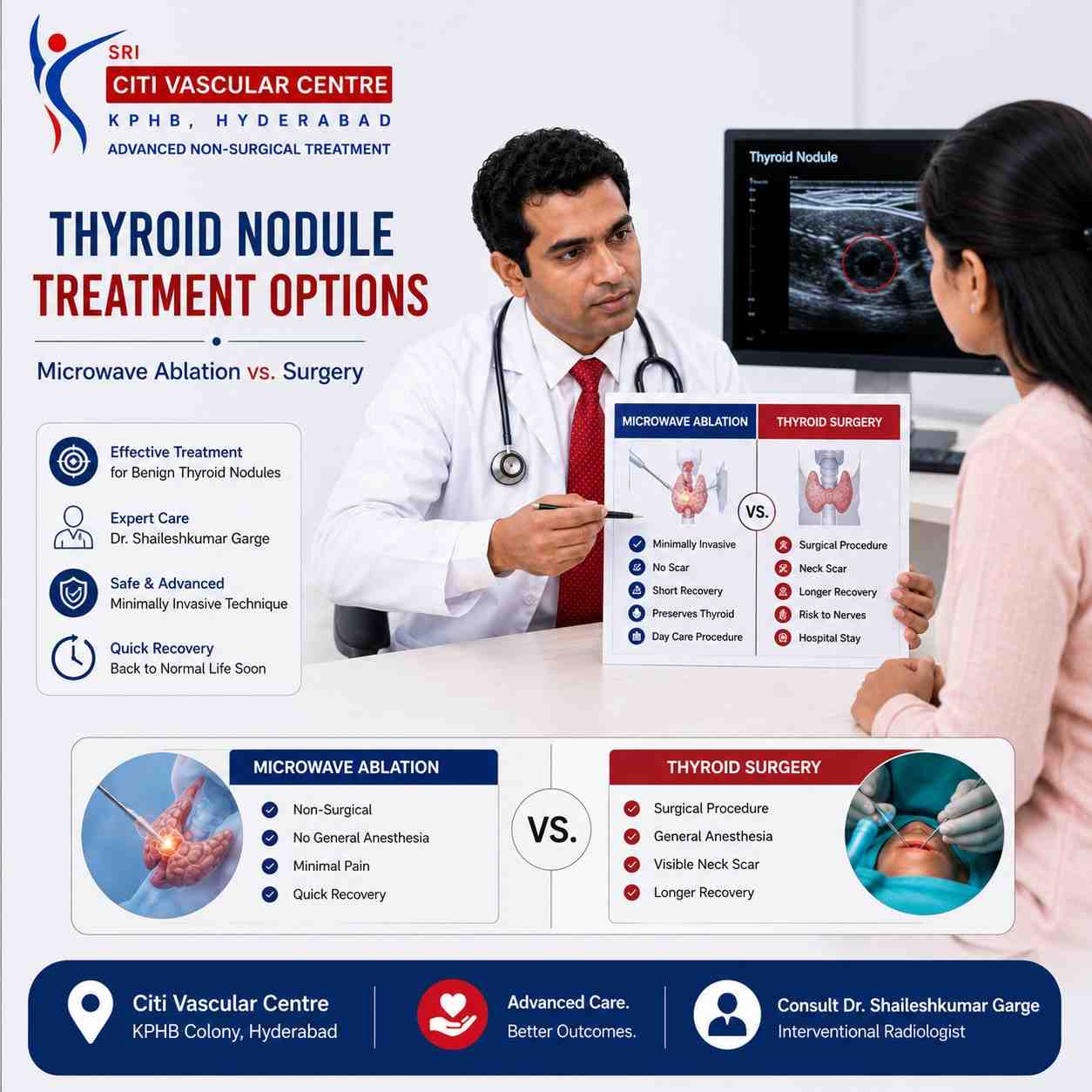
Thyroid surgery for nodule disease involves the surgical removal of either one lobe of the thyroid gland (hemithyroidectomy or lobectomy) or the entire gland (total thyroidectomy), depending on the clinical indication and the distribution of nodules. The operation is performed under general anaesthesia in an operating theatre by an endocrine surgeon. A horizontal incision is made in the lower neck — typically 4–8cm in length — and the relevant portion of the thyroid is dissected from its surrounding structures and removed. The specimen is then sent to histopathology for detailed examination.
Thyroid surgery is the established, definitive treatment for thyroid nodules where malignancy is confirmed or strongly suspected, where the nodule is too large for ablation to be complete, where the cytology result is indeterminate and histological diagnosis is needed, or where the patient has another condition of the thyroid (Graves' disease, toxic multinodular goitre) that requires removal of the glandular tissue itself. It carries the risks associated with general anaesthesia, a visible neck scar, and the possibility of hypothyroidism requiring lifelong hormone replacement — particularly after total thyroidectomy.
For the thyroid ablation procedure in detail: See our dedicated Thyroid Nodule Ablation Procedure page. For cost and insurance of both options: See our Thyroid Ablation Cost in Hyderabad page.
Microwave thyroid nodule ablation is a minimally invasive image-guided procedure in which a thin microwave antenna is introduced through a 2mm skin puncture into the thyroid nodule under continuous real-time ultrasound guidance. Controlled microwave energy heats the nodule tissue from within, causing it to undergo coagulative necrosis — the tissue is destroyed in place, and the body gradually reabsorbs it over the following months. The surrounding healthy thyroid tissue is not treated and continues to produce hormones normally.
Ablation is performed under local anaesthesia and takes 20–45 minutes. Most patients go home the same day. There is no surgical incision, no general anaesthetic, and no removal of thyroid tissue — which means the vast majority of patients maintain normal thyroid function after the procedure without needing hormone replacement. The nodule shrinks progressively over 3–12 months. Ablation is appropriate only for confirmed benign nodules — it does not provide a tissue specimen for histopathological diagnosis and is therefore not appropriate when malignancy has not been excluded.
A decade ago, the comparison between thyroid ablation and surgery did not need to be made — surgery was the only definitive treatment available. The rise of validated image-guided ablation techniques has changed this, and patients are increasingly asking their doctors — and their search engines — which approach is better for their situation. The questions that drive this comparison are consistently the same ones:
|
Patient Priority |
How Ablation and Surgery Differ on This Point |
|
Avoiding a visible neck scar |
Ablation leaves no scar — a 2mm puncture marks the entry point. Surgery leaves a horizontal neck incision of 4–8cm that is visible, though it fades over time. |
|
Preserving the thyroid gland |
Ablation treats only the nodule — the rest of the gland is left intact. Surgery removes the affected lobe (or the whole gland), which can lead to hypothyroidism. |
|
Avoiding general anaesthesia |
Ablation uses local anaesthesia only — no intubation, no anaesthetic risks. Surgery always requires general or regional anaesthesia. |
|
Returning to work and normal life quickly |
Most ablation patients return to desk work within 1–2 days and full activity within 7–10 days. Surgery recovery typically requires 2–4 weeks. |
|
Avoiding lifelong thyroid hormone tablets |
Ablation preserves glandular function — most patients need no medication after ablation. Total thyroidectomy always requires lifelong levothyroxine. Lobectomy may or may not. |
|
Getting a definitive tissue diagnosis |
Surgery provides a complete histopathological specimen — definitive diagnosis of any uncertain features. Ablation does not remove tissue and cannot provide histological diagnosis. |
|
Factor |
Microwave Ablation |
Thyroid Surgery |
|
Invasiveness |
Minimally invasive — needle puncture only |
Open surgical operation |
|
Incision |
2mm needle puncture — no scalpel |
4–8cm horizontal neck incision |
|
Scar |
Minimal or none — tiny puncture mark |
Visible neck scar — fades over 6–12 months but may remain |
|
Thyroid Preserved |
Yes — fully preserved, functions normally |
Partially (lobectomy) or completely removed (thyroidectomy) |
|
Anaesthesia |
Local anaesthesia — awake, sedated if requested |
General anaesthesia — intubated, unconscious throughout |
|
Hospital Stay |
Same day — home same evening |
2–4 nights ward admission |
|
Return to Work |
Desk work: Day 1–2 | Physical work: Day 7–10 |
Desk work: 2–3 weeks | Physical work: 4–6 weeks |
|
Pain Post-Procedure |
Mild neck soreness 1–3 days — paracetamol adequate |
Surgical wound pain 5–10 days — stronger analgesics for first week |
|
Recurrent Laryngeal Nerve Risk |
Low — 1–2% with experienced operator and continuous USG |
0.5–2% permanent nerve injury risk — varies with surgeon experience |
|
Bleeding Risk |
Low — minor haematoma at entry site in uncommon cases |
Higher — operative bleeding risk, occasional haematoma requiring return to theatre |
|
Hypothyroidism Risk |
Very low — gland preserved |
Lobectomy: 10–20% may develop hypothyroidism over time | Total thyroidectomy: 100% |
|
Nodule Size Limit |
Typically 2–5cm solid nodule. Larger nodules: staged ablation |
No size limit — surgery appropriate for all nodule sizes including very large and substernal |
|
Provides Histological Diagnosis |
No — tissue is destroyed in place, not removed |
Yes — complete specimen for pathology, including unexpected findings |
|
Repeat Treatment Possible |
Yes — safe repeat ablation if nodule regrows |
Not typically needed — removed tissue does not recur |
|
Recovery Aspect |
After Microwave Ablation |
After Thyroid Surgery |
|
Procedure Day |
Home same evening. Walk to toilet. Eat normally. Mild neck aching. |
Hospital ward. IV drip. Urinary catheter in many cases. Wound drains occasionally. |
|
Day 1–3 |
Mild neck soreness settling. Paracetamol adequate. Light activities normal. |
Surgical wound pain. Wound care. Drain removal. Suture or staple management. Limited neck movement. |
|
Eating and Swallowing |
Normal from immediately after the procedure |
Some difficulty swallowing in first days due to surgical swelling around oesophagus |
|
Driving |
Day 2 — once local anaesthetic effects fully cleared |
1–2 weeks — once comfortable with neck movement and no narcotic pain relief |
|
Desk / Office Work |
Day 1–2 for most patients |
2–3 weeks — when wound is comfortable and energy levels allow |
|
Physical / Manual Work |
Day 7–10 |
4–6 weeks — full wound healing and stamina recovery required |
|
Exercise / Gym |
Light exercise: Day 7 | Full gym: Day 14 |
Walking from Day 10–14 | Full exercise: 4–6 weeks |
|
Voice Recovery |
Any temporary hoarseness from local anaesthetic — 24–48 hours |
Temporary hoarseness common for 1–3 weeks post-surgery. Permanent in rare cases. |
|
Wound Care |
Small plaster for 24 hours — no wound dressing changes |
Wound dressing changes, scar massage after healing, potential scar therapy |
The difference in hospital stay between thyroid ablation and surgery is one of the most practically significant distinctions for patients — affecting not just the direct cost of ward accommodation, but the disruption to work, family responsibilities, and daily life.
|
Hospital Component |
Ablation vs Surgery |
|
Admission required |
Ablation: No — day-care procedure | Surgery: Yes — pre-admission on the morning of or day before operation |
|
Procedure room vs Operating Theatre |
Ablation: Dedicated intervention room — no surgical theatre | Surgery: Fully equipped operating theatre with surgical team |
|
Length of stay post-procedure |
Ablation: 1–2 hours observation | Surgery: 2–4 nights in hospital ward |
|
Monitoring |
Ablation: Vital signs checked during 1–2 hour observation, then discharged | Surgery: Nursing observations every few hours for 48–96 hours |
|
Catheters, drains, drips |
Ablation: IV cannula only (safety precaution) — removed before discharge | Surgery: IV fluid drip, possible wound drain, urinary catheter for general anaesthesia |
|
Discharge requirements |
Ablation: Walk, eat, drink, vital signs stable — typically 1–2 hours post-procedure | Surgery: Wound stable, eating and drinking, drain removed, pain controlled — 48–96 hours |
For many patients — particularly those in professional or social settings where a visible neck scar would be noticed and where cosmetic appearance is a priority — the question of scarring is not a superficial concern. It is a genuine quality-of-life consideration that is entirely valid when making a treatment decision.
|
Scar Aspect |
After Microwave Ablation |
After Thyroid Surgery |
|
Entry Point |
2mm needle puncture at the side of the neck — no incision, no closure needed |
4–8cm horizontal incision in the lower neck (Kocher incision) — closed with sutures or staples |
|
Appearance at Discharge |
Small plaster covering 2mm puncture — almost invisible within 24–48 hours |
Healing surgical wound 4–8cm length with stitches or staples visible in the first 1–2 weeks |
|
Appearance at 1 Month |
2mm puncture mark fading — typically imperceptible at this stage |
Pink healing scar — may be raised (hypertrophic) in some patients, particularly younger women |
|
Appearance at 6–12 Months |
No visible mark for most patients |
Most surgical scars fade significantly — pale, thin, and narrow in most patients with good wound healing |
|
Scar Therapy Required |
None |
Silicone gel, scar massage, and sun protection often recommended for 3–6 months post-surgery |
|
Keloid / Hypertrophic Risk |
Not applicable — no wound |
Small risk in prone individuals — particularly relevant for patients with known keloid tendency |
For patients who have previously had thyroid surgery and developed a visible scar, or who are particularly concerned about cosmetic outcome, microwave ablation offers the significant practical advantage of no neck incision — the procedure site is at the side of the neck and heals to an imperceptible mark in most cases. Discuss cosmetic concerns openly with Dr. Garge at consultation.
The question of lifelong thyroid hormone replacement is one of the most significant practical differences between ablation and surgery — and one that many patients are not fully aware of when they first consider treatment. Understanding the implications for each option helps patients make a genuinely informed decision.
|
Thyroid Function Aspect |
After Microwave Ablation |
After Thyroid Surgery |
|
Thyroid gland at end of procedure |
Fully intact — only nodule treated |
Affected lobe or whole gland removed |
|
TSH at 3 months |
Normal in most patients — gland continuing to produce hormones |
Variable — depends on how much functioning thyroid tissue remains |
|
Hypothyroidism risk |
Very low — < 5% in published series. Ablation does not damage normal parenchyma. |
Lobectomy: 10–20% develop hypothyroidism over time | Total thyroidectomy: 100% — lifelong hormone replacement mandatory |
|
Thyroid tablets required |
Usually not — most patients need no medication after ablation |
After total thyroidectomy: always. After lobectomy: up to 1 in 5 patients over time. |
|
Monitoring required |
TSH check at 3–6 months post-ablation — usually confirms preserved function |
Regular TSH monitoring lifelong if on replacement therapy | 6–12 monthly if not on tablets after lobectomy |
|
Parathyroid risk |
Not applicable — parathyroids not at risk during ablation |
Temporary or permanent hypoparathyroidism risk after total thyroidectomy — causes low blood calcium requiring calcium supplements |
|
Complication |
Ablation — Risk Profile |
Surgery — Risk Profile |
|
Post-procedure pain |
Mild — neck soreness 1–3 days. Paracetamol adequate. |
Moderate to significant — wound pain for 5–10 days. Stronger analgesics required. |
|
Haematoma / Bleeding |
Minor haematoma at entry site — uncommon. Self-resolving. |
Haematoma requiring return to theatre: 0.5–1% — may be life-threatening if compresses airway |
|
Voice Change (RLN injury) |
Transient: 5–10% | Permanent: < 1–2% with experienced operator |
Transient: 5–10% | Permanent: 0.5–2% depending on surgeon experience |
|
Hypothyroidism |
Very rare with focal nodule ablation |
Lobectomy 10–20% over time | Total thyroidectomy 100% — lifelong medication |
|
Hypoparathyroidism (calcium) |
Not applicable |
Temporary: 5–10% after total thyroidectomy | Permanent: 1–2% |
|
Wound infection |
Rare (< 1%) — sterile technique |
Surgical site infection: 1–2% — managed with antibiotics |
|
Anaesthetic complications |
Not applicable — local anaesthesia only |
General anaesthetic: nausea, sore throat, airway events — risk increases with patient age and comorbidity |
|
Overall major complication rate |
Low — < 2% significant complications in published series |
Overall complication rate: 5–10% depending on extent of surgery and centre volume |
Microwave thyroid ablation produces excellent outcomes in the right patient with the right nodule. The following profile describes the clinical situations where ablation is the most appropriate, evidence-supported, and patient-preferred treatment option.
|
✅ |
Confirmed benign nodule — FNAC Bethesda II — no suspicion of malignancy on ultrasound or biopsy |
|
✅ |
Nodule causing compressive symptoms — difficulty swallowing, neck pressure, or discomfort — that justify intervention |
|
✅ |
Visible neck swelling causing cosmetic concern — particularly for professionally active patients |
|
✅ |
Growing nodule on serial ultrasound (> 20% increase in two dimensions on follow-up scan) |
|
✅ |
Patient wishes to avoid surgery, general anaesthesia, or surgical scarring |
|
✅ |
Patient wishes to preserve thyroid function and avoid lifelong hormone replacement |
|
✅ |
Elderly patients or those with significant medical comorbidities (cardiac, respiratory, renal) where general anaesthesia carries elevated risk |
|
✅ |
Nodule size typically 2–5cm for single-session ablation. Nodules up to 6cm may be staged. |
|
✅ |
Predominantly cystic nodule — ethanol ablation (a related technique) is particularly effective for simple thyroid cysts with recurrent fluid |
Surgery is the appropriate and necessary choice in a clearly defined set of clinical situations — and in those situations, it is not just 'an alternative to ablation' but the clinically correct, evidence-based standard of care. Being offered surgery is not a failure of less invasive options — for some patients, it is simply what the clinical picture requires.
|
✅ |
Confirmed or strongly suspected thyroid cancer — surgery is the standard treatment for thyroid malignancy. Ablation is not appropriate. |
|
✅ |
FNAC result suspicious (Bethesda V) or malignant (Bethesda VI) — surgical excision with histopathology is the definitive management |
|
✅ |
Indeterminate cytology (Bethesda III–IV) requiring histological diagnosis — ablation cannot provide tissue architecture for definitive classification |
|
✅ |
Very large nodule (> 6cm) or substernal extension — surgery can safely remove very large or retrosternal goitres that are beyond the reliable reach of ablation |
|
✅ |
Thyroid disease requiring glandular treatment — Graves' disease, toxic multinodular goitre — where the disease is in the functioning gland, not just a focal nodule |
|
✅ |
Patient preference for definitive removal — some patients simply prefer to have the affected tissue removed and not require any follow-up imaging |
|
✅ |
Recurrence after ablation that is unsuitable for repeat ablation — surgery is available as a next step after ablation for selected patients |
|
✅ |
Anatomy unsuitable for safe ablation — unusual nodule location or relationship to critical structures that makes ablation technically unsafe in individual cases |
This flowchart is a guide to the clinical decision-making pathway — not a substitute for Dr. Garge's assessment of your individual case. It is intended to help you understand the logic behind treatment recommendations.
|
▼ |
Thyroid nodule found on ultrasound or clinical examination |
|
▼ |
High-resolution ultrasound with TIRADS classification — assesses nodule features |
|
▼ |
USG-guided FNAC when indicated — Bethesda I–VI cytological result |
|
? |
FNAC result — BENIGN (Bethesda II)? |
|
YES |
Confirmed benign nodule → Is the patient symptomatic, growing, or cosmetically concerned? |
|
YES |
Symptomatic benign nodule → Discuss ABLATION (if nodule 2–5cm, no contraindications) or SURGERY (if very large, patient preference) |
|
NO |
Asymptomatic, small, stable benign nodule → OBSERVATION — periodic ultrasound every 6–12 months |
|
NO |
FNAC indeterminate (Bethesda III–IV), suspicious (V), or malignant (VI) → SURGERY evaluation required — ablation is not appropriate |
|
▼ |
Patient-specific factors assessed: nodule size, number, anatomy, comorbidities, personal priorities (scar, recovery time, thyroid function preservation) |
|
▼ |
Individualised recommendation from Dr. Garge with full explanation of both options, expected outcomes, risks, and cost |
In my practice, the choice between microwave ablation and surgery is never based on a single factor. We consider ultrasound findings, FNAC results, nodule size, symptoms, thyroid function, and the patient's priorities before recommending treatment. The goal is to choose the safest and most appropriate option for each individual.
|
Myth |
Fact |
|
|
1 |
Every thyroid nodule needs surgery. |
Most thyroid nodules are benign and many never need treatment. Small, asymptomatic, confirmed-benign nodules are safely monitored with periodic ultrasound. |
|
2 |
Thyroid ablation is a new, experimental procedure. |
Microwave thyroid ablation has been extensively validated over a decade with large published trials. It is endorsed by international thyroid societies including KSThR, MITT, and ETA. |
|
3 |
If I have ablation and the nodule comes back, I will need surgery anyway. |
If a nodule regrows after ablation, repeat ablation is safe and effective in most cases. Surgery is an option but is not automatically required after ablation. |
|
4 |
Surgery completely cures the problem — no further concerns. |
Surgical removal of a thyroid lobe removes the treated nodule but not the underlying genetic tendency for nodule formation. New nodules may develop in the remaining thyroid tissue. |
|
5 |
Thyroid ablation can treat thyroid cancer. |
Thyroid ablation is only appropriate for confirmed benign nodules. It is not appropriate for thyroid cancer — surgery is the standard treatment for thyroid malignancy. |
|
6 |
After thyroid surgery, I will always need tablets for life. |
After lobectomy (half-thyroid removal), many patients maintain adequate thyroid function without medication. Lifelong tablets are required after total thyroidectomy, but not always after lobectomy. |
|
7 |
Thyroid ablation leaves a scar just like surgery. |
Thyroid ablation requires only a 2mm needle puncture which leaves no visible scar. Thyroid surgery requires a 4–8cm neck incision which heals but leaves a permanent mark in most cases. |
|
8 |
Ablation results are temporary — the nodule always grows back. |
Published studies show 60–80% volume reduction at 12 months and 70–80% of patients maintaining significant improvement at 5 years. Some regrowth occurs over years but can be retreated with repeat ablation. |
Q1: Is thyroid nodule ablation better than surgery?
Neither is universally better — they serve different clinical situations. For confirmed benign symptomatic nodules where thyroid preservation and avoiding a scar are priorities, microwave ablation is often the preferred option. For suspected or confirmed thyroid cancer, indeterminate biopsy results, very large nodules, or substernal extension, surgery remains the clinically correct choice. The best treatment depends on your specific FNAC result, nodule characteristics, symptoms, and personal priorities.
Q2: Can a benign thyroid nodule be treated without surgery?
Yes — for many patients with confirmed benign thyroid nodules. Three non-surgical management options exist: observation (serial ultrasound for stable, small, asymptomatic nodules), ethanol ablation (for predominantly cystic nodules), and microwave thermal ablation (for symptomatic solid or mixed benign nodules typically 2–5cm). Non-surgical treatment is appropriate only when malignancy has been excluded by FNAC (Bethesda II result) and the nodule is suitable based on ultrasound characteristics.
Q3: Does thyroid ablation leave a scar?
No — microwave thyroid ablation requires only a 2mm needle puncture at the side of the neck, which heals within 24–48 hours and leaves no visible scar in most patients. Thyroid surgery (lobectomy or thyroidectomy) requires a 4–8cm horizontal neck incision that heals into a scar — which fades significantly over 6–12 months but remains as a permanent mark. For patients where a visible neck scar is a significant concern, ablation offers a clear cosmetic advantage.
Q4: Will I need thyroid tablets after ablation or surgery?
After microwave thyroid ablation, the thyroid gland is preserved intact — most patients maintain normal thyroid function and do not require medication. After thyroid lobectomy (half-thyroid removal), approximately 10–20% of patients develop hypothyroidism over time and need levothyroxine. After total thyroidectomy, all patients require lifelong thyroid hormone replacement. Avoiding lifelong medication is one of the most significant practical advantages of ablation over total thyroidectomy.
Q5: Which treatment has a faster recovery?
Microwave ablation has significantly faster recovery. Most patients return to desk work within 1–2 days and full normal activities within 7–10 days. Thyroid surgery recovery requires 2–4 weeks before return to desk work and 4–6 weeks before full physical activity. Ablation patients go home the same evening without a hospital stay. Surgery patients spend 2–4 nights in hospital. For working-age patients or those with family responsibilities, the recovery difference is one of the most practically significant factors in the decision.
Q6: Does thyroid ablation remove the thyroid?
No — thyroid ablation does not remove the thyroid gland. The microwave antenna targets only the nodule within the gland, destroying the abnormal tissue in place. The surrounding healthy thyroid tissue is left intact and continues to produce hormones normally after the procedure. This is the fundamental difference between ablation and surgery: ablation preserves the gland, while surgery removes it partially or completely.
Q7: Can thyroid cancer be treated with microwave ablation?
No — microwave thyroid ablation is only appropriate for confirmed benign thyroid nodules. It is not an approved or appropriate treatment for thyroid cancer. Thyroid malignancy requires surgical removal of the affected tissue, with or without radioactive iodine therapy, depending on the cancer type and stage. Before ablation is planned, malignancy must be excluded by FNAC (Bethesda II — benign cytology) and supported by non-suspicious ultrasound features.
Q8: Which treatment has fewer risks for voice damage?
Both treatments carry a small risk of recurrent laryngeal nerve injury — the nerve that controls voice quality. Published complication rates are broadly similar: transient voice change in 5–10% of patients with both techniques, and permanent voice change in 1–2% with experienced operators for both ablation and surgery. In ablation, hydrodissection (injecting a protective fluid layer) reduces the risk for posterior nodules. Choosing an experienced specialist for either treatment is the most important factor in minimising this risk.
Q9: Can thyroid nodules come back after treatment?
After ablation, the treated nodule continues to shrink and most do not recur significantly. Approximately 5–15% of patients require a repeat ablation session within 12 months for residual or regrown tissue. After surgery, the removed lobe does not regrow — but new nodules may develop in any remaining thyroid tissue over time, as the underlying tendency for nodule formation continues. Both treatments therefore require periodic follow-up ultrasound, though for different reasons.
Q10: Who performs thyroid nodule ablation in Hyderabad?
Microwave thyroid nodule ablation is performed by Interventional Radiologists — specialists trained in image-guided catheter and needle-based procedures. It should not be performed by general radiologists without specific ablation training. At Citi Vascular Centre, KPHB Colony, Hyderabad, ablation is performed by Dr. Shaileshkumar Garge — FRCR (UK), FNVIR (CMC Vellore), EBIR (Spain) — with 12+ years of dedicated IR experience and 15,000+ minimally invasive procedures. Call +91-73375 83901.
Q11: Is thyroid surgery always necessary if the FNAC is inconclusive?
An inconclusive FNAC (Bethesda III–IV — indeterminate cytology) does not always mean surgery is immediately required. Options include: repeat FNAC, core needle biopsy for additional tissue, molecular marker testing (where available) to refine risk stratification, or observation with close ultrasound monitoring. Surgery (diagnostic lobectomy) is recommended when the indeterminate result cannot be resolved by other means and the clinical risk of undetected malignancy justifies surgical excision. Dr. Garge advises specifically at consultation.
Q12: Which is the best hospital for thyroid nodule treatment in Hyderabad?
Citi Vascular Centre, KPHB Colony, Road No. 1, Hyderabad, led by Dr. Shaileshkumar Garge — FRCR (UK), FNVIR (CMC Vellore), EBIR (Spain) — offers both microwave thyroid nodule ablation and coordinated surgical referral. The centre provides USG-guided FNAC, complete pre-treatment assessment, and honest guidance on ablation vs surgery for each patient's specific nodule. Call +91-73375 83901 or WhatsApp 73375 83901 with your ultrasound and FNAC report.
Citi Vascular Centre, KPHB Colony, Road No. 1, Hyderabad — thyroid nodule treatment assessment and microwave ablation available for patients from:
Kukatpally and KPHB — 5 min
Miyapur and Bachupally — 10 min
Hitech City, Madhapur and Ameerpet — 20 min
Gachibowli and Banjara Hills — 25 min
Secunderabad and Begumpet — 25 min
Kompally, Medchal and Alwal — 20–25 min
Telangana and Andhra Pradesh — outstation patients welcome
|
Centre |
Contact |
Hours |
|
Citi Vascular Centre |
+91-73375 83901 |
KPHB Colony, Road No. 1, Hyderabad, Telangana 500072 | Mon–Sat 9AM–6PM |
|
For Consultation |
WhatsApp 73375 83901 |
Bring: thyroid ultrasound disc + FNAC report + thyroid function test results for a specific ablation vs surgery recommendation |
Both microwave thyroid nodule ablation and thyroid surgery are effective treatments for thyroid nodule disease — and both are used by experienced specialists for specific, well-defined clinical indications. Ablation is the right choice for confirmed benign, symptomatic nodules where the patient wants to preserve the thyroid gland, avoid a surgical scar, and return to normal life quickly without the possibility of lifelong hormone replacement. Surgery is the right choice when the biopsy result is suspicious or malignant, when the nodule is very large or extends below the sternum, when histological diagnosis is needed, or when the patient's clinical picture or personal preference points to definitive tissue removal.
The decision should never be made based solely on which treatment sounds easier or costs less — it should be made based on the specific characteristics of your nodule and your complete clinical picture, discussed with a specialist who is equally comfortable offering both options honestly. At Citi Vascular Centre, KPHB Colony, Hyderabad, Dr. Shaileshkumar Garge provides microwave thyroid ablation and coordinates surgical referral when that is the more appropriate recommendation. Bring your thyroid ultrasound disc, FNAC report, and thyroid function tests to your consultation for a specific, personalised recommendation. Call +91-73375 83901 or WhatsApp 73375 83901.
Ablation or Surgery? Get an Honest Recommendation for Your Thyroid Nodule
Bring: Thyroid Ultrasound Disc + FNAC Report + Thyroid Function Tests
Dr. Shaileshkumar Garge | FRCR (UK) | FNVIR (CMC Vellore) | EBIR (Spain) | 12+ Years | 15,000+ Procedures
Call +91-73375 83901 | WhatsApp 73375 83901 | citivascularcentre.com
Citi Vascular Centre, KPHB Colony, Hyderabad | Mon–Sat 9AM–6PM | Thyroid Ablation + Surgical Referral Available