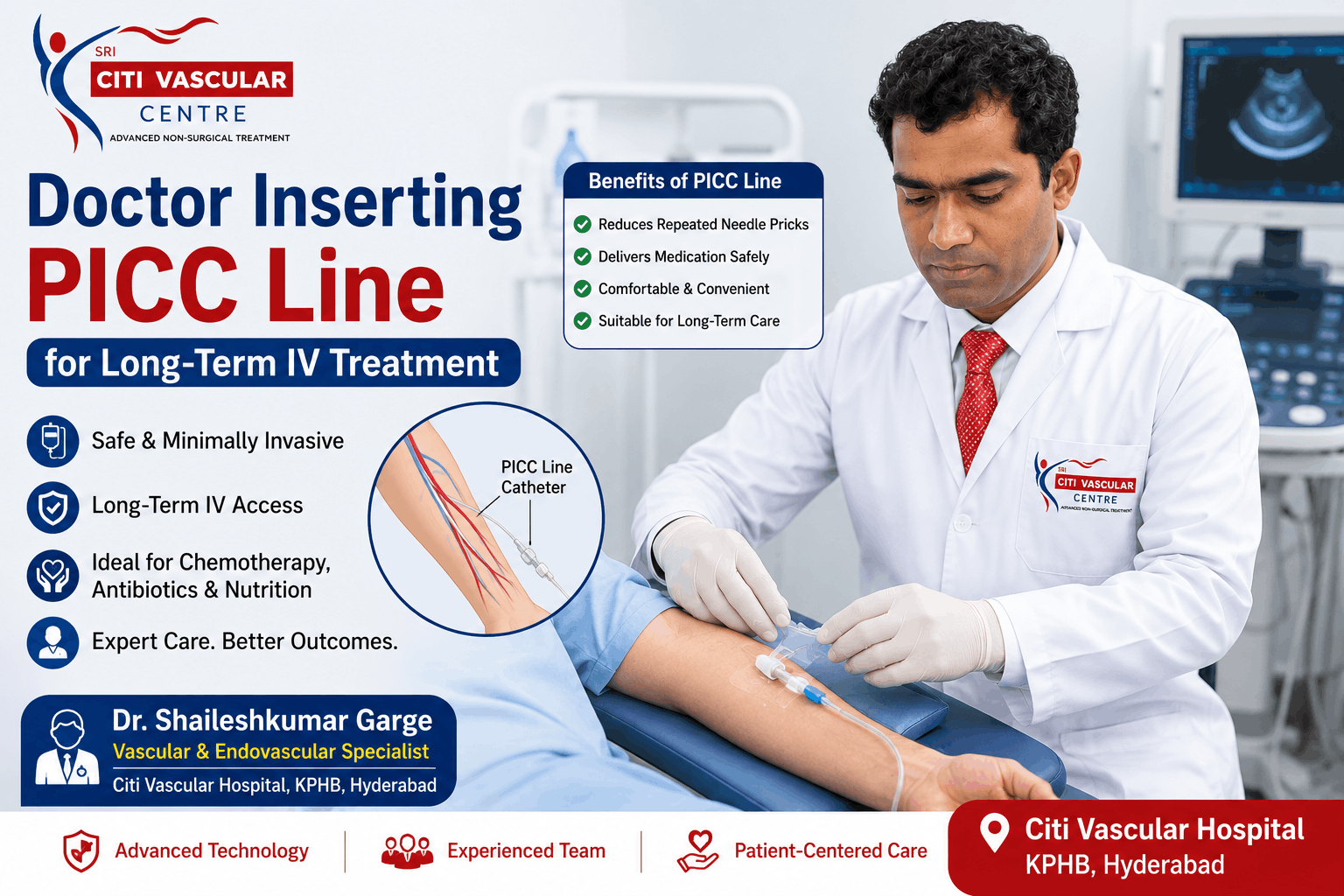
A PICC Line (Peripherally Inserted Central Catheter) is a thin, flexible tube inserted into a vein in the arm and advanced to a large vein near the heart, providing safe, long-term intravenous (IV) access for patients who need weeks or months of IV treatment — without repeated needle pricks.
At Citi Vascular Hospital, KPHB, Hyderabad, Dr. Shaileshkumar Garge performs ultrasound-guided PICC line insertion with precision and expert care using ultrasound & Fluoro guidance. The procedure is minimally invasive, done under local anaesthesia, and patients are discharged the same day.
This comprehensive guide covers everything about the PICC Line Procedure in Hyderabad — indications, types, step-by-step process, benefits, risks, care instructions, cost, and expert tips.
What is a PICC Line Procedure?
Signs You May Need a PICC Line
When Should You Ask Your Doctor About a PICC Line?
Why Is a PICC Line Needed?
What are the Common Indications for the PICC Line?
PICC Line vs Other IV Access Methods (Comparison)
What are the Types of PICC Lines?
How the PICC Line Procedure Is Performed?
What are the Benefits of PICC Line Insertion?
What are the Risks and Possible Complications of the PICC Line?
Recovery and Care After PICC Line Placement
What is the PICC Line Procedure Cost in Hyderabad?
Why Choose Dr. Shaileshkumar Garge, Citi Vascular Hospital, KPHB, Hyderabad?
Expert Tips to Get the Best Results
Frequently Asked Questions (FAQs)
Summary
SEO/GEO/AEO Keywords
A PICC Line (Peripherally Inserted Central Catheter) is a long, thin, flexible catheter inserted through a peripheral vein — usually in the upper arm — and guided forward until the tip rests in a large central vein near the heart called the superior vena cava.
Unlike a regular IV cannula that needs replacement every 3–4 days, a PICC line can remain safely in place for weeks to months, making it ideal for patients requiring prolonged treatment.
The procedure is performed under:
Ultrasound guidance — for accurate vein identification
Local anaesthesia — to minimise discomfort
Sterile conditions — to prevent infection
It is considered one of the safest forms of long-term central venous access available today.
You or your doctor may consider a PICC line if you experience or face any of the following:
Frequent IV cannula failures
Veins that are hard to find or collapse easily
Starting chemotherapy or long-term antibiotic treatment
Need for daily blood tests over several weeks
Prescribed Total Parenteral Nutrition (TPN)
Repeated hospitalisation for IV medication
Dialysis or blood product transfusions needed
Speak with your doctor about a PICC line if you notice or experience:
Your IV line is failing or needs replacement more than once a week
You feel pain, bruising, or swelling at every new IV insertion site
Your treatment course is expected to last more than 7–10 days
You are starting chemotherapy, immunotherapy, or prolonged antibiotics
Your veins are described as 'poor' or 'difficult' by nursing staff
You need both IV fluids and blood draws regularly
Doctors recommend a PICC line when patients require sustained intravenous access that a standard peripheral IV cannot provide safely or comfortably over time.
A PICC line reduces vein damage, minimises the risk of extravasation (medication leaking into surrounding tissue), and improves the overall treatment experience. It is particularly valuable for medications that are caustic to small veins, such as chemotherapy drugs and concentrated IV nutrition.
Common reasons for PICC line placement include:
Long-term IV medications (more than 7 days)
Chemotherapy or immunotherapy administration
IV antibiotics for serious infections (e.g., endocarditis, osteomyelitis)
Nutritional support (Total Parenteral Nutrition)
Frequent blood sampling without repeated venepuncture
Dialysis access support
The PICC Line Procedure is recommended by doctors in the following clinical situations:
Cancer patients often require repeated cycles of intravenous chemotherapy drugs that are toxic to small veins. A PICC line provides a reliable, large-vein route that protects peripheral veins from damage and reduces treatment delays caused by failed IV access.
Patients with serious bacterial infections — such as bone infections (osteomyelitis), heart valve infections (endocarditis), or deep tissue infections — may require four to six weeks of intravenous antibiotics. A PICC line allows safe home IV antibiotic therapy without repeated hospital visits.
Patients unable to eat or absorb nutrients through the digestive system receive complete nutrition intravenously. TPN solutions are highly concentrated and must be delivered through a central vein — a PICC line is one of the safest and most comfortable routes for this purpose.
Patients requiring daily or twice-daily blood tests — such as those in ICU, on anticoagulation therapy, or undergoing bone marrow treatment — benefit greatly from a PICC line, as it eliminates the need for repeated venepunctures that cause pain and bruising.
Conditions such as Crohn's disease, cystic fibrosis, haematological disorders, or autoimmune diseases may require prolonged IV therapy cycles. A PICC line provides consistent, reliable vascular access throughout extended treatment periods.
Some patients have naturally small, deep, or fragile veins — including oncology patients, elderly individuals, or those with a history of IV drug use. When nursing staff and anaesthetists are unable to establish reliable peripheral access, a PICC line inserted by an interventional specialist is the safe and effective solution.
Contains one channel for medication or fluid delivery.
Allows two different medications or fluids simultaneously.
Used in critically ill patients needing multiple infusions.
The type of PICC line depends on the patient’s treatment needs.
Understanding the differences between vascular access options helps patients and families make informed decisions. Here is a comparison of the most common IV access methods:
Feature |
PICC Line |
Peripheral IV |
CVC (Central Line) |
Port-a-Cath |
|
Insertion site |
Arm vein |
Hand / arm vein |
Neck / chest vein |
Chest (under skin) |
|
Duration |
Weeks–months |
3–4 days max |
Days–weeks |
Years |
|
Anaesthesia |
Local |
None / topical |
Local / sedation |
Local / sedation |
|
Repeated pricks? |
No |
Yes — frequent |
No |
Occasional needle |
|
Best for |
Long-term IV therapy |
Short-term IV |
ICU / urgent access |
Cancer port access |
|
Risk of infection |
Low–moderate |
Low |
Moderate–high |
Low |
|
Patient comfort |
High |
Low (frequent) |
Moderate |
High |
The PICC Line insertion procedure is generally quick and completed within 30–60 minutes.
The patient lies comfortably.
The arm is cleaned and sterilized.
Doctors use ultrasound imaging to locate a suitable vein.
A numbing injection is given to minimize discomfort.
A thin catheter is inserted into the vein and guided toward the central vein near the heart.
X-ray or imaging confirms proper catheter placement.
The catheter is secured and covered with a sterile dressing.
Patients can usually return home the same day.
The PICC Line Procedure offers significant advantages for patients requiring long-term intravenous treatment compared to standard peripheral IV access.
Eliminates repeated daily needle pricks — one insertion serves weeks of treatment
Provides reliable, long-term central venous access
Reduces vein damage caused by caustic medications such as chemotherapy
Allows safe delivery of concentrated solutions (nutrition, antibiotics, chemotherapy)
Enables blood sample collection — no separate venepuncture needed
Can be managed at home — suitable for outpatient and home IV therapy
Minimally invasive — no general anaesthesia, no surgical incision
Faster recovery — patients usually resume normal activities the same day
Improves patient comfort and quality of life during long treatment courses
Many patients and caregivers describe the PICC line as significantly reducing the stress and discomfort associated with long-term IV treatment.
A PICC line is generally a safe procedure when performed by an experienced specialist using ultrasound guidance. However, as with any medical procedure, certain risks can occur.
Infection at the insertion site or in the bloodstream (CLABSI)
Bleeding or bruising at the insertion site
Catheter blockage or clotting inside the line
Deep vein thrombosis (DVT) — blood clot formation in the arm vein
Vein irritation or phlebitis (inflammation of the vein)
Catheter displacement or accidental removal
Swelling, redness, or pain along the arm
Catheter tip malposition requiring repositioning
Choosing an experienced interventional specialist like Dr. Shaileshkumar Garge, with ultrasound-guided insertion and strict sterile protocols, significantly reduces the likelihood of these complications.
Most patients resume their normal daily activities shortly after the procedure. Proper PICC line care is essential to prevent infection, maintain catheter function, and ensure the line lasts for the full duration of treatment.
Keep the dressing clean, dry, and intact at all times
Do not touch, pull, or bend the catheter at the exit point
Change the dressing every 5–7 days, or immediately if it becomes wet, loose, or soiled
Use waterproof covers or PICC line protectors when bathing or showering
Flush the PICC line with saline (and heparin if prescribed) after each use, and once daily if not in use
Report any redness, swelling, pain, warmth, or drainage around the site to your doctor immediately
Avoid heavy lifting or strenuous arm exercises on the side of the PICC line
Attend all scheduled dressing change appointments at the hospital or clinic
Fever above 38°C
Chills or rigors
Significant swelling of the arm
Difficulty flushing the line or resistance when pushing fluids
The catheter appears to have moved, lengthened, or come partially out
The cost of PICC line insertion in Hyderabad varies depending on the type of catheter used, imaging guidance, hospital facilities, and the patient's clinical complexity.
Type of PICC line — single, double, or triple lumen
Ultrasound and X-ray guidance during insertion
Duration of hospital stay (if admission is required)
Additional materials — sterile kits, fixation devices, dressings
Doctor's expertise and hospital infrastructure
Procedure Type |
Approximate Cost (INR) |
|
Single-Lumen PICC Line Insertion |
₹8,000 – ₹18,000 |
|
Double-Lumen PICC Line Insertion |
₹15,000 – ₹25,000 |
|
Triple-Lumen PICC Line (complex cases) |
₹20,000 – ₹35,000 |
|
PICC line dressing change (per visit) |
₹500 – ₹1,500 |
|
PICC line removal |
₹1,000 – ₹2,500 |
For accurate pricing tailored to your treatment plan, contact Citi Vascular Hospital, KPHB, Hyderabad directly. We offer clear, transparent pricing with no hidden charges.
Choosing the right specialist for PICC line insertion is critical for safe placement and trouble-free long-term use. Dr. Shaileshkumar Garge at Citi Vascular Hospital, KPHB, is one of Hyderabad's leading Interventional Radiologists, trusted by patients across Kukatpally, Miyapur, Ameerpet, Secunderabad, Banjara Hills, and the broader Hyderabad region.
Over 12 years of dedicated experience in image-guided vascular procedures, including PICC line insertion, central venous catheters, and vascular access for chemotherapy and dialysis patients.
All PICC line insertions at Citi Vascular Hospital are performed under real-time ultrasound guidance, ensuring accurate vein selection, correct catheter positioning, and minimal complications.
Each PICC line procedure is tailored to the individual patient's treatment needs, vein anatomy, and clinical condition. Dr. Garge takes time to explain the procedure clearly to patients and families before proceeding.
Citi Vascular Hospital is equipped with a state-of-the-art Cath Lab, high-resolution ultrasound, and fluoroscopy (X-ray) for real-time catheter tip confirmation — ensuring the highest standards of procedural safety.
All PICC insertions are performed under full sterile conditions following international infection prevention standards, significantly reducing the risk of catheter-related bloodstream infections.
From pre-procedure assessment to PICC line maintenance guidance and scheduled dressing changes, patients receive complete, end-to-end support throughout their treatment journey at Citi Vascular Centre.
MBBS, MD, DNB, FRCR (UK), FNVIR (CMC Vellore), EBIR (Spain, Europe)
Director & Chief Vascular Physician | Consultant Interventional Radiologist
Citi Vascular Hospital, KPHB Colony, Road No. 1, Hyderabad, Telangana 500072
Over 12 years of experience in image-guided vascular and interventional radiology procedures, including PICC line insertion, central venous catheter placement, vascular access for chemotherapy and dialysis patients, varicose veins, varicocele embolisation, and uterine fibroid embolisation. Treats 100+ vascular patients per month across KPHB, Kukatpally, and the greater Hyderabad region.
Following proper care instructions before and after PICC line insertion significantly improves outcomes and helps the line last for the full duration of your treatment.
Keep the insertion site dry — use a waterproof PICC cover or cling film wrap when showering
Follow your dressing change schedule — do not skip appointments
Flush the line exactly as instructed — frequency and solution type matter for preventing clots
Avoid carrying heavy bags or doing intense arm exercises on the PICC side
Inform all treating doctors, nurses, and pharmacists that you have a PICC line
Never attempt to remove or reposition the PICC line yourself
Report fever, chills, or arm swelling to your doctor immediately — these may signal infection or clot
Attend all follow-up visits even if the line appears to be working well
The PICC line procedure is usually not painful because local anaesthesia is used before catheter insertion. Most patients feel only mild pressure or slight discomfort during the procedure.
A PICC line can safely remain in place for several weeks to months depending on the treatment plan, catheter condition, and proper maintenance.
Yes, PICC line insertion is generally a day-care procedure. Most patients can return home the same day after catheter placement and observation.
Yes. PICC lines are commonly used for chemotherapy because they safely deliver medications into a large central vein, reducing damage to smaller veins.
Common signs of PICC line infection include:
Fever or chills
Redness or swelling near the insertion site
Pain in the arm
Fluid discharge
Difficulty flushing the catheter
Immediate medical attention is recommended if these symptoms occur.
The PICC line procedure cost in Hyderabad typically ranges from ₹8,000 to ₹35,000, depending on the catheter type, hospital facilities, and imaging guidance used during the procedure.
The PICC Line (Peripherally Inserted Central Catheter) Procedure is a safe, minimally invasive, and highly effective solution for patients requiring long-term intravenous treatment. It eliminates repeated needle pricks, protects peripheral veins, and provides reliable central venous access for chemotherapy, antibiotics, nutrition, and blood sampling — all while allowing patients to continue their daily lives with minimal disruption.
Proper PICC line care, regular follow-up, and prompt attention to warning signs ensure the catheter remains functional and complication-free throughout the full course of treatment.
Book Your PICC Line Consultation in HyderabadIf you or a loved one needs PICC line insertion in Hyderabad, consult Dr. Shaileshkumar Garge at Citi Vascular Hospital, KPHB, for expert ultrasound-guided PICC line placement with same-day discharge. Patients from Kukatpally, Miyapur, Ameerpet, Secunderabad, and across Hyderabad are welcome. Call +91-73375 83901 or visit www.citivascularcentre.com to book your appointment. |