LAST MEDICALLY REVIEWED:
September 2026 — Dr. Shaileshkumar Garge
MBBS, MD (Mumbai), DNB (Delhi), FRCR (UK), FNVIR (CMC Vellore), EBIR (Spain)
Citi Vascular Hospital, KPHB Colony, Road No. 1, Hyderabad, Telangana 500072
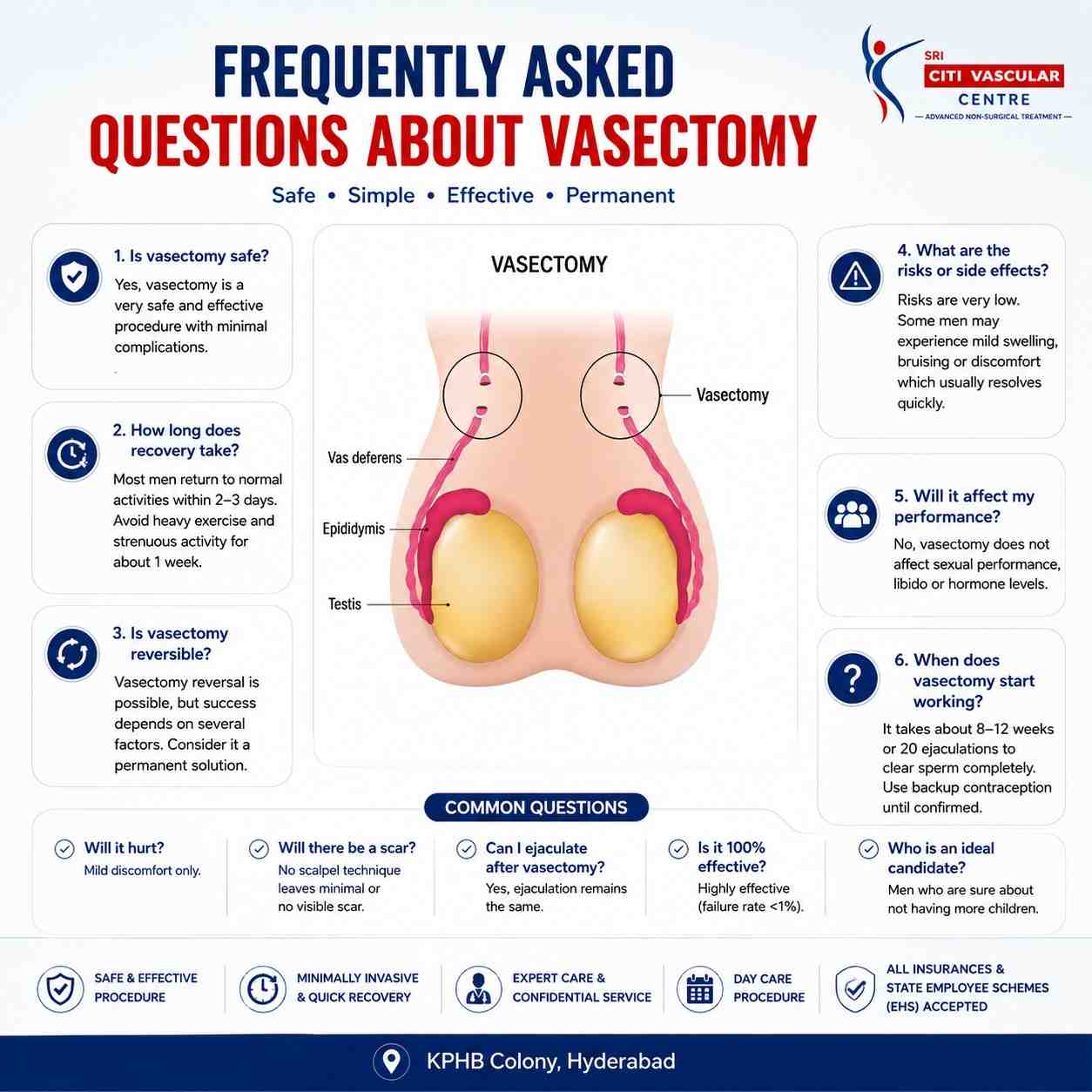
A vasectomy is one of the safest and most effective permanent birth control options for men. It works by blocking the vas deferens, preventing sperm from mixing with semen. Vasectomy does not affect sexual performance, testosterone levels, erections, or ejaculation. Most men return to normal activities within a few days.
This FAQ guide answers the most common questions about vasectomy safety, recovery, risks, reversal, effectiveness, long-term outcomes, cost, insurance, and more — helping men and couples in Kukatpally, Miyapur, Hitech City, Secunderabad, and across Hyderabad make a fully informed decision, and reviewed by Dr. Garge and Dr Vamshi Mohan, Citi Vascular Hospital, KPHB, Hyderabad.
Quick Answer:
|
Question |
Quick Answer |
|
Is vasectomy safe? |
Yes — one of the safest permanent contraception procedures available |
|
How effective is vasectomy? |
Over 99% effective after confirmation semen analysis |
|
Does vasectomy affect sex life? |
No — no change to erections, orgasm, testosterone, or sexual desire |
|
Is vasectomy permanent? |
Yes — should always be considered a permanent decision |
|
Procedure duration |
15–30 minutes under local anaesthesia |
|
Recovery time |
2–7 days for most men; heavy activity avoided for 1 week |
|
Does semen change after vasectomy? |
No visible change — sperm account for < 3% of semen volume |
|
Pregnancy risk after vasectomy |
< 1% — only after confirmed clearance on semen analysis |
|
Can vasectomy be reversed? |
Possible, but not guaranteed — success decreases with time |
|
Is no-scalpel vasectomy available? |
Yes — less bleeding, faster recovery, fewer complications than conventional |
|
Cost in Hyderabad (2026) |
₹15,000–₹40,000 depending on technique and facility |
|
Who performs vasectomy? |
Urologist or trained surgeon — at Citi Vascular Hospital, KPHB by Dr. Vamshi Mohan and Team |
|
Is vasectomy covered by insurance? |
Varies by policy — confirm with insurer before appointment |
|
Available at |
Citi Vascular Hospital, KPHB Colony, Road No. 1, Hyderabad — +91-73375 83901 |
|
Step |
Check This Question |
YES → Next |
NO → Action |
|
1 |
Are you certain you do not want biological children in the future? |
→ Step 2 |
Do not proceed — vasectomy is permanent |
|
2 |
Are you in a stable relationship OR have discussed this with your partner? |
→ Step 3 |
Discuss with partner before deciding |
|
3 |
Have you considered this decision for > 6 months without doubt? |
→ Step 4 |
Take more time — this is a permanent decision |
|
4 |
Are you in generally good health with no active genital infection or bleeding disorder? |
→ Step 5 |
Address medical condition first, then reassess |
|
5 |
Is your partner's sterilization more risky/complex than vasectomy in your situation? |
→ Step 6 |
Female sterilization may be preferred in some cases — discuss |
|
6 |
Do you understand vasectomy is NOT immediately effective and requires semen testing? |
✅ Book a vasectomy consultation at Citi Vascular, KPHB |
Learn about post-vasectomy semen analysis requirements first |
⚠️ Important: Vasectomy should NEVER be considered reversible. All men considering vasectomy must have a thorough consultation with Dr. Garge at Citi Vascular Hospital, KPHB before proceeding. Younger men and those in new relationships are counselled extensively before scheduling.
|
Condition / Factor |
Suitability |
Reason / Alternative |
|
Uncertainty about having children |
❌ Not suitable |
Vasectomy is permanent — reversal not guaranteed |
|
Active scrotal/genital infection |
❌ Not now |
Postpone until infection is treated and resolved |
|
Bleeding disorder / anticoagulant use |
⚠️ Assess |
Medication review required; procedure may need modification |
|
Previous scrotal surgery / anatomy |
⚠️ Assess |
Specialist evaluation required — may affect technique selection |
|
Younger men (< 25–30 years) |
⚠️ Counsel carefully |
Higher rate of future regret — extensive counselling required |
|
Only child or recent loss of a child |
⚠️ Counsel carefully |
Delayed decision advised — emotional circumstances may change |
Get Expert Vasectomy Questions Answered in Hyderabad
Citi Vascular Hospital, KPHB — Dr. Vamshi Mohan and Dr Garge | 1200+ vasectomy Procedures Same-Day Discharge
+91-73375 83901 | WhatsApp Now | citivascularcentre.com |
Rated 4.9/5 by 639+ patientsTransparent Pricing | Insurance Assistance | No Hidden Charges | Mon–Sat, 9 AM–6 PM
VASECTOMY SAFETY
SEXUAL PERFORMANCE AFTER VASECTOMY
RECOVERY AFTER VASECTOMY
VASECTOMY REVERSAL
EFFECTIVENESS
COMMON CONCERNS
PEOPLE ALSO ASK
MYTHS & FACTS
SUMMARY
Q1:Is vasectomy safe?
Yes. Vasectomy is one of the safest permanent contraception procedures available. Performed under local anaesthesia in 15–30 minutes, it has a very low complication rate. Minor side effects like temporary swelling or bruising resolve within days. Serious complications are rare when performed by an experienced specialist. Most men return to routine activities within 2–7 days.
Q2:Is vasectomy safer than female sterilization?
Yes. Vasectomy is safer, simpler, and less invasive than female sterilization (tubectomy). It requires only local anaesthesia — not general anaesthesia — takes 15–30 minutes versus 30–60 minutes for tubectomy, carries fewer surgical risks, costs significantly less, and allows recovery in 2–7 days compared to 1–2 weeks after female sterilization.
Q3:What are the risks of vasectomy?
Vasectomy risks are generally minor. Common temporary side effects include swelling, bruising, and mild scrotal soreness. Less common complications include haematoma (blood collection), infection, and sperm granuloma (small lump). Chronic testicular pain affects approximately 1–2% of men. Serious complications are uncommon when the procedure is performed by an experienced specialist using the no-scalpel technique.
Q4:Can vasectomy fail?
Vasectomy failure is rare but possible. Over 99% effective after confirmed semen analysis, failure can occur if sperm remain in the reproductive tract before clearance is confirmed, or if the vas deferens naturally reconnects (recanalization — very rare). This is why post-vasectomy semen analysis at 8–12 weeks is essential before stopping contraception.
Q5:Is no-scalpel vasectomy safer?
Yes. No-scalpel vasectomy (NSV) is safer than conventional vasectomy. It involves a tiny puncture instead of a scalpel incision, requires no stitches, causes less bleeding, has a lower risk of haematoma and infection, and allows faster recovery — typically 2–5 days. The World Health Organization recommends no-scalpel vasectomy as the preferred technique due to its superior safety profile.
Q1:How long does recovery take after vasectomy?
Most men recover within 2–7 days after vasectomy. Mild soreness and swelling are normal in the first 48 hours and managed with rest, ice packs, and supportive underwear. Desk work and light activities can often resume within 24–48 hours. Strenuous exercise, heavy lifting, and cycling should be avoided for at least one full week post-procedure.
Q2:When can I return to work after vasectomy?
Most men with desk jobs or office-based work return within 1–2 days after vasectomy. Men with physically demanding jobs involving heavy lifting, standing for long periods, or strenuous activity should rest for at least 5–7 days. Your doctor at Citi Vascular Hospital, KPHB will advise based on your specific job requirements and individual recovery.
Q3:When can I have sex after vasectomy?
Most doctors recommend waiting approximately 7 days before resuming sexual activity after vasectomy. This allows the scrotal area time to heal and reduces the risk of discomfort or complications. Importantly, contraception must continue after resuming sex — vasectomy is NOT effective until a post-vasectomy semen analysis at 8–12 weeks confirms the complete absence of sperm.
Q4:Is vasectomy painful?
Vasectomy causes minimal pain. The procedure is performed under local anaesthesia — a brief sting for 5–10 seconds during the injection, after which the area is fully numb. After the anaesthetic wears off, mild to moderate scrotal soreness is normal for 2–3 days and is well managed with paracetamol, ibuprofen, ice packs, and supportive underwear.
Q5:What helps recovery after vasectomy?
Key vasectomy recovery tips: wear supportive underwear for 48–72 hours to reduce swelling; apply ice packs for 20 minutes on and 20 minutes off during the first 48 hours; rest at home for 1–2 days; take prescribed pain relief; avoid heavy lifting, cycling, and exercise for one week; and attend your post-vasectomy semen analysis appointment at 8–12 weeks.
Q1:Can a vasectomy be reversed?
Yes, vasectomy reversal (vasovasostomy) is technically possible — a microsurgical procedure that reconnects the vas deferens. However, reversal is significantly more complex, expensive (₹50,000–₹1,50,000+), requires general anaesthesia, and does not guarantee restored fertility. Success rates decline over time. Every man must consider vasectomy permanent from the outset and never rely on future reversal as a backup plan.
Q2:How successful is vasectomy reversal?
Vasectomy reversal success depends heavily on time elapsed. Within 3 years: 75–97% patency rate, ~55–76% pregnancy rate. After 3–8 years: ~50–55% patency. After 9–14 years: ~40–44%. After 15+ years: success drops to ~30% or lower. Female partner's age also significantly affects pregnancy outcomes regardless of reversal technique. Success is never guaranteed at any timeframe.
Q3:Should I consider vasectomy reversible?
No. Vasectomy must always be considered a permanent, irreversible decision. While reversal is technically possible, it is expensive, requires microsurgery under general anaesthesia, and does not guarantee restoration of fertility — especially after many years. Making a vasectomy decision while counting on future reversal is strongly discouraged by all urology guidelines. Only proceed if you are absolutely certain your family is complete.
Q4:How many years after vasectomy can reversal work?
Vasectomy reversal is technically possible even 15–20 years after the original procedure. However, success rates decline significantly with time: approximately 75–97% within 3 years, dropping to below 30% after 15 years. Partner's age, sperm quality, and antibody formation also affect outcomes. Later reversals carry higher complexity, cost, and much lower pregnancy rates — reversal is never a reliable fallback.
Q1:How effective is vasectomy?
Vasectomy is over 99% effective at preventing pregnancy — making it one of the most reliable contraception methods available. However, it is NOT immediately effective after the procedure. Effectiveness is only confirmed once a post-vasectomy semen analysis at 8–12 weeks (or approximately 20 ejaculations) shows complete absence of sperm (azoospermia). Contraception must continue until clearance is confirmed.
Q2:Is vasectomy effective immediately?
No. Vasectomy is NOT immediately effective. Residual sperm remain in the vas deferens above the blockage and continue to be present in semen for several weeks after the procedure. Contraception must be used without interruption until a semen analysis — at approximately 8–12 weeks post-procedure or after about 20 ejaculations — confirms that no sperm remain in the ejaculate.
Q3:How many ejaculations are needed after vasectomy?
Approximately 20 ejaculations are needed to clear residual sperm from the vas deferens after vasectomy. This typically takes 8–12 weeks. After approximately 20 ejaculations, a semen analysis is performed to confirm azoospermia (no sperm detected). Contraception must be used consistently until the semen test result confirms clearance — stopping contraception before testing risks unintended pregnancy.
Q4:Why is semen testing important after vasectomy?
Post-vasectomy semen analysis is essential because vasectomy is not immediately effective. Residual sperm can remain in the reproductive tract for weeks. Only a laboratory semen test confirming azoospermia (zero sperm) establishes that vasectomy has succeeded. Without this test, there is no way to know if the procedure worked. Abandoning contraception before test confirmation risks pregnancy — even months after vasectomy.
Q1:What happens to sperm after vasectomy?
After vasectomy, the testicles continue producing sperm normally — this does not stop. However, sperm can no longer travel through the blocked vas deferens. The sperm that are produced are naturally reabsorbed by the body through a completely harmless biological process. Testosterone production, testicular function, and all hormonal processes continue entirely unaffected by this natural reabsorption.
Q2:Can vasectomy cause prostate cancer?
No. Current medical evidence — including large-scale studies reviewed by the American Cancer Society, WHO, and major urology bodies — does not establish that vasectomy causes prostate cancer. Early studies suggested a possible link, but rigorous controlled research has not confirmed a causal relationship. Men with vasectomy should follow standard age-appropriate prostate cancer screening guidelines recommended for all men.
Q3:Can vasectomy increase the risk of heart disease?
No. Multiple large-scale studies have found no association between vasectomy and increased cardiovascular disease risk. The American Heart Association and WHO confirm vasectomy does not raise the risk of heart disease, hypertension, or stroke. The procedure is limited to the vas deferens and has no effect on the cardiovascular system, hormones, or metabolic health markers.
Q4:Can vasectomy cause chronic pain?
Post-vasectomy pain syndrome (PVPS) affects approximately 1–2% of men — characterised by persistent scrotal discomfort lasting more than 3 months. Most cases are mild and respond to conservative management: NSAIDs, supportive underwear, and warm compresses. Severe long-term pain requiring further intervention is uncommon. The risk of PVPS is lower with no-scalpel technique performed by an experienced specialist.
Q5:Can vasectomy affect urination?
No. Vasectomy has no effect on urination whatsoever. The vas deferens — the only structure involved in vasectomy — carries sperm and is completely separate from the urinary system. The urethra, bladder, prostate, and urinary flow are entirely unaffected. If urinary symptoms develop after vasectomy, they are unrelated to the procedure and should be investigated separately by your doctor.
Q1:Is vasectomy 100% effective?
No contraceptive method is 100% effective, but vasectomy comes very close — over 99% effective after semen analysis confirms azoospermia. The tiny remaining risk exists only if sperm persist after the procedure (detected on semen testing) or if rare spontaneous reconnection of the vas deferens (recanalization) occurs. Confirming clearance with semen analysis makes vasectomy one of the most reliable methods available.
Q2:Can I get someone pregnant years after a vasectomy?
Pregnancy after a confirmed, successful vasectomy — verified by semen analysis showing azoospermia — is extremely rare, occurring in less than 1 in 2,000 cases. It can happen in exceptional circumstances if the vas deferens reconnects spontaneously (late recanalization). Men who notice any change in semen appearance or have concerns years after vasectomy should request a repeat semen analysis.
Q3:Is vasectomy covered by insurance in Hyderabad?
Insurance coverage for vasectomy in Hyderabad varies by policy. Government family planning schemes frequently cover vasectomy. Some corporate group mediclaim plans include male sterilisation. Ayushman Bharat/PMJAY coverage depends on empanelment. Individual policies vary — confirm with your insurer before booking. Citi Vascular Hospital, KPHB assists with documentation and insurance queries. Call +91-73375 83901 for help.
Q4:Which doctor performs vasectomy?
Vasectomy is performed by urologists, trained surgeons, and specialist physicians experienced in male sterilisation procedures. At Citi Vascular Hospital, KPHB, Hyderabad, vasectomy is performed by Dr. Vamshi Mohan and Dr Garge and Team — using the no-scalpel technique for minimal discomfort, faster recovery, and the lowest possible complication rate. Both no-scalpel and conventional techniques are available.
Q5:What is the cost of vasectomy in Hyderabad?
No-scalpel vasectomy at Citi Vascular Hospital, KPHB, Hyderabad costs approximately ₹15,000–₹40,000 in 2026 — including consultation, procedure, and post-procedure medications. This is significantly less than female sterilisation (₹25,000–₹60,000). All costs are discussed transparently before the procedure with no hidden charges. EMI options are available. Call +91-73375 83901 or WhatsApp for a personalised estimate before booking.
“I Have Completed My Family. Is Vasectomy Better Than Female Sterilization?”
For most couples who have completed their family, vasectomy is the better choice — it is simpler, less invasive, faster (15–30 min vs 30–60 min), cheaper (₹15,000–₹40,000 vs ₹25,000–₹60,000), requires only local anaesthesia, and allows recovery in 2–7 days versus 1–2 weeks after tubectomy. Both are equally effective. The decision should always be made jointly and discussed with Dr. Vamshi Mohan or Dr. Garge at Citi Vascular, KPHB.
12 Common Myths Debunked with Clinical Evidence
|
❌ MYTH — Commonly believed, clinically incorrect |
✅ CLINICAL FACT — What evidence actually shows |
SOURCE — Supporting clinical evidence |
|
❌ MYTH |
✅ CLINICAL FACT |
SOURCE |
|
❌ MYTH Vasectomy affects masculinity |
✅ CLINICAL FACT Vasectomy has no effect on masculinity, confidence, identity, or physical appearance. Only the vas deferens is blocked. The testicles, hormones, and all male characteristics remain completely unchanged after the procedure. |
AUA Patient FAQ; Multiple psychological outcome studies |
|
❌ MYTH Vasectomy lowers testosterone levels |
✅ CLINICAL FACT Testosterone is produced by the testicles, which are completely unaffected by vasectomy. Hormone levels, muscle mass, energy, mood, and libido remain entirely normal. No testosterone reduction occurs after vasectomy. |
AUA Guidelines; Endocrine Society clinical data |
|
❌ MYTH Vasectomy causes erectile dysfunction |
✅ CLINICAL FACT Vasectomy has no effect on erections. The nerves and blood supply responsible for erections are not involved in the procedure. Multiple controlled studies confirm no link between vasectomy and erectile dysfunction. |
Journal of Urology; Multiple controlled clinical trials |
|
❌ MYTH Vasectomy causes impotence |
✅ CLINICAL FACT Vasectomy does not cause impotence. Sexual function, including erections, orgasm, ejaculation, and sensation, remain fully intact. Only the sperm pathway is interrupted — no other male sexual function is affected. |
WHO Male Sterilisation Guidelines; SIR data |
|
❌ MYTH Vasectomy significantly reduces semen volume |
✅ CLINICAL FACT Semen volume remains virtually unchanged after vasectomy. Sperm contribute less than 3% of total ejaculate volume — the rest comes from the seminal vesicles and prostate, which are completely unaffected by the procedure. |
AUA Patient Education; Semen composition studies |
|
❌ MYTH Vasectomy is immediately effective |
✅ CLINICAL FACT Vasectomy is NOT immediately effective. Residual sperm remain in the vas deferens for 8–12 weeks. Contraception must continue until a post-vasectomy semen analysis confirms zero sperm (azoospermia) — typically after ~20 ejaculations. |
SIR / AUA Post-Vasectomy Protocol Guidelines |
|
❌ MYTH Vasectomy reversal always restores fertility |
✅ CLINICAL FACT Vasectomy reversal is not guaranteed to restore fertility. Success rates decline significantly over time — from ~75–97% within 3 years to below 30% after 15 years. Partner's age and sperm antibody levels also affect outcomes. |
Belker et al. Multi-centre Vasovasostomy Study Group |
|
❌ MYTH Vasectomy causes prostate cancer |
✅ CLINICAL FACT Current evidence does not show vasectomy causes prostate cancer. Large-scale reviews by the American Cancer Society and WHO found no confirmed causal link. Men should follow standard age-appropriate prostate screening regardless of vasectomy status. |
American Cancer Society; WHO 2023 Review |
|
❌ MYTH Vasectomy increases the risk of heart disease |
✅ CLINICAL FACT Vasectomy has no effect on cardiovascular health. Multiple large-scale studies, including those reviewed by the American Heart Association, confirm no increased risk of heart disease, hypertension, or stroke following vasectomy. |
American Heart Association; NEJM cardiovascular studies |
|
❌ MYTH Vasectomy is extremely painful |
✅ CLINICAL FACT Vasectomy is performed under local anaesthesia — only a brief sting during the injection. The procedure itself is painless. Mild scrotal soreness for 2–3 days post-procedure is managed easily with paracetamol and supportive underwear. |
Patient satisfaction surveys; No-Scalpel Vasectomy outcome data |
|
❌ MYTH Vasectomy means no more ejaculation |
✅ CLINICAL FACT Ejaculation is completely normal after vasectomy — same volume, sensation, force, and frequency. Sperm make up less than 3% of semen. The experience of ejaculation and orgasm is identical before and after the procedure. |
AUA; Semen composition clinical data |
|
❌ MYTH Vasectomy = castration |
✅ CLINICAL FACT Vasectomy and castration are completely different procedures. Vasectomy only blocks the vas deferens through a tiny puncture. The testicles remain fully intact and functional — producing testosterone and sperm normally — after vasectomy. |
Standard anatomical + surgical education; AUA Guidelines |
Vasectomy FAQ Summary
✅ Safe and effective permanent birth control
✅ More than 99% effective after confirmation testing
✅ Does not affect sexual performance
✅ Does not affect testosterone levels
✅ Recovery usually within a few days
✅ Vasectomy reversal is possible but not guaranteed
✅ One of the safest male contraception options available
If you are considering permanent male birth control, an expert consultation can help you understand the benefits, risks, recovery, and suitability of vasectomy.
Citi Vascular Hospital, KPHB Colony, Hyderabad
Call / WhatsApp: 7337583901
Serving patients from Kukatpally, Miyapur, Hitech City, Gachibowli, Madhapur, Secunderabad, and across Telangana.
This article is for informational purposes only and does not substitute professional medical advice. Always consult a qualified healthcare provider for diagnosis and treatment.