LAST MEDICALLY REVIEWED:
July 2026 — Dr. Shaileshkumar Garge
Citi Vascular Hospital, KPHB Colony, Road No. 1, Hyderabad, Telangana 500072
|
QUICK ANSWER What Is Microwave Thyroid Nodule Ablation and How Is It Done? Microwave thyroid nodule ablation is a minimally invasive image-guided procedure that uses a thin antenna to deliver controlled heat into a benign thyroid nodule, shrinking it without surgery or removing the thyroid gland. Performed under local anaesthesia. No surgical incision. Same-day discharge. Recovery 1–3 days. Nodule reduces by 60–80% over 3–12 months. Dr. Garge FRCR (UK) | Citi Vascular Centre, KPHB, Hyderabad. Call +91-73375 83901. |
A benign thyroid nodule that has grown large enough to cause difficulty swallowing, create visible neck swelling, or produce a feeling of pressure has become a clinical problem that deserves treatment. For decades, the only definitive treatment was surgical — removing the affected lobe of the thyroid (lobectomy) or in some cases the entire gland. Surgery works, but it carries the risks of general anaesthesia, leaves a visible neck scar, may necessitate lifelong thyroid hormone replacement, and involves a hospital stay of 2–4 days followed by 2–4 weeks of recovery.
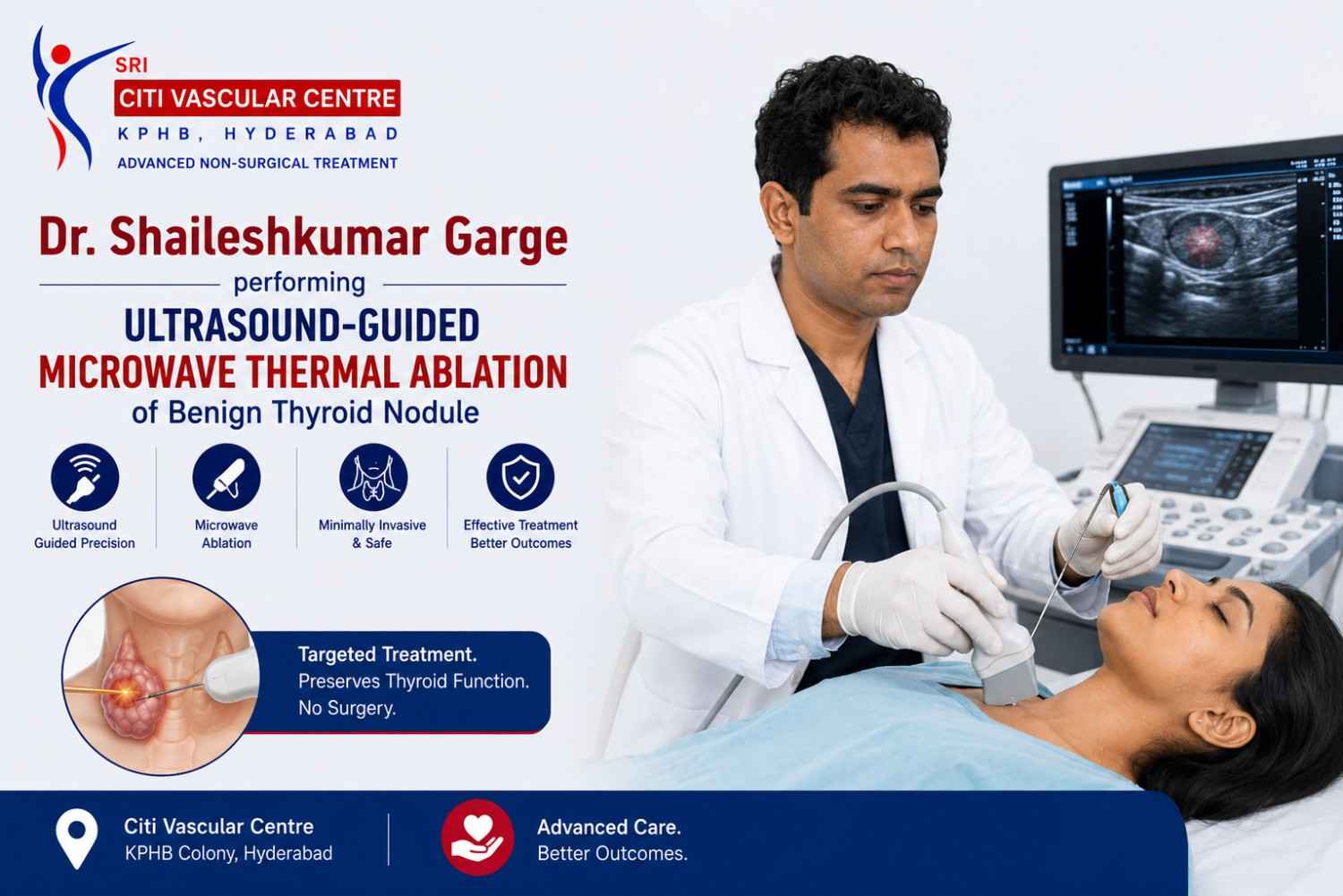
Microwave thermal ablation changes this picture entirely. A thin microwave antenna, no wider than a standard needle, is guided precisely into the thyroid nodule under continuous real-time ultrasound imaging. Controlled microwave energy heats the abnormal nodule tissue from within, causing it to undergo coagulative necrosis — the tissue is destroyed, and the body gradually reabsorbs it over the following months. The nodule shrinks progressively. The surrounding healthy thyroid tissue is left intact and continues to function normally. The patient goes home the same day.
This page covers everything you need to know about the microwave thyroid ablation procedure at Citi Vascular Centre, KPHB, Hyderabad — from what it involves and who it suits, through the step-by-step procedure on the day, recovery, aftercare, and what results to expect. For information about other treatment options including surgery, see our Thyroid Nodule Treatment in Hyderabad page. For ablation cost and insurance, see our Thyroid Ablation Cost page.
Book Thyroid Nodule Ablation — Citi Vascular Centre, KPHB, Hyderabad
Call +91-73375 83901 | WhatsApp 73375 83901 | citivascularcentre.com | Mon–Sat 9AM–6PM
|
Feature |
Detail |
|
Procedure Type |
Microwave Thermal Ablation (MWA) — image-guided, non-surgical, no thyroid removal |
|
Guidance Used |
Continuous real-time high-resolution ultrasound throughout |
|
Anaesthesia |
Local anaesthesia — no general anaesthetic required for most patients |
|
Incision / Wound |
None — tiny needle puncture only. No scalpel, no stitches, no visible scar. |
|
Duration |
20–45 minutes depending on nodule size and number. Total clinic time: 2–3 hours. |
|
Hospital Stay |
Day-care — same-day discharge for most patients |
|
Is the Thyroid Removed? |
No — the thyroid gland is fully preserved. Only the nodule is treated. |
|
Thyroid Function After |
Normal thyroid function preserved in the vast majority of patients |
|
Recovery |
1–3 days for most patients. Return to desk work: 1–2 days. |
|
Nodule Reduction |
60–80% volume reduction over 3–12 months in published studies |
|
First Visible Improvement |
Most patients notice neck swelling reducing by 4–8 weeks |
|
Can It Be Repeated? |
Yes — if needed, repeat ablation is safe and feasible in most cases |
Microwave ablation (MWA) is one of a family of image-guided thermal ablation techniques — a group of procedures that use different forms of energy to generate heat within a target lesion and destroy it. Other members of the same family include Radiofrequency Ablation (RFA) and Laser Ablation. What they share is the core principle: energy delivered through a thin needle-like device, guided precisely into the target tissue under ultrasound, generates localised heat that destroys the abnormal tissue while protecting the surrounding structures. What distinguishes microwave ablation is the speed and uniformity of heating it provides — microwave energy rotates water molecules in the tissue at extremely high frequency, generating heat rapidly and consistently throughout the treatment zone without the impedance limitations that radiofrequency ablation can sometimes encounter in fibrotic or calcified nodules.
For thyroid nodules specifically, microwave ablation has been extensively studied and validated over the past decade — with large published series from South Korea, Italy, China, and European centres consistently reporting 60–80% nodule volume reduction at 12 months, high patient satisfaction, excellent preservation of thyroid function, and low complication rates when performed by experienced operators under continuous ultrasound guidance. The technique has been endorsed by multiple international societies including the Korean Society of Thyroid Radiology (KSThR), the Italian Minimally Invasive Treatments of the Thyroid Group (MITT), and the European Thyroid Association (ETA).
Understanding how microwave ablation achieves nodule shrinkage helps patients have realistic expectations about the timeline of improvement and why the effect is gradual rather than immediate.
|
1 |
The microwave antenna is positioned precisely within the thyroid nodule under continuous ultrasound. The antenna tip sits at the deepest part of the treatment zone. |
|
2 |
Microwave energy (typically 2.45 GHz) is delivered from the antenna tip, causing rapid oscillation of water molecules in the surrounding tissue. Temperature within the treatment zone rises to 60–100°C within seconds. |
|
3 |
The sustained heat causes coagulative necrosis of the targeted nodule tissue — the tissue proteins denature and the cells die. This creates a zone of necrosis within the nodule that will be gradually reabsorbed. |
|
4 |
The antenna is slowly moved through the nodule (moving-shot technique) to ensure the entire nodule volume is covered. Real-time ultrasound shows the treated area as an echogenic (bright) zone as it heats. |
|
5 |
After the energy delivery is complete, the nodule has been thermally treated. The body's own immune and absorption processes gradually break down and remove the necrotic tissue over the following weeks and months. |
|
6 |
The nodule shrinks progressively — typically 30–50% reduction by 3 months, 50–70% by 6 months, and 60–80% by 12 months. The surrounding healthy thyroid tissue, which was not treated, continues to function normally. |
Key clinical insight: Microwave ablation does not remove the nodule — it destroys it in place. The treated tissue undergoes coagulation necrosis and is gradually reabsorbed by the body. This is why the effect is progressive over months rather than immediate. On ultrasound immediately after the procedure, the treated zone appears bright (hyperechoic) and may initially look larger before it begins to shrink.
Patient selection is the most important factor in thyroid ablation outcomes. The right patient with the right nodule type, the right size, and the right clinical indication consistently produces good results. Suitability is assessed at consultation by Dr. Garge after reviewing your ultrasound, FNAC result, thyroid function tests, and clinical symptoms.
|
Suitable Profile |
Why Ablation Is Appropriate |
|
Benign thyroid nodule confirmed on FNAC (Bethesda II) |
Cytological confirmation of benign nature is mandatory before ablation. Ablation is not appropriate for any nodule without prior benign FNAC. |
|
Nodule causing compressive symptoms — difficulty swallowing, pressure, discomfort |
Ablation reduces nodule volume and relieves pressure on the oesophagus and trachea — the primary indication for most patients |
|
Visible neck swelling causing cosmetic concern |
A valid clinical indication — particularly for professionally active patients. 60–80% volume reduction significantly improves cosmetic appearance. |
|
Growing nodule on serial ultrasound |
A benign nodule that has grown > 20% in two dimensions on follow-up ultrasound is a clinical indication for intervention |
|
Patient wishing to avoid surgery |
For patients who want definitive treatment of a symptomatic nodule without general anaesthesia, surgical scar, or risk of hypothyroidism requiring lifelong medication |
|
Elderly patients or those with higher surgical risk |
Local anaesthesia-only ablation is particularly valuable for patients where general anaesthesia carries elevated risk |
|
Predominantly cystic nodule with recurring fluid (ethanol ablation preferred) |
Ethanol ablation is highly effective for simple thyroid cysts — MWA is preferred for solid or complex (solid-cystic) components |
|
Not Suitable When |
Reason / Alternative |
|
Suspected or confirmed thyroid malignancy |
Ablation is not appropriate for any nodule where malignancy has not been excluded or where FNAC suggests cancer. Surgery with pathological examination is the correct management. |
|
FNAC result indeterminate — Bethesda III or IV |
Indeterminate cytology cannot be resolved by ablation — surgical excision with histopathology is the definitive diagnostic and therapeutic approach. |
|
Diffuse thyroid disease requiring whole-gland treatment |
Ablation treats focal nodules — it is not appropriate for Graves' disease, diffuse toxic goitre, or thyroiditis requiring systemic management. |
|
Very large nodule > 6cm or substernal extension |
Very large nodules or those extending behind the sternum are more effectively treated with surgery — staged ablation is possible but less complete. |
|
Uncorrected coagulation disorder |
Bleeding risk during antenna insertion must be within acceptable range. Active anticoagulation requires specific management before ablation. |
|
Active infection at the treatment site |
Ablation through infected skin or in the context of active thyroid infection is deferred until the infection is fully resolved. |
Preparation for thyroid nodule ablation is simpler than for surgical procedures — but it is not trivial. A systematic pre-procedure assessment is essential to confirm the nodule is suitable for ablation and to plan the approach safely.
|
When |
Preparation Step |
Why |
|
At Consultation |
Thyroid ultrasound review — existing scan disc and report | FNAC result (Bethesda II) confirmed |
USG maps nodule size, composition, location, and vascularity. Benign FNAC is mandatory before planning ablation. |
|
Before Procedure |
Thyroid function tests (TSH, T3, T4) | Full blood count | Coagulation screen (PT/INR, platelets) |
Confirms thyroid function is normal and bleeding risk is acceptable before needle insertion into the thyroid gland |
|
1 Week Before |
Review blood thinners — aspirin usually continued. Warfarin and NOACs paused as per Dr. Garge's instruction. |
Minimises bleeding risk at antenna entry without creating thromboembolic risk |
|
Day Before |
No special fasting required — thyroid ablation is performed under local anaesthesia only. Clear fluids allowed. |
Local anaesthesia only — no general anaesthetic, so strict fasting is not required. Light meals preferred on procedure day. |
|
Day of Procedure |
Comfortable, loose-necked clothing | No jewellery around neck | Bring all ultrasound discs and FNAC report |
Easy access to neck. Previous imaging needed for comparison throughout the procedure. |
|
Before Start |
Written informed consent | Neck positioned and marked | Pre-procedure local anaesthetic test dose | IV cannula placed |
IV cannula placed for safety — in case sedation or emergency medication is needed during the procedure |
The following is a complete step-by-step account of the microwave thyroid ablation procedure as performed at Citi Vascular Centre, KPHB, Hyderabad. Every step is confirmed under continuous ultrasound before proceeding — nothing is done without visual confirmation of position.
|
1 |
Patient Positioning You lie on your back with a small pillow under your shoulders — this gently extends your neck and lifts the thyroid to a comfortable working position for Dr. Garge. A towel protects your clothing. The procedure room is quiet and the ultrasound screen is visible to you if you would like to watch. |
|
2 |
High-Resolution Ultrasound Planning Before any needle enters the skin, Dr. Garge performs a detailed ultrasound mapping of the nodule — confirming its exact position, depth, dimensions, and relationship to adjacent structures including the carotid artery, jugular vein, trachea, and recurrent laryngeal nerve. The entry route is planned to maximise safety. |
|
3 |
Skin Preparation and Local Anaesthesia The neck is cleaned with antiseptic solution and sterile drapes are applied. A small amount of local anaesthetic is injected at the planned skin entry point and along the needle tract into the thyroid capsule. A deeper injection at the thyroid capsule level produces the most important anaesthetic effect — numbing the capsule dramatically reduces any discomfort from antenna insertion. |
|
4 |
Microwave Antenna Insertion Under Ultrasound Once the local anaesthetic has taken full effect (typically 3–5 minutes), the microwave antenna is introduced through the skin under continuous real-time ultrasound guidance. The antenna is advanced to the deepest part of the nodule — its position within the target is confirmed on the ultrasound screen before any energy is delivered. |
|
5 |
Microwave Energy Delivery — Moving-Shot Technique Controlled microwave energy is delivered through the antenna. Dr. Garge uses the 'moving-shot technique' — the antenna is slowly withdrawn through the nodule in a systematic pattern that ensures complete coverage of the nodule volume. On the ultrasound screen, the treated area becomes progressively brighter (hyperechoic) as the tissue heats. Energy delivery is adjusted in real time based on ultrasound appearance, nodule size, and patient comfort. |
|
6 |
Real-Time Monitoring Throughout Throughout the energy delivery, Dr. Garge monitors the ultrasound continuously for: the expanding treatment zone, proximity to adjacent critical structures (carotid, trachea, nerve), and patient comfort. If the ablation zone approaches a critical structure, energy delivery is paused or modified. The recurrent laryngeal nerve runs close to the thyroid — its protection is the primary safety priority. |
|
7 |
Completion Scan — Confirming Adequate Treatment When the entire nodule has been covered by the moving-shot technique and the ultrasound confirms an adequate hyperechoic (bright) treatment zone encompassing the original nodule volume, the antenna is removed. A final ultrasound assesses: extent of nodule coverage, any immediate haematoma, vascularity change (Doppler confirms ablation has reduced blood flow within the treated nodule). |
|
8 |
Dressing and Observation A small adhesive dressing is placed at the 2mm antenna entry point. You are moved to a comfortable recovery chair. Vital signs are checked. You are offered water and a snack. Most patients are ready to leave within 1–2 hours of the procedure ending. Written aftercare instructions and contact details are provided before discharge. |
The immediate post-ablation period is gentle for most patients — considerably more comfortable than any surgical alternative. You will be in the recovery area in a comfortable chair, not a hospital bed, and you will be able to walk, eat, and drink normally. The clinic setting feels more like leaving a dental appointment than recovering from an operation.
|
Timeframe |
What You Will Experience |
What to Expect |
|
0–30 minutes post-procedure |
Mild neck aching or soreness as local anaesthetic wears off. Small plaster on neck. |
Paracetamol or mild NSAID manages comfortably. Most patients describe it as very manageable. |
|
30–90 minutes (recovery) |
Eating and drinking normally. Walking. Resting comfortably. Vital signs checked. |
No restriction on eating or drinking. No nausea (no general anaesthetic). Walk to toilet normally. |
|
At Discharge (1–2 hours post-procedure) |
Written aftercare instructions. Pain relief prescription. Follow-up appointment date. Contact number. |
Most patients leave feeling significantly better than they expected. No IV drip, no catheter, no hospital gown. |
|
Night of procedure |
Mild neck soreness — 2–3 out of 10. Possibly slight swelling around the treatment area. |
Sleep with an extra pillow to slightly elevate the head. Paracetamol as needed. |
|
Signs to call us |
Significant increasing pain not controlled by paracetamol | Large rapidly expanding neck swelling | Voice change persisting > 24 hours |
Call +91-73375 83901 immediately if any of these develop. These are uncommon but need prompt assessment. |
|
Timeframe |
Phase |
What to Expect |
|
Day 0 (Procedure Day) |
Procedure + Discharge |
Ablation complete. 1–2 hours observation. Home same evening. Mild neck soreness. Eat and drink normally. |
|
Day 1–2 |
Immediate Recovery |
Neck soreness settling. Small plaster may still be in place. Paracetamol adequate. Light activities normal. Return to desk work possible. |
|
Day 3–7 |
Normal Activities |
Soreness almost fully resolved. Normal daily activities resumed. Avoid heavy lifting or vigorous neck movement for the first week. |
|
Week 2 |
Full Normal Life |
Fully normal. No restrictions. The treated nodule is still present at this stage — do not be concerned if the neck feels the same. Absorption takes months. |
|
Month 1 |
Early Volume Reduction |
Approximately 20–30% reduction in nodule volume on follow-up ultrasound. Some patients begin to notice the neck swelling softening or reducing. |
|
Month 3 |
Visible Improvement |
30–50% nodule volume reduction typical. Swallowing symptoms improving in most patients. Cosmetic improvement becoming apparent. Follow-up ultrasound recommended. |
|
Month 6 |
Significant Shrinkage |
50–70% volume reduction in most patients. Pressure symptoms substantially improved or resolved. Cosmetic improvement evident. TIRADS re-assessment on follow-up USG. |
|
Month 12 |
Maximum Benefit |
60–80% volume reduction — the published endpoint of most thyroid ablation trials. Thyroid function check. Ultrasound confirms final nodule size. Most patients satisfied with outcome. |
Setting expectations: The nodule does not disappear — it shrinks significantly. Most patients see 60–80% reduction in nodule volume at 12 months. This typically means a nodule that was 4cm before ablation measures 1–1.5cm at 12 months. The improvement in cosmetic appearance and symptoms is proportional. Some patients achieve > 90% reduction. A small number may need repeat ablation for residual symptomatic tissue.
|
Area |
What to Do |
What to Avoid |
|
Neck puncture site |
Small plaster — keep dry for 24 hours. Remove plaster after 24 hours. The 2mm entry point seals within 24–48 hours. |
Do not press or rub the entry point. No creams or oils on the neck for 48 hours. No tight neckwear for 48 hours. |
|
Pain management |
Paracetamol 500mg–1000mg up to 4 times daily as needed for neck aching. NSAID (ibuprofen) if prescribed. |
Do not take aspirin for pain relief (may increase bruising). Do not exceed paracetamol maximum dose. |
|
Physical activity |
Walk normally from Day 0. Light household activities from Day 1. Office work from Day 1–2. |
No heavy lifting (> 5kg) for 1 week. No vigorous neck stretching or exercise for 1 week. No contact sports for 2 weeks. |
|
Eating and drinking |
Normal diet from immediately after the procedure. Warm foods and drinks may feel slightly more comfortable in the first 24 hours. |
No specific dietary restrictions. Avoid very hot drinks in the first 24 hours while the local anaesthetic fully wears off. |
|
Voice |
Mild temporary hoarseness or voice change for up to 48 hours is occasionally expected from the local anaesthetic and minor capsule irritation. |
If voice change persists beyond 48–72 hours, or if you experience significant difficulty breathing, call +91-73375 83901 immediately. |
|
Follow-up |
First follow-up ultrasound at 4–6 weeks with Dr. Garge to assess early treatment zone change. Full outcome assessment at 3 and 6 months. |
Do not skip follow-up ultrasound appointments — interval imaging monitors the ablation response and guides whether any additional treatment is needed. |
|
Preserves the thyroid gland |
Only the nodule is treated — the healthy surrounding thyroid tissue continues to produce hormones normally after the procedure |
|
No surgical incision |
A 2mm antenna entry point is all that is required — no scalpel, no stitches, no neck scar |
|
Local anaesthesia only |
No general anaesthetic required — safe for patients with cardiac or respiratory conditions where general anaesthesia carries elevated risk |
|
Same-day discharge |
No hospital ward admission in the standard protocol — home the same evening, not 2–4 days later |
|
Rapid return to normal life |
Desk work and light activities resumable within 1–2 days. Full activity by Day 7. Compare with thyroid surgery: 2–4 weeks. |
|
No lifelong medication |
Thyroid function is preserved — patients do not need lifelong thyroid hormone replacement as they may after total thyroidectomy |
|
Excellent cosmetic outcome |
Significant nodule volume reduction eliminates visible neck swelling in most patients. No surgical scar to conceal. |
|
Minimal blood loss |
Negligible blood loss compared to any surgical approach |
|
Can be repeated |
If the nodule is not fully reduced or regrows over years, repeat ablation is safe and feasible in most patients |
|
Treats multiple nodules |
More than one nodule can be treated in the same session if the combined procedure time and planned approach make it appropriate |
Microwave thyroid ablation has been the subject of multiple prospective trials, multicentre studies, and systematic reviews over the past decade. The evidence base is now robust enough for the procedure to be included in multiple international society guidelines as a validated non-surgical treatment option for benign thyroid nodules.
|
Outcome Measure |
Published Evidence |
|
Nodule Volume Reduction at 12 months |
Mean 60–80% volume reduction in most published multicentre series. Some studies report mean reduction of 85%+ in selected solid nodules. |
|
Symptom Score Improvement |
Significant reduction in both pressure/cosmetic symptom scores and difficulty-swallowing scores at 6 and 12 months in prospective trials |
|
Thyroid Function Preservation |
TSH, T3, and T4 levels remain within normal range in the vast majority of patients — no clinically significant hypothyroidism attributable to ablation |
|
Patient Satisfaction |
High satisfaction rates — typically 85–95% of patients report they would recommend the procedure to others in published patient-reported outcome studies |
|
Repeat Ablation Rate |
Approximately 5–15% of patients require a repeat ablation session for residual or recurrent symptomatic nodule volume at 12–24 months |
|
Malignancy incidence post-ablation |
Long-term follow-up studies of ablated benign nodules confirm very low rate of subsequent malignancy in the treated area — consistent with the expected low malignancy rate of Bethesda II nodules |
For a comparison of thyroid ablation success rates with surgery outcomes and other ablation modalities (RFA vs MWA vs laser), see our dedicated Thyroid Ablation vs Surgery comparison page. This page covers the procedure in detail — the comparative effectiveness guide is on the linked page.
Microwave thyroid ablation has a favourable safety profile when performed by an experienced specialist under continuous ultrasound guidance — the complication rates in published series are substantially lower than those for thyroid surgery. The following are the documented complications, divided by frequency.
|
Complication |
Frequency |
Severity |
Management |
|
Neck pain and soreness |
Very common |
Mild |
Paracetamol and mild NSAID. Resolves within 1–3 days. |
|
Temporary swelling around treatment site |
Common |
Mild — cosmetic |
Self-resolving within 3–7 days. Cold compress if helpful. |
|
Transient voice hoarseness |
Common — 5–10% |
Temporary |
Usually resolves within 48–72 hours. Relates to local anaesthetic or capsule irritation rather than nerve injury. |
|
Small haematoma at entry site |
Uncommon |
Usually minor |
Resolves spontaneously. Firm pressure immediately post-procedure prevents in most cases. |
|
Skin burns or blistering at entry point |
Rare with continuous USG monitoring |
Minor to moderate |
Prevented by careful ultrasound monitoring of antenna tip proximity to skin. Treated with wound dressing if occurs. |
|
Infection |
Rare (< 1%) |
Moderate if untreated |
Sterile technique prevents this. Short antibiotic course if confirmed. |
|
Recurrent laryngeal nerve injury |
Rare (< 1–2%) — risk related to operator experience |
Potentially significant |
Prevented by hydrodissection and continuous ultrasound monitoring of nerve proximity. Most cases transient. |
|
Persistent hypothyroidism |
Very rare — nodule ablation only |
Managed with hormone replacement |
Significantly less likely than after thyroid surgery. Requires ablation of substantial normal parenchyma — avoided by experienced operators. |
Hydrodissection: At Citi Vascular Centre, Dr. Garge routinely uses hydrodissection — injecting a small volume of sterile fluid into the space between the posterior thyroid capsule and the recurrent laryngeal nerve before ablation begins. This creates a protective fluid layer that increases the distance between the ablation zone and the nerve, significantly reducing the risk of thermal nerve injury. This technique is published and recommended by international guidelines for posterior nodule ablation.
|
Credential / Feature |
Relevance to Thyroid Ablation |
|
FRCR (UK) — Royal College of Radiologists |
Highest UK standard in diagnostic and interventional radiology — covers both imaging interpretation of thyroid lesions and procedural techniques for ablation |
|
FNVIR (CMC Vellore) |
India's most prestigious IR fellowship — direct training in image-guided interventional procedures including thyroid ablation |
|
EBIR (Spain/Europe) |
European Board of Interventional Radiology — the professional body that publishes European guidelines for thyroid thermal ablation |
|
Personal ultrasound operation |
Dr. Garge scans the thyroid himself before and throughout every ablation — the same specialist who plans the procedure performs it |
|
Moving-shot technique |
International guideline-recommended technique for thyroid MWA — requires specific training and real-time ultrasound skill to execute safely |
|
Hydrodissection for nerve protection |
Routine use of nerve protection technique for posterior nodules — reduces risk of the most clinically significant complication of thyroid ablation |
|
High-resolution USG with Doppler |
State-of-the-art imaging confirms pre-ablation nodule vascularity, real-time antenna position during ablation, and post-ablation treatment zone on Doppler |
|
Complete follow-up pathway |
4–6 week first review + 3-month + 6-month + 12-month ultrasound outcome assessments — all with Dr. Garge at the same centre |
|
Credential |
Detail |
|
Name |
Dr. Shaileshkumar Garge | MBBS | MD (Mumbai) | DNB (Delhi) | FRCR (UK) | FNVIR (CMC Vellore) | EBIR (Spain) | Fellowship (North Carolina, USA) |
|
Role |
Director and Chief Vascular Physician | Senior Consultant Vascular and Interventional Radiologist |
|
Centre |
Citi Vascular Centre, KPHB Colony, Road No. 1, Hyderabad, Telangana 500072 |
|
Experience |
12+ years dedicated interventional radiology | 15,000+ minimally invasive image-guided procedures |
|
Find out if thyroid ablation is right for you WhatsApp your thyroid ultrasound and FNAC report for Dr. Garge's initial assessment before booking. WhatsApp: 73375 83901 |
Book an ablation consultation USG review + suitability assessment + procedure explanation + cost estimate — all in one appointment. Call +91-73375 83901 |
Q1: What is microwave thyroid nodule ablation?
Microwave thyroid ablation is a minimally invasive image-guided procedure in which a thin microwave antenna is positioned within a benign thyroid nodule under real-time ultrasound and delivers controlled heat to destroy the abnormal tissue. The nodule gradually shrinks over 3–12 months as the body reabsorbs the treated tissue. The healthy thyroid gland is preserved. No surgical incision, no general anaesthesia, and same-day discharge for most patients.
Q2: Is thyroid ablation painful?
Thyroid ablation is performed under local anaesthesia — the skin and thyroid capsule are numbed before the microwave antenna is introduced. Most patients experience mild pressure or a dull ache during energy delivery rather than sharp pain. Temporary neck soreness for 1–3 days after the procedure is common and managed comfortably with paracetamol. Most patients rate the overall discomfort at 2–3 out of 10 — significantly less than expected.
Q3: Will my thyroid be removed during ablation?
No — this is the most important distinction between thyroid ablation and surgery. Microwave ablation treats only the thyroid nodule while leaving the surrounding healthy thyroid gland completely intact. The thyroid gland continues to produce normal hormone levels after ablation. This means most patients do not require thyroid hormone replacement medication after the procedure — unlike patients who have part or all of their thyroid surgically removed.
Q4: How long does the thyroid ablation procedure take?
The microwave ablation itself takes 20–45 minutes depending on nodule size and the number of nodules being treated. Total clinic time on the day — including preparation, local anaesthesia, the procedure, and 1–2 hours observation before discharge — is typically 3–4 hours. Most patients are home by the early afternoon if they arrive in the morning. Plan to bring a driver as a precaution.
Q5: How soon will I notice the thyroid nodule shrinking?
Nodule shrinkage is gradual, not immediate — the treated tissue is absorbed by the body over months rather than days. Most patients notice a softening or slight reduction in neck swelling by 4–8 weeks. Significant reduction (30–50% of nodule volume) is typically visible on ultrasound by 3 months. Maximum benefit — is usually reached at 6–12 months.
Q6: Can I go home the same day as my thyroid ablation?
Yes — thyroid nodule ablation is a day-care procedure. Most patients are discharged 1–2 hours after the procedure is completed. No hospital ward admission is required in the standard protocol. You will need a driver home as a precaution, even though you were not under general anaesthesia. There is no IV drip, catheter, or overnight monitoring requirement for the vast majority of patients.
Q7: When can I return to work after thyroid ablation?
Most patients return to desk or office work within 1–2 days of thyroid nodule ablation. Light physical work and routine daily activities are resumable from Day 1–3. Heavy manual work or vigorous exercise is avoided for 1 week to allow the ablation site to settle. Voice-intensive work (teachers, singers, presenters) should plan for up to 3–5 days off in case of temporary voice changes.
Q8: Is ultrasound guidance always necessary during thyroid ablation?
Yes — continuous real-time ultrasound throughout thyroid ablation is not optional. The recurrent laryngeal nerve (which controls voice), the carotid artery, the trachea, and the parathyroid glands all run in close proximity to the thyroid. Without continuous real-time imaging confirming the antenna position at every stage of energy delivery, the risk of injuring these structures rises substantially. At Citi Vascular Centre, Dr. Garge operates the ultrasound personally throughout.
Q9: Can thyroid nodule ablation be repeated if needed?
Yes — repeat ablation is safe and feasible for most patients if the nodule does not achieve adequate volume reduction, if a previously adequately treated nodule regrows over years, or if residual symptomatic tissue remains after the first session. Approximately 5–15% of patients require a second ablation session within 12 months. Repeat ablation is technically similar to the first procedure and carries a comparable risk profile.
Q10: What are the alternatives to microwave thyroid ablation?
Alternatives to microwave thyroid ablation for benign symptomatic thyroid nodules include: observation (for slowly growing or mildly symptomatic nodules), ethanol ablation (for predominantly cystic nodules), radiofrequency ablation (RFA — similar efficacy to MWA), laser ablation (smaller treatment zone — for smaller nodules), and surgery (thyroid lobectomy or total thyroidectomy — most definitive, requires general anaesthesia). Dr. Garge discusses all options at your consultation.
Q11: Who is the best doctor for thyroid ablation in Hyderabad?
Dr. Shaileshkumar Garge — FRCR (UK), FNVIR (CMC Vellore), EBIR (Spain) — Director and Chief Vascular Physician at Citi Vascular Centre, KPHB Colony, Hyderabad, is one of Hyderabad's most internationally credentialled interventional radiologists for image-guided thyroid nodule ablation. With 12+ years of dedicated IR experience and 15,000+ minimally invasive procedures, he performs microwave ablation using the moving-shot technique with hydrodissection for nerve protection. Call +91-73375 83901.
Q12: Which is the best hospital for thyroid nodule ablation in Hyderabad?
Citi Vascular Centre, KPHB Colony, Road No. 1, Hyderabad, led by Dr. Shaileshkumar Garge — FRCR (UK), FNVIR (CMC Vellore), EBIR (Spain) — is one of Hyderabad's most credentialled centres for ultrasound-guided microwave thyroid nodule ablation. Advanced high-resolution imaging, guideline-based moving-shot technique, hydrodissection for nerve protection, same-day discharge, complete follow-up pathway, and transparent pricing. Call +91-73375 83901 or WhatsApp 73375 83901.
Citi Vascular Centre, KPHB Colony, Road No. 1, Hyderabad — microwave thyroid nodule ablation available for patients from:
Kukatpally and KPHB — 5 min
Miyapur and Bachupally — 10 min
Hitech City, Madhapur and Ameerpet — 20 min
Gachibowli, Kondapur and Banjara Hills — 25 min
Secunderabad and Begumpet — 25 min
Kompally, Medchal and Alwal — 20–25 min
Telangana and Andhra Pradesh — outstation patients welcome
|
Centre |
Contact |
Hours |
|
Citi Vascular Centre |
+91-73375 83901 |
KPHB Colony, Road No. 1, Hyderabad, Telangana 500072 | Mon–Sat 9AM–6PM |
|
|
73375 83901 |
Send thyroid USG and FNAC report for initial suitability assessment before booking | Same-week appointments |
Microwave thyroid nodule ablation is a validated, guideline-supported minimally invasive treatment for selected benign thyroid nodules that cause symptoms, are growing, or are creating cosmetic concern. The procedure takes 20–45 minutes under local anaesthesia, leaves no surgical scar, requires no hospital admission, and most patients are home the same day with a recovery of 1–3 days. The nodule shrinks progressively over 3–12 months as the body absorbs the treated tissue — with most patients achieving 60–80% volume reduction at 12 months and significant relief of their presenting symptoms.
Eligibility requires a confirmed benign FNAC result — ablation is not appropriate for indeterminate or suspicious cytology. The procedure is performed under continuous real-time ultrasound, with the moving-shot technique and hydrodissection for nerve protection as standard practice at Citi Vascular Centre, KPHB, Hyderabad. If you have a benign thyroid nodule that is growing, causing symptoms, or affecting your appearance and you want to explore non-surgical treatment — WhatsApp your thyroid ultrasound and FNAC result to 73375 83901 for Dr. Garge's initial assessment.
Thyroid Nodule Ablation — Non-Surgical. No Scar. Same Day Home.
Microwave Thermal Ablation | Local Anaesthesia | 20–45 Minutes | Significant Nodule Shrinkage | Thyroid Preserved
Dr. Shaileshkumar Garge | FRCR (UK) | FNVIR (CMC Vellore) | EBIR (Spain) | 12+ Years | 15,000+ Procedures
Call +91-73375 83901 | WhatsApp 73375 83901 | citivascularcentre.com
Transparent Pricing | Insurance Assisted | Same-Day Discharge | Citi Vascular Centre, KPHB | Mon–Sat 9AM–6PM