LAST MEDICALLY REVIEWD
September 2026 — Dr. Shaileshkumar Garge
Citi Vascular Hospital, KPHB Colony, Road No. 1, Hyderabad, Telangana 500072
QUICK ANSWER
Surgery vs EVLT vs RFA vs VenaSeal vs Foam Sclerotherapy — Which Is Best in 2026?
For most patients with truncal varicose veins in 2026: RFA, EVLT, or VenaSeal are preferred over surgery — same 95-98% success, no surgical incision, same-day discharge, 1-3 day recovery vs 2-6 weeks. Surgery remains valid for complex anatomy. Foam sclerotherapy treats tributaries and spider veins. The best choice depends on YOUR duplex Doppler findings.
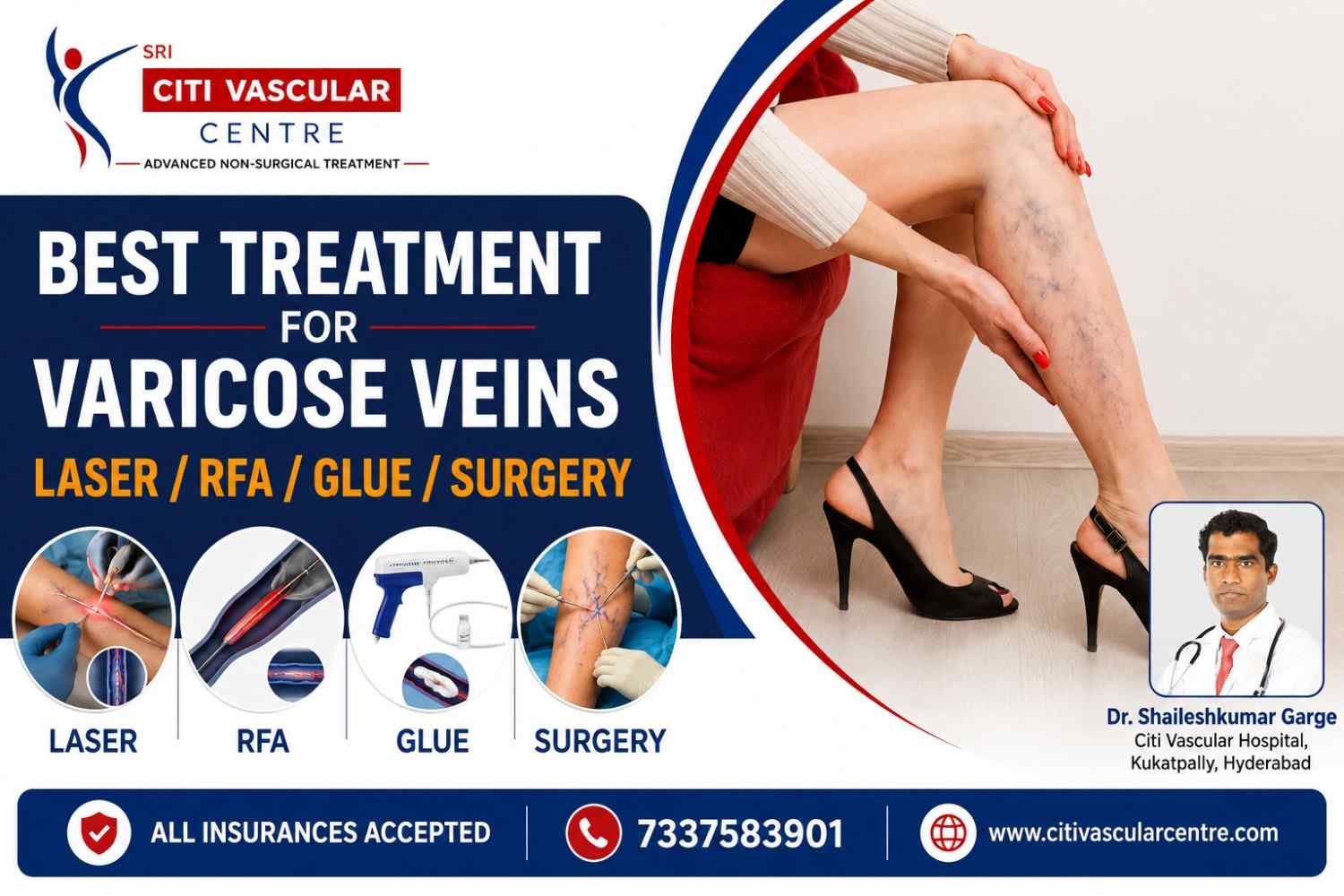
In 2026, five treatment options exist for varicose veins in Hyderabad — traditional surgical stripping, radiofrequency ablation (RFA), endovenous laser treatment (EVLT), VenaSeal cyanoacrylate glue closure, and foam sclerotherapy. All five are effective. The differences lie in HOW treatment is delivered, how quickly patients recover, what anaesthesia is required, which vein sizes and anatomies each technique best serves, and which risks are specific to each method.
Traditional surgery has been the standard treatment for decades — and remains valid for specific situations, particularly complex anatomy and perforator disease. However, NICE UK (National Institute for Health and Care Excellence), the European Society for Vascular Surgery, and the American Venous Forum all now recommend minimally invasive endovenous techniques (RFA, EVLT, VenaSeal) as FIRST-LINE treatment for truncal saphenous reflux — replacing surgery for most patients.
At Citi Vascular Hospital, KPHB, Hyderabad, Dr. Shaileshkumar Garge — FRCR (UK), FNVIR (CMC Vellore), EBIR (Spain), Fellowship (North Carolina, USA) — offers all five techniques under one roof. Every patient receives a duplex Doppler assessment and an individualised treatment recommendation — not a single protocol applied universally. This comparison guide explains every dimension of the decision so you can arrive at your consultation fully informed.
All 5 Varicose Vein Treatments Available — One Consultation Determines Yours
Citi Vascular Hospital, KPHB, Hyderabad | Dr. Garge FRCR (UK) | Duplex Doppler + All Techniques
Call +91-73375 83901 | WhatsApp | citivascularcentre.com
Book your Appointment here: | Appoinment: |Call +91-7032508468| Whatsapp:+91-7337583901
|
Feature |
Surgery |
RFA |
EVLT (Laser) |
VenaSeal (Glue) |
Foam Sclerotherapy |
|
Mechanism |
Physical vein removal |
RF heat 85C seals vein |
Laser heat seals vein |
Glue bonds vein walls |
Chemical sclerosant destroys vein |
|
Target Vein |
GSV/SSV + all |
GSV/SSV (straight) |
GSV/SSV (any) |
GSV/SSV (any) |
Tributaries + spider veins |
|
Uses Heat? |
No |
Yes - 85C |
Yes - laser |
No |
No |
|
Surgical Incision? |
Yes - multiple |
No - 2mm needle |
No - 2mm needle |
No - 2mm needle |
No - fine needle |
|
Anaesthesia |
General/Spinal |
Tumescent local (30-60 inj) or SA |
Tumescent local (30-60 inj) or SA |
1 local injection only |
None / topical cream |
|
Hospital Stay |
1-2 days |
Same day |
Same day |
Same day |
Same day |
|
Walking After |
Next day |
Immediately |
Immediately |
Immediately |
Immediately |
|
Return to Desk Work |
2-6 weeks |
1-3 days |
1-3 days |
1-2 days |
Same/next day |
|
Return to Physical Work |
4-6 weeks |
1-2 weeks |
1-2 weeks |
1-2 weeks |
1-2 weeks |
|
Visible Bruising |
Significant |
Moderate |
More than RFA |
Minimal |
Minimal |
|
Visible Scar |
Yes - multiple |
None |
None |
None |
None |
|
Compression Stockings |
2-4 weeks |
2 weeks |
2 weeks |
1 week or none |
1-2 weeks |
|
Closure Rate (1yr) |
95-98% (stripping) |
95-98% |
95-98% |
95-97% |
80-95% (UGFS) |
|
Hydrocele/Nerve Risk |
1-3% nerve | 2-5% lymphocele |
1-5% nerve (heat) |
1-5% nerve (heat) |
< 0.5% nerve (no heat) |
< 1% (no heat) |
|
Bilateral Same Session? |
Usually 2 ops |
Yes - single visit |
Yes - single visit |
Yes - single visit |
Yes - single visit |
|
Best For |
Complex anatomy | perforators | GSV > 20mm |
Standard GSV/SSV | good access |
Any GSV/SSV | small/tortuous veins |
Needle-anxious | no stocking | tortuous |
Spider veins | tributaries | adjunct |
|
Sessions Required |
1 (definitive) |
1 (usually) |
1 (usually) |
1 (usually) |
1-3 (may need repeat) |
|
Cost Hyderabad |
Rs 40K-60K/leg |
Rs 50K-80K/leg |
Rs 50K-80K/leg |
Rs 80K-1L/leg |
Rs 15K-40K/session |
|
NICE UK Guidance |
3rd line (after endo fails) |
First-line |
First-line |
First-line |
Adjunct to first-line |
IMPORTANT: This table provides general guidance only. The right treatment for YOU depends on your specific vein anatomy, vein diameter, tortuosity, bilateral involvement, prior surgery history, allergy status, and personal recovery needs — determined at your duplex Doppler consultation with Dr. Garge at Citi Vascular KPHB.
TREATMENT 1: TRADITIONAL SURGERY (Vein Stripping/Phlebectomy)
Surgical stripping (conventional varicocelectomy) involves making multiple incisions at the groin and ankle, physically tying the saphenofemoral junction, and removing the great saphenous vein by threading a stripper probe through it and pulling it out. Larger tributary varicosities are avulsed (pulled out) through additional small cuts along the leg. General or spinal anaesthesia, 1-2 days in hospital, and 2-6 weeks recovery.
Current Role of Surgery: Surgery is now THIRD-LINE per NICE UK guidelines — recommended only when endovenous techniques are technically not feasible or have failed. It remains the best option for very large veins (> 20mm), complex anatomical variants, perforator incompetence requiring direct ligation, and recurrent disease where endovenous access is not possible.
TREATMENT 2: RFA — RADIOFREQUENCY ABLATION
RFA (ClosureFast system) uses a catheter inserted through a 2mm needle puncture to deliver radiofrequency electrical energy at 85 degrees C to the great saphenous vein wall in segmental 20-second cycles — thermally collapsing and sealing it. Tumescent local anaesthesia (30-60 small injections) is required along the vein. Same-day discharge, 1-3 days recovery. Preferred for straight veins 5-15mm in diameter.
TREATMENT 3: EVLT — ENDOVENOUS LASER TREATMENT (Laser Ablation)
EVLT uses a laser fibre (810nm or 1470nm wavelength) inserted through a 2mm needle puncture to deliver pulsed laser energy along the length of the diseased saphenous vein — thermally damaging the endothelium and sealing the vein. Like RFA, EVLT requires tumescent local anaesthesia (30-60 injections) along the vein. Same-day discharge, 1-3 days recovery. EVLT is more flexible than RFA and navigates tortuous veins better.
TREATMENT 4: VenaSeal — CYANOACRYLATE GLUE CLOSURE
VenaSeal uses a catheter to deliver medical-grade cyanoacrylate adhesive every 3cm along the diseased saphenous vein under duplex Doppler guidance — the glue bonds vein walls together on contact with blood. NO heat, NO tumescent anaesthesia (only 1 entry-point injection), NO compression stockings typically required. Shortest recovery (1-2 days). Cannot be used if patient has cyanoacrylate allergy.
TREATMENT 5: FOAM SCLEROTHERAPY (UGFS + CSS)
Foam sclerotherapy converts a liquid sclerosant (polidocanol or STS) into stable microfoam using the Tessari technique (1:4 ratio) and injects it into diseased veins via fine needle — chemically destroying the vein wall. Used primarily for varicose tributaries, spider veins, and residual veins after thermal ablation. No anaesthesia for most applications. May need 1-3 sessions. Key risks: pigmentation (10-30%) and visual disturbance via PFO (< 1%).
|
Anaesthesia Factor |
Surgery |
RFA |
EVLT |
VenaSeal |
Foam Sclero |
|
Type Required |
General or spinal |
Tumescent local |
Tumescent local |
Local (1 inj) |
None usual |
|
Injections Needed |
1 IV line |
30-60 injections |
30-60 injections |
1 injection |
0-2 injections |
|
Conscious During? |
No |
Yes - awake |
Yes - awake |
Yes - awake |
Yes - awake |
|
Anaesthetic Risk |
GA risk (1-3% adverse) |
Minimal |
Minimal |
Minimal |
None |
|
Drive Home After? |
No |
Usually not Day 0 |
Usually not Day 0 |
Yes - same day |
Yes - same day |
|
Fasting Required? |
Yes - 6+ hours |
No |
No |
No |
No |
Who Should Care About Anaesthesia Choices: Men and women with respiratory conditions, sleep apnoea, or prior anaesthetic reactions should discuss with Dr. Garge — these patients are particularly suited to VenaSeal or foam sclerotherapy which require essentially no anaesthetic. For patients on blood thinners (anticoagulants), the reduced surgical trauma of endovenous techniques is a significant safety advantage over surgery.
|
Recovery Stage |
Surgery |
RFA |
EVLT |
VenaSeal |
Foam Sclero |
|
Day of Procedure |
Hospital ward | pain controlled |
Walk + home same day |
Walk + home same day |
Walk + home same day |
Walk + home same day |
|
Day 1-2 |
Hospital or home rest | wound care | catheter removal |
Mild bruising | desk work Day 2 |
Bruising | desk work Day 2 |
Minimal bruise | desk Day 1-2 |
Walk normally | desk same/next day |
|
Day 3-7 |
Home recovery | pain managed | no driving |
Driving Day 3-5 | mild tightness |
Driving Day 3-5 | bruising peaks |
Driving Day 1-2 | almost normal |
Normal activities | stocking worn |
|
Week 1-2 |
Office work begins for sedentary workers |
Light exercise | compression stockings |
Light exercise | stockings |
Full activity Week 1 | no stockings often |
Light exercise | stockings |
|
Week 2-4 |
Physical work begins | wounds healing |
Gym/cycling | stocking off |
Gym/cycling | stocking off |
Gym/cycling | veins fading |
Veins fading | next session if needed |
|
Month 1-3 |
Full recovery | scars healing |
Treated vein absorbed | 3-month Doppler |
Vein absorbed | 3-month Doppler |
Vein fading | 3-month Doppler |
Veins clearing | further session if needed |
|
Overall Recovery |
2-6 weeks |
1-3 days (desk) |
1-3 days (desk) |
1-2 days (desk) |
Same/next day |
|
Pain Factor |
Surgery |
RFA |
EVLT |
VenaSeal |
Foam |
|
During Procedure |
Asleep - nil |
Pressure felt | no pain (tumescent active) |
Pressure felt | slightly more than RFA |
One injection sting only |
Tiny needle pricks |
|
Day 0-2 Post-Procedure |
Significant wound pain | opioid analgesia often |
Tightness + mild ache | paracetamol |
More bruising ache | paracetamol/ibuprofen |
Minimal | paracetamol |
Mild burning | paracetamol |
|
Day 3-7 |
Wound pain reducing | oral analgesics |
Cord sensation | mild |
Bruising ache | subsiding |
Almost none |
Mild tenderness |
|
Injection Discomfort |
1 IV cannula |
30-60 tumescent injections (main discomfort of RFA) |
30-60 tumescent injections |
1 injection only (best for needle-anxious) |
Fine needle pricks |
|
Post-Procedure Bruising |
Significant - multiple incision sites |
Moderate - tumescent bruising |
More than RFA - laser causes more bruising |
Minimal - no tumescent |
Minimal |
|
Overall Pain Rating |
Highest (4-7/10 Day 1) |
Low (2-3/10 Day 1) |
Low-Moderate (2-4/10 Day 1) |
Minimal (1-2/10 Day 1) |
Minimal (1-2/10) |
Published Evidence on Pain: Multiple randomised controlled trials including the EVOLVeS and e-VCLOSE trials consistently show VenaSeal produces the lowest post-procedure pain scores of all endovenous techniques. RFA shows lower pain than EVLT in head-to-head comparisons (CLASS trial). Surgery produces the highest pain scores and requires the most post-operative analgesia.
|
Outcome |
RFA |
EVLT (Laser) |
VenaSeal (Glue) |
Surgery |
|
Vein closure at 1 year |
95-98% |
95-98% |
95-97% |
95-98% |
|
Vein closure at 5 years |
85-90% |
80-90% |
90-94% |
85-90% |
|
Symptom improvement |
85-90% |
85-90% |
85-90% |
80-90% |
|
Patient satisfaction (1yr) |
90-95% |
85-90% |
> 90% |
75-85% |
|
DVT rate |
< 1% |
< 1% |
< 1% |
1-3% |
|
Nerve injury rate |
1-5% (heat risk) |
1-5% (heat risk) |
< 0.5% (no heat) |
1-3% |
|
Wound infection |
Not applicable |
Not applicable |
Not applicable |
2-5% |
|
Primary trial evidence |
EVOLVeS RCT |
CLASS RCT |
e-VCLOSE RCT |
Decades of data |
|
NICE UK recommendation |
First-line |
First-line |
First-line |
Third-line |
The Equivalence Conclusion: RFA, EVLT, and VenaSeal all achieve statistically equivalent vein closure rates to surgery at 1 and 5 years. The superiority of minimally invasive techniques is in HOW PATIENTS FEEL during recovery — not in the long-term efficacy of vein closure. Surgery has not been shown to produce better long-term results than any endovenous technique in major trials.
|
Unsure which technique suits you? Duplex Doppler at Citi Vascular KPHB determines the right technique for your specific vein anatomy. Call +91-73375 83901 |
All 5 techniques available at KPHB RFA | EVLT | VenaSeal | Foam Sclerotherapy | Surgery referral — all under one roof. WhatsApp for Quick Booking |
|
Risk Category |
Surgery |
RFA |
EVLT |
VenaSeal |
Foam Sclero |
|
Wound infection |
2-5% |
Not applicable |
Not applicable |
Not applicable |
< 0.5% |
|
DVT / PE |
1-3% |
< 1% |
< 1% |
< 1% |
< 1% (UGFS) |
|
Nerve injury / numbness |
1-3% (sensory) |
1-5% (heat) |
1-5% (heat) |
< 0.5% (no heat) |
< 0.5% |
|
Haematoma / bruising |
Significant bruising |
Moderate (tumescent) |
More bruising than RFA |
Minimal |
Mild |
|
Skin hyperpigmentation |
Along scar |
Minimal |
Minimal |
Minimal |
10-30% |
|
Glue allergy |
Not applicable |
Not applicable |
Not applicable |
3-5% |
Not applicable |
|
Visual disturbance |
Not applicable |
Not applicable |
Not applicable |
< 1% (no PFO risk) |
< 1% (PFO risk) |
|
Surgical scar |
Multiple scars |
None |
None |
None |
None |
|
Lymphoedema risk |
1-3% (lymph disruption) |
< 1% |
< 1% |
< 1% |
< 1% |
For full component-by-component cost breakdown, insurance details, and EMI amounts — see our dedicated Varicose Vein Treatment Cost Guide at citivascularcentre.com
|
Cost Factor |
Surgery |
RFA / EVLT |
VenaSeal |
Foam Sclero |
|
Procedure cost per leg |
Rs 30K-60K |
Rs 50K-80K |
Rs 80K-1L |
Rs 15K-40K per session |
|
Hospital stay cost |
Rs 5K-15K per night |
Nil - day care |
Nil - day care |
Nil - day care |
|
Days off work (lost income) |
14-42 days (at Rs 1K/day = Rs 14K-42K) |
1-3 days (Rs 1K-3K) |
1-2 days (Rs 1K-2K) |
0-1 day (minimal) |
|
Bilateral treatment |
2 separate operations |
Both legs one session |
Both legs one session |
Both legs one session |
|
Sessions needed |
1 definitive |
1 (usually) |
1 (usually) |
1-3 |
|
Total economic cost estimate |
Rs 55K-1.35L (including stay + days off) |
Rs 52K-84K (minimal indirect costs) |
Rs 82K-1.02L |
Rs 15K-55K (multiple sessions) |
'Which Treatment Is Right for Me?' — Decision Flowchart
|
Step |
Check This Question |
YES — Direction |
NO — Direction |
|
1 |
Is main vein (GSV/SSV) reflux confirmed on Doppler? |
Endovenous technique (RFA/EVLT/VenaSeal) is first-line |
Sclerotherapy for isolated spider/reticular veins |
|
2 |
Do you have a known cyanoacrylate (glue) allergy? |
Exclude VenaSeal — RFA or EVLT is preferred |
VenaSeal is an option if needle-anxious |
|
3 |
Is the saphenous vein tortuous (winding) or very small? |
VenaSeal or EVLT preferred over RFA (flexible catheters navigate tortuous veins better) |
RFA is optimal for straight veins 5-15mm diameter |
|
4 |
Do you have bilateral varicose veins (both legs)? |
All 3 endovenous techniques treat bilateral in one session - vs surgery needing 2 operations |
Single leg — any technique appropriate |
|
5 |
Are you extremely anxious about multiple needle injections? |
VenaSeal: 1 injection only vs 30-60 for RFA/EVLT |
RFA or EVLT are both appropriate options |
|
6 |
Can you not wear compression stockings (skin/arterial disease)? |
VenaSeal: often no compression stocking required |
RFA/EVLT: 2 weeks stocking required |
|
7 |
Is anatomy too complex for endovenous access (very large > 20mm / recurrent with scarring)? |
Surgery or combined approach — discuss with Dr. Garge |
Endovenous technique feasible - proceed to assessment |
|
8 |
Are residual spider or tributary veins the main concern? |
Foam sclerotherapy — alone or combined with truncal ablation |
Truncal ablation as the primary procedure |
Patient Profile Match Table
|
Patient Profile |
Recommended Technique |
Second Option |
Reason |
|
Standard GSV reflux, straight vein, no allergy |
RFA |
EVLT or VenaSeal |
RFA is gold-standard first-line for straightforward GSV — excellent evidence base |
|
Tortuous or small GSV, difficult anatomy |
EVLT |
VenaSeal |
Laser fibre flexibility navigates tortuous veins better than rigid RFA catheter |
|
Needle-anxious patient, wants minimal injections |
VenaSeal |
Foam sclerotherapy (if smaller veins) |
VenaSeal requires 1 injection only vs 30-60 tumescent for RFA/EVLT |
|
Cannot wear compression stockings post-procedure |
VenaSeal |
Discuss individually |
VenaSeal often requires no compression stockings — unique advantage |
|
Bilateral disease, both legs confirmed |
Any endovenous technique |
Not surgery |
All three endovenous techniques treat bilateral in ONE session vs surgery needing 2 operations |
|
Spider veins / thread veins only (cosmetic) |
Foam sclerotherapy (CSS) |
Microsclerotherapy |
Spider veins are treated by sclerotherapy — RFA/EVLT/VenaSeal are for truncal saphenous veins only |
|
Residual tributaries after prior RFA/EVLT |
Foam sclerotherapy (UGFS) |
Micro-phlebectomy |
Sclerotherapy specifically designed for post-ablation tributary clearance |
|
Complex anatomy: GSV > 20mm, perforators, recurrent scarring |
Surgery (discussion) |
Endovenous with larger catheter |
Very large or recurrently operated veins may require surgical approach — discuss at consultation |
|
Cyanoacrylate allergy confirmed |
RFA or EVLT |
Not VenaSeal |
Glue allergy = absolute contraindication to VenaSeal. RFA/EVLT equally effective alternative. |
|
PFO confirmed / high migraine history |
RFA or EVLT |
Not foam sclerotherapy |
PFO risk of visual disturbance = relative contraindication to foam. Thermal ablation or VenaSeal preferred. |
Book your Appointment here: | Appoinment: |Call +91-7032508468| Whatsapp:+91-7337583901
|
What Surgery Requires |
What Endovenous Offers Instead |
Clinical Impact |
|
|
1 |
General or spinal anaesthesia |
Local anaesthesia, SA or none at all |
No anaesthetic risk, no fasting, no post-GA nausea, no intubation |
|
2 |
1-2 days in hospital |
Day care — home same day |
No hospital admission cost, no hospital stay disruption to work/family |
|
3 |
Multiple skin incisions + stitches |
2mm needle puncture only |
No surgical scar, no wound care, no stitch removal appointment |
|
4 |
2-6 weeks off work |
1-3 days (desk) | 1-2 weeks (physical) |
Major economic advantage — most patients lose < 3 working days |
|
5 |
Significant post-operative pain |
Mild tightness and bruising only |
Oral paracetamol sufficient for most endovenous patients — opioids rarely needed |
|
6 |
2-4 weeks compression stockings |
1-2 weeks (or none for VenaSeal) |
Faster return to normal clothing and daily routine |
|
7 |
Wound infection risk (2-5%) |
No wound — no infection risk |
Particularly important for diabetic patients and immunosuppressed individuals |
|
8 |
Lymphoedema risk (1-3%) |
< 1% — no lymph node dissection |
Major long-term quality of life advantage — lymphoedema is lifelong once established |
|
9 |
Equivalent long-term success rates |
Equivalent long-term success rates |
Same 5-year efficacy — no clinical justification for surgery as first-line for treatable anatomy |
NICE UK Statement (2013, updated 2022): 'Offer endovenous ablation (laser or radiofrequency ablation) first to people with truncal varicose veins who are suitable for treatment. If endovenous ablation is not suitable, offer ultrasound-guided foam sclerotherapy. If foam sclerotherapy is not suitable, offer conventional surgery.' This hierarchy places surgery definitively at third-line for suitable anatomy.
|
Differentiator |
Specific Evidence |
What This Means for You |
|
All 5 Techniques Available In-House |
RFA | EVLT | VenaSeal | Foam Sclerotherapy | Micro-Phlebectomy — all at Citi Vascular KPHB. Surgery referral coordinated when needed. |
Your recommended technique is based on what is genuinely best for YOUR anatomy — not what the clinic is limited to offering |
|
Triple International Credentials |
FRCR (Royal College of Radiologists, UK) + FNVIR (CMC Vellore) + EBIR (European Board of IR, Spain) + Fellowship (North Carolina, USA) |
Three of the highest international certifications in interventional radiology — verified and globally recognised |
|
NICE UK Guidelines Applied |
Dr. Garge follows NICE UK and ESVS guidelines in treatment selection — endovenous first, surgery reserved for appropriate indications |
You receive internationally guideline-compliant care — not legacy practice |
|
Duplex Doppler Anatomy-Based Decision |
Every treatment recommendation follows a complete duplex Doppler assessment — vein diameter, tortuosity, bilateral involvement, junction anatomy |
Technique selected on anatomical evidence — not patient preference alone or single-technique bias |
|
Genuine Two-Way Consultation |
All options are explained with clinical evidence including advantages, limitations, and applicable trials for each technique |
You make an informed, shared decision — not a prescribed treatment without explanation |
|
12+ Years and 15,000+ Procedures |
Dedicated minimally invasive vascular interventions at Citi Vascular Hospital, KPHB, Hyderabad |
High-volume specialist: consistent technique, refined outcomes, lower complication rates across all 5 techniques |
|
One-Stop Combined Treatment |
RFA/EVLT/VenaSeal + phlebectomy + foam sclerotherapy all performed in the same session when appropriate |
Complete varicose vein clearance in 1-2 visits rather than multiple procedures at different centres |
|
What We Offer |
Specifics |
Why It Matters |
|
All Endovenous Techniques In One Centre |
RFA generator + EVLT laser unit + VenaSeal system + sclerosant foam + phlebectomy kit — all available at KPHB |
One consultation, one Doppler, one centre — no referrals to different specialists for different techniques |
|
High-Resolution Duplex Doppler |
Pre-procedure duplex vein mapping and real-time intra-procedure guidance — available on-site |
One-stop: Doppler + treatment planning + procedure in the same facility |
|
Same-Day Discharge Protocol |
Standard for RFA, EVLT, VenaSeal, and foam sclerotherapy. Patient walks in, is treated, walks out same day. |
No hospital admission, no ward stay, minimal disruption to work and family |
|
Insurance and Cashless |
All major TPAs and mediclaim. Pre-auth documentation by Citi Vascular team for medically indicated treatment. |
Insurance paperwork handled by us — you focus on recovery |
|
Technique-Neutral Recommendation |
Dr. Garge does not have a single-technique preference — he recommends what the Doppler anatomy dictates |
You receive an unbiased recommendation rather than the technique the clinic defaults to |
|
1-Week Post-Procedure Doppler |
All endovenous procedures include 1-week follow-up Doppler to confirm closure and screen for DVT/EHIT |
Evidence-based safety protocol — not optional or an additional charge |
|
Patient |
Clinical Situation |
Treatment Selected |
Key Reason for Choice |
|
Kavitha, 48, Teacher |
Left leg GSV reflux 7mm | bilateral visible varicosities | standing 6 hrs/day |
RFA Left GSV + UGFS for residual tributaries |
Standard GSV anatomy — RFA optimal. Tributaries cleared with sclerotherapy same session. |
|
Arun, 41, IT Manager |
Both legs confirmed reflux | bilateral visible veins | worried about 2+ weeks off work |
Bilateral VenaSeal |
Both sides in ONE session | 1-2 days return to work | only 1 injection per leg |
|
Padma, 55, Diabetic |
Right GSV reflux | skin changes (lipodermatosclerosis) | diabetes | concerned about infection |
RFA Right GSV |
No surgical wound = no infection risk. Critical for diabetic patient. |
|
Rahul, 32, Post-Prior Surgery |
Left GSV recurrence after surgical stripping 4 years ago | now visible tributaries + residual reflux |
EVLT (or VenaSeal) + UGFS |
Endovenous approaches avoid re-dissection of scarred surgical field |
|
Sunita, 38, Spider Veins Only |
No GSV reflux on Doppler | bilateral thigh spider veins | cosmetic concern only |
Conventional surface sclerotherapy (CSS) |
No truncal reflux = no truncal ablation needed. Spider veins = sclerotherapy first-line. |
|
Venkat, 60, Complex Anatomy |
GSV diameter 22mm | recurrent post-surgery | failed prior UGFS | dense perforator disease |
Surgical referral + combined approach |
Very large GSV > 20mm + perforator disease + prior treatment failure — surgery appropriate |
|
Credential |
Detail |
|
Full Name |
Dr. Shaileshkumar Garge |
|
Qualifications |
MBBS | MD (Mumbai) | DNB (Delhi) | FRCR (UK) | FNVIR (CMC Vellore) | EBIR (Spain/Europe) | Fellowship (North Carolina, USA) |
|
Role |
Director and Chief Vascular Physician | Senior Consultant Vascular and Interventional Radiologist |
|
Hospital |
Citi Vascular Hospital, KPHB Colony, Road No. 1, Hyderabad, Telangana 500072 |
|
All Techniques Performed |
RFA (ClosureFast) | EVLT (810nm/1470nm laser) | VenaSeal (cyanoacrylate) | MOCA | Foam Sclerotherapy (UGFS + CSS) | Micro-Phlebectomy |
|
Experience |
12+ years | 15,000+ minimally invasive vascular procedures across Hyderabad and Telangana |
|
Guideline Adherence |
NICE UK | ESVS (European Society for Vascular Surgery) | ACP guidelines followed in treatment selection |
|
Last Review |
June 2026 — this comparison article medically written and reviewed by Dr. Shaileshkumar Garge |
Q1: Which is better for varicose veins — surgery or laser (EVLT)?
For most patients with truncal saphenous reflux in 2026, EVLT laser treatment is clinically superior to surgery in practical terms — same 95-98% closure rates but same-day discharge, local anaesthesia only, 1-3 day return to work vs 2-6 weeks for surgery, no surgical scar, and significantly less post-procedure pain. NICE UK guidelines recommend EVLT as first-line ahead of surgery. Surgery remains appropriate for complex anatomy or when endovenous access is not feasible.
Q2: Is VenaSeal glue better than laser (EVLT) for varicose veins?
VenaSeal and EVLT achieve equivalent closure rates (95-97% vs 95-98% at 1 year). VenaSeal advantages over EVLT: only 1 anaesthetic injection vs 30-60 tumescent injections, less post-procedure bruising, often no compression stockings required, and no thermal nerve injury risk. EVLT advantages: better suited to very tortuous or small veins. Choice depends on vein anatomy confirmed by duplex Doppler — Dr. Garge offers both at Citi Vascular KPHB.
Q3: What is the difference between RFA and EVLT laser for varicose veins?
Both RFA and EVLT use heat energy via catheter to seal the diseased saphenous vein permanently — both require tumescent local anaesthesia (30-60 injections), achieve 95-98% closure at 1 year, and give same-day discharge. The key clinical differences: RFA produces less post-procedure bruising and pain than EVLT (CLASS trial data) but is less flexible for tortuous veins. EVLT laser fibres navigate tortuous anatomy better. Dr. Garge selects based on your vein anatomy.
Q4: Which varicose vein treatment has the fastest recovery?
VenaSeal has the fastest recovery of all varicose vein treatments: return to desk work in 1-2 days, drive home same day, compression stockings often not required, and minimal post-procedure bruising or discomfort. RFA and EVLT: 1-3 days to desk work. Foam sclerotherapy: same or next day. Traditional surgery: 2-6 weeks. Fastest to slowest: VenaSeal = Foam Sclero > RFA > EVLT >> Surgery.
Q5: Is laser treatment or surgery better for large varicose veins?
For large varicose veins with confirmed saphenous reflux on Doppler, EVLT or RFA are preferred over surgery for veins up to approximately 15-20mm in diameter. Beyond 20mm, vein walls are thicker and the heat energy may be less effective — surgery becomes a stronger consideration. VenaSeal can treat larger veins but may require higher glue volumes per segment. All large vein cases are assessed individually at duplex Doppler consultation.
Q6: Can I choose my own varicose vein treatment?
Patient preference is important and always discussed at Citi Vascular KPHB — but the final recommendation is anatomy-guided. Vein diameter, tortuosity, bilateral involvement, allergy status, and prior treatment history determine feasibility. For example, if you prefer VenaSeal but have a known cyanoacrylate allergy, RFA or EVLT will be recommended instead. Dr. Garge openly discusses all options and their trade-offs at your duplex Doppler consultation.
Q7: Is surgery for varicose veins still done in Hyderabad in 2026?
Yes — surgical vein stripping is still performed in Hyderabad in 2026, but its role has significantly narrowed. NICE UK guidelines place surgery as THIRD-LINE — recommended only when endovenous techniques are technically not feasible (very large veins > 20mm, complex perforator disease, dense post-surgical scarring, or failed prior endovenous treatment). Most patients with straightforward saphenous reflux are now treated with RFA, EVLT, or VenaSeal instead.
Q8: What is the success rate comparison of all varicose vein treatments?
At 1 year: Surgery 95-98% | RFA 95-98% | EVLT 95-98% | VenaSeal 95-97%. All four achieve statistically equivalent closure rates — confirmed in major randomised controlled trials (EVOLVeS, CLASS, e-VCLOSE). Foam sclerotherapy (UGFS): 80-95% for tributaries (lower, but targets smaller veins). The superiority of minimally invasive techniques is not in long-term efficacy — it is in faster recovery, less pain, and fewer complications during the recovery period.
Q9: How many varicose vein procedures will I need?
RFA, EVLT, and VenaSeal typically treat the main saphenous vein in ONE session. Foam sclerotherapy for tributaries or spider veins may need 1-3 sessions at 4-6 week intervals. Surgery is a single definitive operation. A combined approach — RFA/EVLT/VenaSeal + same-session sclerotherapy and phlebectomy for tributaries — achieves complete clearance in 1-2 total visits at Citi Vascular Hospital, KPHB, without multiple return procedures.
Q10: Is varicose vein treatment covered by insurance in Hyderabad?
Yes — medically indicated varicose vein treatment (causing pain, swelling, skin changes, or venous ulcers) is covered by most insurance policies in Hyderabad when confirmed by duplex Doppler. Pre-authorisation documentation is required. Cosmetic treatment (spider veins only, no symptoms) is generally not covered. Citi Vascular Hospital, KPHB, prepares and submits all pre-authorisation documents on your behalf. Call +91-73375 83901.
Citi Vascular Hospital, KPHB Colony, Road No. 1, Hyderabad — all 5 varicose vein treatment techniques available for patients from:
Kukatpally and KPHB — 5 min drive
Miyapur and Bachupally — 10 min
Hitech City and Madhapur — 20 min
Ameerpet and SR Nagar — 20 min
Gachibowli and Kondapur — 25 min
Secunderabad and Begumpet — 25 min
Kompally, Medchal and Alwal — 20-25 min
Telangana and Andhra Pradesh — outstation consultations welcome
|
Hospital |
Contact |
Hours |
|
Citi Vascular Hospital |
+91-73375 83901 |
KPHB Colony, Road No. 1, Hyderabad, Telangana 500072 | Mon-Sat 9AM-6PM |
|
Online Booking |
citivascularcentre.com |
WhatsApp + online | Same-day Doppler + treatment possible | Insurance assisted |