LAST MEDICALLY REVIEWED:
September 2026 — Dr. Shaileshkumar Garge
Citi Vascular Hospital, KPHB Colony, Road No. 1, Hyderabad, Telangana 500072
⚡ QUICK ANSWER
RFA Treatment for Varicose Veins in Hyderabad — Key Facts
Radiofrequency Ablation (RFA) | 95%+ closure rate | Local anaesthesia | No incision | Same-day discharge | 1–3 day return to work | Walk same day | Dr. Garge FRCR (UK) | Citi Vascular KPHB, Hyderabad
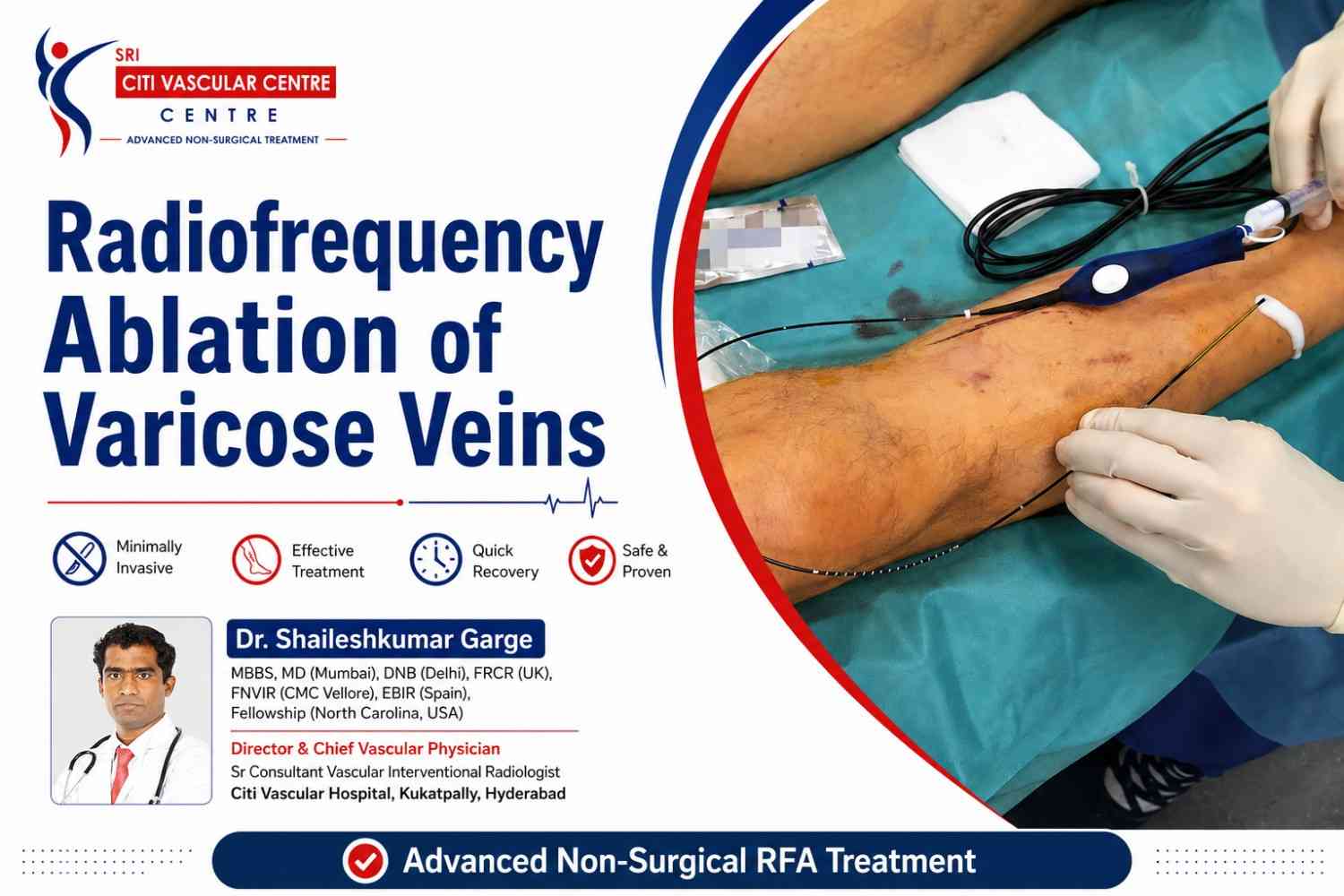
Radiofrequency Ablation (RFA) for varicose veins is a minimally invasive, ultrasound-guided procedure that permanently closes diseased leg veins using controlled heat energy — without any surgical incision, general anaesthesia, or overnight hospital admission. It achieves over 95% technical closure rates with same-day discharge, walking immediately after the procedure, and return to office work within 1–3 days.
At Citi Vascular Hospital, KPHB Colony, Hyderabad, RFA is performed by Dr. Shaileshkumar Garge — FRCR (UK), FNVIR (CMC Vellore), EBIR (Spain) — using real-time duplex Doppler ultrasound guidance throughout every stage of the procedure. Dr. Garge selects the most appropriate thermal or non-thermal ablation technique — RFA, EVLT (laser), VenaSeal (glue), or MOCA — based on vein anatomy, diameter, and individual patient factors.
This complete guide covers everything about RFA for varicose veins: how radiofrequency ablation works, who is suitable, the 8-step procedure in full clinical detail, anaesthesia options, recovery timeline with Dos & Don'ts, success rates with clinical data, risks and management, and how RFA compares to surgery, laser, and newer vein glue techniques — helping patients in Hyderabad make a fully informed decision.
Book RFA Varicose Vein Consultation — Citi Vascular Hospital, KPHB, Hyderabad
+91-73375 83901 | WhatsApp | citivascularcentre.com
RFA | EVLT | VenaSeal | MOCA — All Options | Dr. Garge FRCR (UK) | 95%+ Success | Same-Day Discharge
Book your Appointment here: | Appoinment: |Call +91-7032508468| Whatsapp:+91-7337583901
|
Feature |
RFA — Radiofrequency Ablation |
|
Procedure Name |
Radiofrequency Ablation (RFA) | Also known as: ClosureFast / VNUS Closure / RFA Thermal Ablation |
|
Mechanism |
Controlled radiofrequency heat (85–120°C) delivered via catheter — seals vein wall permanently |
|
Surgical Incision? |
❌ No — 2mm needle puncture under ultrasound guidance only |
|
Anaesthesia |
Local anaesthesia (tumescent) or Spinal anesthesia — no general anaesthesia required |
|
Hospital Stay |
Same-day discharge — day-care procedure |
|
Procedure Duration |
30–60 minutes per leg — depending on number of veins and extent of disease |
|
Walking After? |
✅ Yes — soon after procedure with compression stockings |
|
Return to Work |
1–3 days for desk work | 1–2 weeks for standing jobs |
|
Technical Success Rate (Closure) |
95–98% at 1 year | 85–90% at 5 years |
|
Visible Scar? |
None — 2mm needle mark fades within days |
|
Compression Stockings Required? |
Yes — worn for 1–2 weeks post-procedure |
|
Suitable Vein Size |
Great Saphenous Vein (GSV) and Small Saphenous Vein (SSV) | typically 5–15mm diameter |
|
Bilateral Treatment |
Both legs can be treated in a single session if clinically appropriate |
|
Available At |
Citi Vascular Hospital, KPHB Colony, Road No. 1, Hyderabad — Dr. Shaileshkumar Garge FRCR (UK) |
Definition and Clinical Context
Radiofrequency Ablation (RFA) is an endovenous thermal ablation procedure — meaning the treatment is delivered INSIDE the vein (endo = inside) using heat (thermal) to ablate (destroy and seal) the diseased vessel. A flexible catheter is inserted through a tiny needle puncture in the leg under ultrasound guidance and advanced to the diseased section of the great saphenous vein (GSV) or small saphenous vein (SSV).
Radiofrequency energy — a form of electrical energy in the 460–500 kHz frequency range — is delivered through the catheter tip, heating the vein wall to 85–120°C. This controlled heat causes the collagen in the vein wall to contract and the vessel to seal permanently. The treated vein gradually fibroses (scars) and is reabsorbed by the body over 6–12 months, leaving no residual vessel.
RFA vs Open Surgery — The Essential Difference
|
What Happens |
RFA (Radiofrequency Ablation) |
Traditional Surgical Stripping |
|
How vein is treated |
Sealed FROM INSIDE using radiofrequency heat via catheter |
Physically removed — incision made, vein stripped out |
|
Access |
2mm needle puncture under ultrasound |
Multiple surgical incisions in leg and groin |
|
Anaesthesia |
Local (tumescent) or spinal anaesthesia only |
General or spinal anaesthesia |
|
Hospital Stay |
Same day — go home within hours |
Usually 1–2 days |
|
Walking |
soon after procedure |
Next day typically |
|
Recovery |
1–3 days to office work |
2–6 weeks for full activity |
|
Bruising/Scarring |
Minimal — compression mark only |
Significant bruising and surgical scars |
→ For varicose vein causes, symptoms, and basics: see our dedicated Varicose Veins Guide
→ For full cost breakdown and insurance: see our Varicose Veins Cost Guide
The Physics of Radiofrequency Heat Ablation
RFA works through resistive heating — when radiofrequency electrical current passes through tissue, electrical resistance generates heat. The catheter tip (electrode) delivers this energy to the vein wall in a controlled, segmental fashion. Each segment of the vein is treated for 20 seconds at 85°C — causing immediate thermal damage to the endothelium, collagen contraction, and permanent vein sealing.
|
Stage |
Phase |
What Happens Inside the Vein |
Result |
|
1 |
Catheter Heating |
RF energy at 460–500 kHz heats catheter tip to 85–120°C |
Endothelial destruction within seconds |
|
2 |
Collagen Contraction |
Heat denatures collagen fibres in the vein wall — immediate shrinkage |
Vein diameter reduces; wall thickens |
|
3 |
Vein Sealing |
Vein walls fuse together — lumen permanently closed, no blood can flow through |
Vein sealed — occlusion confirmed on Doppler |
|
4 |
Blood Rerouting |
Venous blood immediately reroutes through deeper, healthy venous channels |
Varicose vein pressure eliminated |
|
5 |
Fibrosis (Weeks) |
Treated vein progressively fibroses (scar tissue) over 4–12 weeks |
Vein shrinks and becomes invisible under skin |
|
6 |
Reabsorption (Months) |
Body gradually reabsorbs the fibrosed vein over 6–12 months |
Complete — treated vessel disappears |
Tumescent Anaesthesia — The Key to Painless RFA
Tumescent anaesthesia is what makes RFA possible under local anaesthesia. A dilute solution of local anaesthetic (lidocaine) mixed with saline and adrenaline is infiltrated around the diseased vein under ultrasound guidance before the catheter is activated. This creates a protective 'jacket' of fluid around the vein that: (1) numbs the area completely, (2) compresses the vein onto the catheter for better contact, (3) dissipates heat away from surrounding tissues, preventing thermal injury to nerves and skin.
|
Clinical Profile |
RFA Suitable? |
Clinical Rationale |
|
Duplex Doppler confirmed great saphenous vein (GSV) reflux |
✅ Yes — first-line |
RFA is the gold-standard endovenous technique for GSV incompetence |
|
Small saphenous vein (SSV) reflux with posterior knee varicosities |
✅ Yes |
SSV also amenable to RFA — catheter approach adjusted to SSV anatomy |
|
Leg pain, heaviness, swelling with confirmed venous reflux |
✅ Yes |
RFA eliminates the refluxing vein — venous hypertension resolved |
|
Visible bulging varicose veins in thigh + calf |
✅ Yes + Phlebectomy |
RFA seals the feeding truncal vein; micro-phlebectomy removes visible clusters at same session |
|
Venous skin changes (lipodermatosclerosis, pigmentation) |
✅ Yes — urgent |
Progressive skin damage without treatment — early RFA prevents venous ulcer formation |
|
Active or healed venous ulcer |
✅ Yes — priority |
Underlying venous reflux must be treated for ulcer to heal and prevent recurrence |
|
Recurrent varicose veins after prior surgery |
✅ Yes |
RFA can treat recurrent saphenous incompetence without re-exploration of prior surgical field |
|
Patient wants bilateral leg treatment |
✅ Yes — both legs same session possible |
Both GSV or SSV ablations can be performed in one visit if appropriate anatomically |
|
Straight saphenous vein diameter 5–15mm |
✅ Yes — optimal |
Optimal RFA catheter contact with vein wall requires relatively straight, appropriately-sized vessels |
|
Vein > 15mm diameter or markedly tortuous |
⚠️ Consider EVLT/VenaSeal |
Very large or tortuous veins may have lower RFA closure rates — alternative technique may be preferred |
|
Contraindication |
Suitability for RFA |
Alternative Approach |
|
Active Deep Vein Thrombosis (DVT) |
❌ Contraindicated |
DVT must be fully treated and resolved before any vein ablation procedure |
|
Pregnancy |
❌ Contraindicated |
All elective varicose vein treatment deferred until after delivery and 3 months post-partum |
|
Severe peripheral arterial disease (ABPI < 0.5) |
❌ Contraindicated |
Compression stockings may worsen ischaemia — arterial disease must be assessed and treated first |
|
Inability to walk post-procedure |
❌ Not suitable |
Walking is essential post-RFA to prevent DVT — bedridden patients not candidates |
|
Very tortuous or large vein (>15mm) |
⚠️ Relative |
Consider EVLT (laser) or VenaSeal (cyanoacrylate glue) — better suited to tortuous anatomy |
|
Known allergy to local anaesthetic (lidocaine) |
⚠️ Assess |
Alternative local anaesthetic or controlled environment management — discuss pre-procedure |
|
Isolated cosmetic thread veins only (no truncal reflux) |
❌ Not indicated |
RFA treats truncal venous reflux — thread veins treated with sclerotherapy instead |
All candidacy assessments at Citi Vascular Hospital, KPHB, are based on duplex Doppler ultrasound findings — not visual inspection alone. Dr. Garge will recommend the most appropriate technique (RFA, EVLT, VenaSeal, MOCA, or sclerotherapy) based on your individual venous anatomy.
|
When |
Preparation Step |
Details / Notes |
|
1–2 Weeks Before |
Duplex Doppler Ultrasound — Vein Mapping |
Essential pre-procedure imaging — maps reflux, identifies which veins to treat, measures vein diameter, confirms saphenous junction anatomy |
|
1–2 Weeks Before |
Initial Consultation with Dr. Garge |
Review Doppler findings, explain procedure, discuss anaesthesia, answer questions, obtain written informed consent, plan technique selection |
|
1 Week Before |
Medication Review |
Blood-thinning medications (warfarin, aspirin, clopidogrel, novel anticoagulants) reviewed — pause decision made per Dr. Garge's advice |
|
1 Week Before |
Purchase Grade 2 Compression Stockings |
Below-knee graduated compression stockings (class 2 = 23–32 mmHg) — must be worn immediately after procedure and for 1–2 weeks |
|
Day Before |
Shave legs (if instructed) |
Shave from ankle to groin on the treated side if advised by the clinical team |
|
Day Before |
Hydration |
Drink adequate water — being well-hydrated aids tumescent anaesthesia delivery and reduces DVT risk post-procedure |
|
Day of Procedure |
Clothing |
Wear loose, comfortable trousers that can roll up above the knee. Avoid tight jeans. Bring compression stockings to the appointment. |
|
Day of Procedure |
No fasting required for most patients |
Light meal is acceptable — no general anaesthesia means extended fasting is not routinely required |
|
Day of Procedure |
Arrange Transport |
You CAN drive yourself home after RFA in most cases — local anaesthetic is in the leg only. Confirm with Dr. Garge's team at booking. |
|
Day of Procedure |
Bring Documents |
ID, insurance card, Doppler ultrasound report, medication list, blood test results (if applicable) |
|
1 |
Pre-Procedure Duplex Doppler Marking (Day of Procedure) On the treatment day, a duplex Doppler ultrasound scan is performed with the patient standing — confirming the reflux pattern, marking the exact course of the diseased saphenous vein on the skin, identifying the saphenofemoral junction (SFJ) or saphenopopliteal junction (SPJ), and selecting the catheter entry point. This 'roadmap' is created by Dr. Garge directly before the patient lies down for treatment. |
|
2 |
Positioning, Skin Preparation & Sterile Draping The patient lies comfortably on the procedure table. The treated leg is cleaned with antiseptic solution (chlorhexidine) from foot to thigh. Sterile drapes are applied. The leg may be slightly elevated or flat depending on which vein is being treated. Compression is avoided at this stage to keep the vein filled and visible on ultrasound. |
|
3 |
Ultrasound-Guided Access — 2mm Needle Puncture Under direct ultrasound visualisation, a 19G needle punctures the great saphenous vein (GSV) — typically just below the knee for GSV treatment. A guidewire is advanced through the needle, the needle is removed, and a 6/7Fr introducer sheath is placed over the guidewire. The RFA catheter is then advanced through the sheath to the saphenofemoral junction (2–3cm from the junction). Real-time ultrasound confirms correct catheter position. |
|
4 |
Tumescent Anaesthesia Injection — The Pain-Free Step The most important step for patient comfort. Under continuous ultrasound guidance, dilute tumescent anaesthetic solution (lidocaine 0.1% in saline) is injected into the tissue SURROUNDING the target vein — creating a fluid jacket along the entire length of the vein to be treated. This takes 5–10 minutes but is critical: it numbs the area completely, compresses the vein onto the catheter, and protects surrounding nerves, skin, and deep structures from thermal damage. |
|
5 |
Radiofrequency Energy Delivery — Sequential Segmental Heating The catheter is activated — delivering radiofrequency energy to the vein wall at 85°C for 20 seconds per segment. The catheter is withdrawn 6.5cm per treatment cycle. Each pull-back takes approximately 20 seconds. The entire GSV from knee to saphenofemoral junction is treated sequentially — ensuring no segment is missed. Duplex Doppler ultrasound continuously monitors the closure and confirms adequate vein contraction. |
|
6 |
Treatment of Varicose Tributary Veins (If Required) After RFA of the main truncal vein, visible varicose clusters in the thigh or calf may be treated in the same session using micro-phlebectomy (avulsion of clusters through 1–2mm incisions) or ultrasound-guided foam sclerotherapy. This 'one-stop' approach treats both the feeding truncal vein and the visible varicosities in a single visit — maximum benefit per session. |
|
7 |
Final Duplex Doppler Check — Confirming Closure A final duplex Doppler ultrasound scan confirms successful closure of the treated vein — no blood flow visible within the ablated segment on colour Doppler. The junction is assessed to confirm no reflux. If any segment shows residual flow, additional treatment is applied before the patient leaves the treatment room. Closure is confirmed before discharge. |
|
8 |
Compression Application, Dressing & Discharge Instructions Compression bandage is applied over the treated leg from foot to thigh. Class 2 compression stockings (23–32 mmHg) are then worn over the bandage for the first 24 hours, then stockings alone for 1–2 weeks. Patient is encouraged to walk for 30 minutes before leaving. Discharge instructions cover: walking schedule, compression stocking care, activity restrictions, when to shower, warning signs, and follow-up Doppler appointment at 1 week. |
⏱️ Total Procedure Time: 30–45 minutes per leg for straightforward GSV ablation. If additional phlebectomy or sclerotherapy is performed in the same session, total time is 45–75 minutes. Bilateral leg treatment in one session: 60–90 minutes. Total clinic visit including preparation and recovery: approximately 2–3 hours.
|
Timeframe |
What to Expect |
Dos & Don'ts |
|
Immediately After Procedure |
Mild tightness along the treated vein. Bruising around needle entry site. Compression bandage + stockings applied. Walk 30 min before leaving. |
✅ Walk 30 min before going home. ✅ Compression stockings ON. ❌ Do NOT sit still for > 1 hour. |
|
Day 0–1 (First 24 Hours) |
Tightness and bruising along vein course — normal post-RFA inflammatory response. Mild soreness on walking. Leg feels 'warm. |
✅ Walk 30 min minimum every day. ✅ Keep stockings on. ✅ Paracetamol for soreness. ❌ No hot bath/sauna. ❌ No running. |
|
Days 1–3 |
Most patients return to desk work. Bruising and tightness progressively reduce. Light activities comfortable. |
✅ Return to desk work. ✅ Light cooking and walking. ❌ No gym. ❌ No heavy lifting. ❌ No cycling yet. |
|
Days 3–7 |
Significant improvement in comfort. Stockings worn during the day. Swelling usually reducing. |
✅ Continue compression stockings daily. ✅ Driving after Day 3 for most. ❌ No flight > 2 hours yet. |
|
Week 1–2 |
Return to standing and light physical work. Follow-up Doppler at 1 week confirms successful closure. Stockings worn for full 2 weeks. |
✅ Light exercise — walking, swimming from Week 2. ✅ Stocking compliance critical. ❌ No high-impact exercise. |
|
Week 2–4 |
Full return to most physical activities. Treated vein progressively fibroses. Visible varicosities begin shrinking over this period. |
✅ Gym, cycling, jogging from Week 2–3. ✅ Remove stockings after Week 2 unless advised otherwise. |
|
Month 1–3 |
Visible varicosities fade as underlying reflux is eliminated. Treated vein scars internally and shrinks. Follow-up at 1 and 3 months. |
✅ 3-month Doppler to confirm maintained closure. ✅ Report any new leg swelling or pain. |
|
⚠️ Call Citi Vascular Immediately |
Sudden significant calf swelling | Hot, red, hard cord along vein course | Fever > 38°C | Shortness of breath or chest pain |
⚠️ These may indicate DVT or other complication — call +91-73375 83901 immediately |
|
Clinical Outcome |
Data / Rate |
Source / Notes |
|
Technical closure rate at 1 year |
95–98% |
Duplex Doppler confirmed — no blood flow in treated vein |
|
Technical closure rate at 5 years |
85–90% |
Long-term follow-up RCT data — RFA vs surgical stripping |
|
Symptom improvement (pain, heaviness, swelling) |
85–90% of patients |
VCSS (Venous Clinical Severity Score) improvement |
|
Patient satisfaction at 1 year |
90–95% |
Published patient-reported outcome measures — RFA cohorts |
|
Return to work |
Average 1–2 days |
Compared to 2–6 weeks for surgical stripping |
|
DVT rate post-RFA |
< 1% |
Lower than surgical stripping — walking encouraged immediately post-RFA |
|
Nerve damage rate |
< 1% (RFA) |
Lower than surgery due to tumescent protection of surrounding tissues |
|
Recurrence at 5 years |
~10–15% symptomatic recurrence |
Due to new reflux in untreated veins or neovascularisation — not treated vein reopening |
|
Superiority vs surgical stripping |
Equal efficacy | better recovery | lower complication |
Multiple RCTs including NICE UK guidance and EVOLVeS trial |
NICE UK (National Institute for Health and Care Excellence) and multiple international guidelines recommend endovenous thermal ablation (RFA or laser) as the FIRST-LINE treatment for truncal varicose veins — ahead of surgical stripping. This reflects RFA's comparable efficacy with significantly fewer complications and faster recovery.
|
Category |
Risk / Side Effect |
Frequency |
Management |
|
Very Common (>20%) |
Bruising along treated vein course |
Almost all patients |
Self-resolving in 1–3 weeks. No treatment needed. Normal post-ablation response. |
|
Very Common more than 20 percent |
Tightness or cord sensation along vein |
70 percent lasts 2-6 weeks |
Normal fibrosing vein. Ibuprofen and warm compress. Resolves. |
|
Common (5–20%) |
Skin bruising and discolouration at puncture site |
~30–50% |
Fades within 2–4 weeks. Compression helps minimise. |
|
Common (5–20%) |
Phlebitis (superficial thrombophlebitis) of treated vein |
~5–15% |
NSAIDs + compression stockings + walking. Self-limiting 2–6 weeks. |
|
Uncommon (1–5%) |
Skin numbness / paraesthesia (nerve irritation) |
~1–5% — usually medial calf |
Usually temporary — resolves 3–6 months. Tumescent technique minimises this significantly. |
|
Uncommon (1–5%) |
Hyperpigmentation (skin darkening over vein) |
~3–10% |
Usually temporary — sun protection + time. Rare cases require dermatological input. |
|
Rare (< 1%) |
Deep Vein Thrombosis (DVT) |
< 1% with walking protocol |
Encouraged walking + compression immediately post-procedure dramatically reduces risk. DVT screening at 1-week Doppler. |
|
Rare (< 1%) |
Skin burn or thermal injury |
< 0.1% |
Prevented by tumescent anaesthesia — fluid jacket dissipates heat. Extremely rare with proper technique. |
|
Rare (< 1%) |
Endovenous Heat-Induced Thrombosis (EHIT) — extension of clot to DVT level |
< 1% |
Monitored on 1-week Doppler — anticoagulation if Grade 3–4 EHIT detected. |
Contact Citi Vascular Hospital Immediately (+91-7337583901) If: Sudden significant leg swelling after RFA | Redness + heat + hardness in calf | Fever > 38°C | Shortness of breath or chest tightness (possible pulmonary embolism — go to emergency room immediately). Most RFA treatments are uncomplicated. These warning signs require prompt assessment.
Book your Appointment here: | Appoinment: |Call +91-7032508468| Whatsapp:+91-7337583901
|
Feature |
RFA |
EVLT (Laser) |
VenaSeal (Glue) |
Surgery |
|
Mechanism |
Radiofrequency heat 85°C |
Laser light energy 810–1470nm |
Cyanoacrylate glue seals vein |
Physical removal of vein |
|
Anaesthesia |
Tumescent (local) |
Tumescent (local) |
Local — minimal tumescent |
General/spinal |
|
Pain level |
Minimal |
Slightly more bruising |
Minimal — no tumescent |
Significant post-op pain |
|
Hospital Stay |
Same day |
Same day |
Same day |
1–2 days |
|
Return to Work |
1–3 days |
1–3 days |
1–2 days |
2–6 weeks |
|
Closure Rate (1yr) |
95–98% |
95–98% |
95–97% |
95–98% |
|
Compression Stockings |
2 weeks |
2 weeks |
1 week only |
Varies |
|
Tortuous / large veins |
Less suitable |
Better |
Best |
Any |
|
Allergies concern |
❌ None |
❌ None |
⚠️ Glue allergy possible |
❌ None |
|
Cost Hyderabad (approx.) |
₹40K–₹80K/leg |
₹40K–₹80K/leg |
₹50K–₹1L/leg |
₹30K–₹60K/leg |
|
Best For |
Standard GSV/SSV | good vein access |
Tortuous or small veins | younger patients |
Avoid tumescent | faster | no heat |
Perforator incompetence | complex anatomy |
At Citi Vascular Hospital, KPHB, all four endovenous ablation techniques are available — RFA, EVLT (laser), VenaSeal (cyanoacrylate glue), and MOCA (mechanochemical ablation). Dr. Garge selects the most appropriate technique based on duplex Doppler findings, vein diameter, tortuosity, and individual patient factors. No single technique suits every vein.
|
Not sure which technique suits you? Duplex Doppler at Citi Vascular determines the right technique for YOUR vein anatomy. +91-73375 83901 |
Check Insurance Coverage Many policies cover varicose vein treatment. We handle pre-authorisation. WhatsApp for Quick Reply |
|
Differentiator |
Specific Evidence |
What This Means for You |
|
Triple International Credentials |
FRCR (Royal College of Radiologists, UK) | FNVIR (CMC Vellore) | EBIR (European Board of IR, Spain) | Fellowship (USA) |
Three of the highest international IR certifications — globally verified. One of the few RFA practitioners in India hold all. |
|
All Endovenous Techniques Available |
RFA | EVLT (laser) | VenaSeal (glue) | MOCA (mechanochemical) — all available in-house |
He recommends the right technique for YOUR anatomy — not the only technique his clinic offers |
|
12+ Years Dedicated IR Experience |
Specialised exclusively in image-guided minimally invasive vascular procedures |
Not a general surgeon who 'also does' veins — vascular interventional radiology is his entire focus |
|
15,000+ Procedures Performed |
Total minimally invasive vascular interventions at Citi Vascular Hospital, KPHB |
High procedure volume = refined technique, lower complication rate, faster procedure time |
|
Real-Time Duplex Doppler Guidance |
Every RFA procedure performed under continuous duplex ultrasound guidance — from access to closure confirmation |
No 'blind' steps — every catheter position, tumescent injection, and closure confirmed under imaging |
|
One-Stop Treatment |
RFA + phlebectomy + sclerotherapy all performed in a single session when clinically appropriate |
Maximum treatment in one visit — no repeat procedures for satellite veins |
|
Transparent Pricing |
All-inclusive costs discussed before procedure — no hidden charges |
You know the full cost before agreeing to proceed |
|
What We Offer |
The Specifics |
Why It Matters |
|
Dedicated Vascular Interventional Suite |
Full duplex Doppler USG + RF generator + laser unit + VenaSeal system — all in-house |
All endovenous techniques available at one location — no external referrals needed |
|
Pre-Procedure Duplex Doppler On-Site |
Complete vein mapping performed at Citi Vascular before RFA — no separate radiology centre |
One-stop pre-procedure planning and treatment in the same facility |
|
Same-Day Discharge Protocol |
Standard for all endovenous varicose vein treatments — monitored post-procedure, then walk and go home |
Minimal disruption to work, family, and daily life |
|
One-Stop Treatment Session |
RFA + phlebectomy + foam sclerotherapy for satellite veins all performed in same session |
Maximum clinical benefit per visit — no multiple return procedures |
|
Insurance & Cashless Facility |
All major TPAs, corporate mediclaim, government schemes | Pre-authorisation handled by Citi Vascular team |
We prepare and submit documentation — you focus on recovery |
|
1-Week Follow-Up Doppler |
Mandatory post-RFA duplex Doppler at 1 week confirms vein closure and screens for EHIT/DVT |
Safety check included — not an additional cost for most packages |
|
Post-Procedure WhatsApp Support |
48-hour check-in by Dr. Garge's team after every RFA procedure |
Immediate access to expert guidance if any concern during recovery |
Priya's Story — 48-Year-Old Teacher, Hyderabad
|
Stage |
Priya's Experience |
Clinical Details |
|
Presentation |
5 years of left leg aching and heaviness | Visible bulging veins in calf | Ankle swelling by evening | Standing for 6 hours/day as teacher |
CEAP Classification C3 (varicosities + oedema) | 6-year symptom history |
|
Doppler Evaluation |
Duplex Doppler at Citi Vascular — left GSV reflux 5.8 sec on Valsalva | Vein diameter 8mm | No DVT |
Classic GSV reflux — ideal RFA candidate | Vein diameter and straightness confirmed suitable |
|
Consultation |
Dr. Garge explained RFA vs surgical stripping | Priya chose RFA — faster recovery for return to teaching |
RFA + phlebectomy of prominent calf clusters planned in one session |
|
Procedure Day |
Arrived 9 AM | Leg marking 9:30 AM | RFA + phlebectomy completed by 10:45 AM | Walking by 11 AM |
GSV ablated 35cm + 3 phlebectomy sites | Final Doppler confirmed complete closure |
|
Recovery |
Day 1: tight cord sensation + mild bruising | Day 2: desk admin tasks | Day 3: back to teaching |
Significantly faster than the 6-week recovery she had feared from what friends described with surgery |
|
1-Month Review |
Visible varicosities 70% reduced | Leg heaviness resolved | Ankle swelling gone |
1-week Doppler: GSV confirmed closed | 1-month: VCSS score improved from 6 to 2 |
"I was terrified of surgery — I couldn't afford weeks off work. Dr. Garge explained everything clearly. I walked out of the clinic in under 6 hours and was back at school on Day 3. The difference in my legs is remarkable." — Priya, 48, Teacher, Hyderabad
|
Credential |
Detail |
|
Full Name |
Dr. Shaileshkumar Garge |
|
Qualifications |
MBBS | MD (Mumbai) | DNB (Delhi) | FRCR (UK) | FNVIR (CMC Vellore) | EBIR (Spain/Europe) | Fellowship (USA) |
|
Role |
Director & Chief Vascular Physician | Senior Consultant Vascular & Interventional Radiologist |
|
Hospital |
Citi Vascular Hospital, KPHB Colony, Road No. 1, Hyderabad, Telangana 500072 |
|
RFA / Varicose Vein Expertise |
RFA (ClosureFast) | EVLT (810nm/1470nm laser) | VenaSeal (cyanoacrylate) | MOCA | Ultrasound-guided foam sclerotherapy | Micro-phlebectomy |
|
Experience |
12+ years | 15,000+ minimally invasive vascular procedures across Hyderabad & Telangana |
|
Other Specialisations |
Laser, RFA, Embolisation, UFE/UAE, Varicocele Embolization, PAD, DVT, Pelvic Congestion Syndrome, Vascular Malformations |
|
Technology |
Dedicated Vascular Suite | Duplex Doppler | RF Generator | Laser Unit | VenaSeal System | Fluoroscopy |
Q1: Is RFA treatment for varicose veins painful?
RFA is performed under tumescent local anaesthesia or SA — a dilute anaesthetic solution injected around the vein under ultrasound guidance, making the entire procedure painless. The only discomfort is during anaesthetic injection (a series of small needle stings over 5–10 minutes). During the actual radiofrequency energy delivery, most patients feel nothing at all. Post-procedure tightness for 1–3 days is mild and managed with ibuprofen.
Q2: How long does RFA treatment for varicose veins take?
RFA for a single leg (GSV ablation) takes approximately 30–45 minutes for the procedure itself. The total clinic visit — including pre-procedure Doppler marking, preparation, procedure, and post-procedure monitoring — is approximately 2–3 hours. If phlebectomy or sclerotherapy of tributary veins is performed in the same session, add 15–30 minutes. Bilateral legs in one session: approximately 90–120 minutes procedure time.
Q3: Which is the Best Hospital for RFA varicose veins in Hyderabad?
Citi Vascular Hospital, KPHB Colony, Hyderabad is widely regarded as the best hospital for RFA varicose vein treatment in Hyderabad in 2026. Led by Dr. Shaileshkumar Garge FRCR (UK), the centre offers same-day discharge, local anaesthesia only, 95%+ success rates, insurance assistance, and all endovenous ablation techniques under one roof. Call +91-73375 83901 to book.
Q4: Is RFA better than laser (EVLT) for varicose veins?
RFA and EVLT (Endovenous Laser Therapy) achieve comparable closure rates (95–98% at 1 year). RFA has lower post-procedure bruising and discomfort in head-to-head trials. EVLT may be preferred for smaller or more tortuous veins where laser fibre flexibility offers advantages. At Citi Vascular KPHB, Dr. Garge offers both — the best technique is selected based on your duplex Doppler vein anatomy findings.
Q5: What is the success rate of RFA treatment for varicose veins?
RFA achieves 95–98% technical closure rate at 1 year on duplex Doppler follow-up. Symptom improvement (pain, heaviness, swelling) is reported in 85–90% of patients. Patient satisfaction at 1 year exceeds 90%. At 5 years, 85–90% of treated veins remain closed. Symptomatic recurrence (~10–15% at 5 years) usually represents new reflux in untreated collateral veins, not reopening of the ablated vessel.
Q6: Will varicose veins come back after RFA?
The treated vein is permanently sealed and will not reopen after successful RFA. However, varicose veins can return in 10–15% of patients within 5 years — not because the treated vein reopens, but because new reflux develops in untreated collateral veins due to underlying genetic predisposition or lifestyle factors. Compression stockings, regular walking, and weight management reduce the risk of recurrence.
Q7: How many days off work do I need after RFA for varicose veins?
Most desk workers and office-based professionals return to work within 1–3 days after RFA at Citi Vascular Hospital, KPHB, Hyderabad. Teachers, retail staff, and others who stand for extended periods may need 3–5 days. Manual labourers and physically demanding jobs require 1–2 weeks. Many patients specifically choose RFA for its significantly faster recovery compared to surgical stripping (2–6 weeks off work).
Q8: What is the difference between RFA and vein stripping surgery for varicose veins?
RFA seals the vein FROM INSIDE using heat via catheter — no incision, local anaesthesia, same-day discharge, 1–3 days recovery. Surgery REMOVES the vein physically through multiple groin and leg incisions — general anaesthesia, 1–2 days hospital, 2–6 weeks recovery. Both achieve similar long-term efficacy (~95%). NICE UK guidelines recommend RFA as first-line ahead of surgery due to fewer complications and faster recovery.
Q9: Can both legs be treated with RFA in the same session?
Yes. Bilateral leg RFA treatment — treating both left and right varicose veins in a single session — is clinically possible and commonly performed at Citi Vascular Hospital, KPHB, when both legs require treatment. Total procedure time for bilateral treatment is approximately 90–120 minutes. This avoids a second visit, second preparation, and second recovery — completing bilateral treatment in one day.
Q10: What are the risks of RFA for varicose veins?
Common temporary effects: bruising (almost all patients), cord-like tightness along vein (70%), mild skin discolouration. Uncommon: superficial thrombophlebitis (~5–15%), skin numbness (~1–5%), hyperpigmentation. Rare (< 1%): DVT, thermal skin injury (prevented by tumescent technique), EHIT (heat-induced thrombus extension). Serious complications are rare with ultrasound-guided technique. 1-week Doppler screens for DVT/EHIT at Citi Vascular KPHB.
Q11: Is RFA for varicose veins covered by insurance in Hyderabad?
Many health insurance policies in Hyderabad cover RFA for varicose veins when medically indicated — typically when causing pain, swelling, skin changes, or venous ulcers confirmed by duplex Doppler. Pre-authorisation is required. Cosmetic indications are usually not covered. Citi Vascular Hospital, KPHB, prepares and submits all pre-authorisation documentation on your behalf. Call +91-73375 83901 to check your policy coverage.
Q12: Who is the best doctor for RFA treatment for varicose veins in Hyderabad?
Dr. Shaileshkumar Garge — FRCR (UK), FNVIR (CMC Vellore), EBIR (Spain) — Director and Chief Vascular Physician at Citi Vascular Hospital, KPHB, Hyderabad, is one of the city's most internationally credentialled specialists for endovenous varicose vein treatment. All techniques available in-house (RFA, EVLT, VenaSeal, MOCA), 12+ years experience, 15,000+ procedures, real-time duplex Doppler guidance. Call +91-73375 83901.
Citi Vascular Hospital, KPHB Colony, Road No. 1, Hyderabad — RFA and all varicose vein treatments available for patients from:
Kukatpally & KPHB — 5 min drive
Miyapur & Bachupally — 10 min
Hitech City & Madhapur — 20 min
Ameerpet & SR Nagar — 20 min
Gachibowli & Kondapur — 25 min
Secunderabad & Begumpet — 25 min
Kompally, Medchal & Alwal — 20–25 min
Warangal, Nizamabad & AP — outstation welcome
|
Hospital |
Contact |
Hours |
|
Citi Vascular Hospital |
+91-73375 83901 |
KPHB Colony, Road No. 1, Hyderabad, Telangana 500072 | Mon–Sat 9AM–6PM |
|
Online Booking |
citivascularcentre.com |
WhatsApp + online booking | Same-day Doppler available | Free parking | Insurance assisted |
|
✅ |
RFA = radiofrequency heat delivered via catheter — seals diseased saphenous vein from inside without any surgical incision |
|
✅ |
95–98% technical closure rate at 1 year | NICE UK first-line recommendation ahead of surgical stripping |
|
✅ |
Local (tumescent) anaesthesia only — no general anaesthesia, no intubation, no anaesthetic recovery |
|
✅ |
Same-day discharge | Walk immediately | 1–3 days to office work | No surgical scar |
|
✅ |
Both legs treated in one session | Phlebectomy + sclerotherapy in same visit | One-stop treatment |
|
✅ |
All 4 techniques available at Citi Vascular KPHB — RFA, EVLT, VenaSeal, MOCA — Dr. Garge selects based on YOUR anatomy |
|
✅ |
Dr. Shaileshkumar Garge FRCR (UK) | 12+ years | 15,000+ procedures | Continuous duplex Doppler guidance |
Radiofrequency Ablation (RFA) is the most widely recommended minimally invasive treatment for varicose veins globally in 2026 — endorsed by NICE (UK), ACP (USA), and all major international venous disease guidelines as first-line ahead of surgical stripping. It permanently seals the diseased saphenous vein using controlled radiofrequency heat via a