LAST MEDICALLY REVIEWED:
september 2026 — Dr. Shaileshkumar Garge
Citi Vascular Hospital, KPHB Colony, Road No. 1, Hyderabad, Telangana 500072
QUICK ANSWER
Foam Sclerotherapy for Varicose Veins in Hyderabad — Key Facts
No surgery | No heat | No catheter for smaller veins | Injection-based | Same-day discharge | Walk immediately | 80-95% success | Multiple sessions for some veins | Dr. Garge FRCR (UK) | Citi Vascular KPHB, Hyderabad
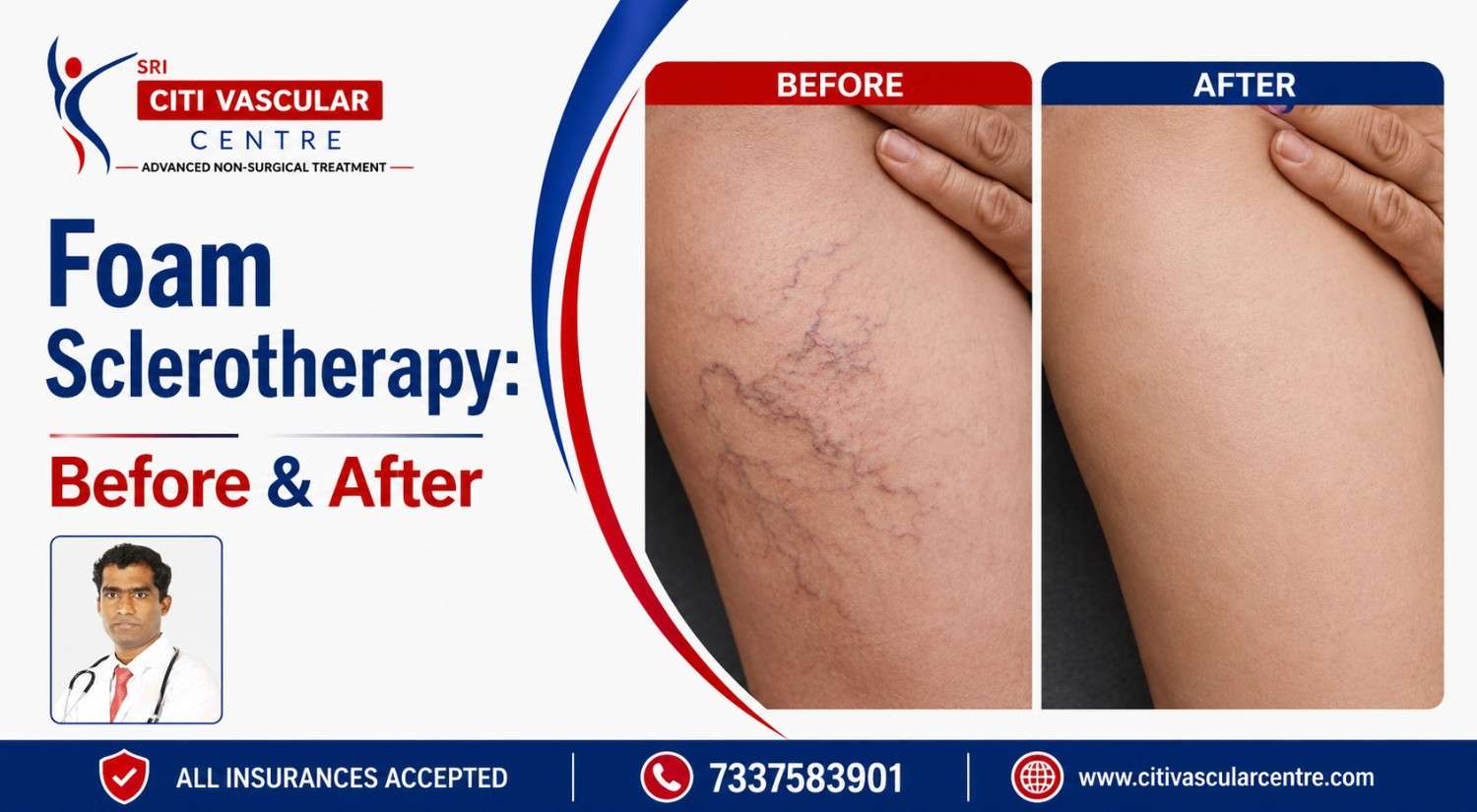
Foam sclerotherapy is the most versatile minimally invasive injection treatment for varicose veins — effective as a standalone treatment for spider veins, reticular veins, and smaller varicose tributaries, and as a complementary procedure alongside RFA, EVLT, or VenaSeal for residual varicose clusters after truncal vein ablation. It requires no heat, no catheter for surface veins, and no anaesthesia in most cases, achieving 80-95% vein closure with same-day discharge.
At Citi Vascular Hospital, KPHB Colony, Hyderabad, foam sclerotherapy is performed by Dr. Shaileshkumar Garge — FRCR (UK), FNVIR (CMC Vellore), EBIR (Spain) — using ultrasound-guided injection technique (UGFS) for larger tributaries and conventional surface sclerotherapy for spider and thread veins. Dr. Garge integrates sclerotherapy into a comprehensive one-stop varicose vein treatment plan alongside RFA, EVLT, VenaSeal, and micro-phlebectomy.
This complete guide covers: the science of foam vs liquid sclerotherapy, the Tessari technique, types and uses, who is suitable, the 7-step procedure, anaesthesia, recovery with Dos and Don'ts, clinical success data, risks including visual disturbance warning (PFO), and how foam sclerotherapy compares to every endovenous alte
Book Foam Sclerotherapy Consultation — Citi Vascular Hospital, KPHB, Hyderabad
No Surgery | No Heat | Injection Treatment | Spider Veins | Varicose Tributaries | Dr. Garge FRCR (UK)
Call +91-73375 83901 | WhatsApp | citivascularcentre.com
RFA | EVLT | VenaSeal | Sclerotherapy | Phlebectomy — All Techniques | Insurance Assisted | Mon-Sat 9AM-6PM
rnative — giving you a complete picture before your consultation.
Book your Appointment here: | Appoinment: |Call +91-7032508468| Whatsapp:+91-7337583901
|
Feature |
Foam Sclerotherapy Details |
|
Procedure Name |
Ultrasound-Guided Foam Sclerotherapy (UGFS) | Conventional Surface Sclerotherapy (CSS) |
|
Mechanism |
Sclerosant foam damages vein endothelium — causes inflammatory closure and permanent vein disappearance |
|
Uses Heat? |
No — purely chemical/mechanical irritation of vein wall |
|
Uses Catheter? |
UGFS: small needle only. No catheter required for most sclerotherapy applications |
|
Anaesthesia Required? |
Usually none — tiny needle pricks; topical anaesthetic cream optional for spider veins |
|
Procedure Duration |
15-30 minutes per session | Multiple sessions may be needed (typically 1-3) |
|
Hospital Stay |
Same-day discharge — walk out of clinic immediately after |
|
Success Rate |
80-95% for varicose tributaries (UGFS) | 60-80% for spider veins per session |
|
Sessions Required |
1-3 sessions typically for varicose tributaries | 2-4 for spider veins (interval 4-6 weeks) |
|
Compression Stockings |
Class 1-2 stockings recommended for 1-2 weeks post-procedure |
|
Return to Work |
Same day or next day for most patients |
|
Key Unique Role |
Best adjunct to RFA/EVLT/VenaSeal — clears residual tributary varicosities in the same session |
|
Best For |
Spider veins | Reticular veins | Varicose tributaries | Residual veins after thermal ablation | Perforator veins |
|
Available At |
Citi Vascular Hospital, KPHB Colony, Road No. 1, Hyderabad — Dr. Shaileshkumar Garge FRCR (UK) |
Definition
Foam sclerotherapy is a non-surgical, non-thermal injection-based treatment for varicose veins and spider veins. A liquid sclerosant agent — typically polidocanol (Aethoxysklerol) or sodium tetradecyl sulphate (STS/Fibrovein) — is transformed into a stable microfoam using the Tessari technique and injected directly into the diseased vein using a fine needle under ultrasound guidance (UGFS) or direct vision (conventional surface sclerotherapy).
The foam irritates the vein wall, causing chemical inflammation, endothelial destruction, and eventual vein fibrosis — the vein progressively scars, shrinks, and disappears over 4-12 weeks. Blood is naturally rerouted through healthy venous channels. Unlike RFA, EVLT, or VenaSeal which require catheters and treat the main truncal saphenous vein, foam sclerotherapy treats the tributary varicosities — the visible branching veins — making it the complementary finishing treatment to complete a full varicose vein management programme.
The Two Sclerosant Agents Used
|
Sclerosant |
Chemical Name |
Concentration Used |
Best For |
|
Polidocanol |
Aethoxysklerol (Lauromacrogol 400) |
0.5-3% foam depending on vein size |
Spider veins (0.5%), reticulars (1%), tributaries (1.5-3%) |
|
Sodium Tetradecyl Sulphate (STS) |
Fibrovein / STD |
0.2-3% foam depending on vein size |
Spider veins (0.2%), larger tributaries (1-3%) |
At Citi Vascular Hospital, KPHB, Dr. Garge uses both polidocanol and STS depending on vein size, location, and patient preference. The sclerosant agent and concentration are individually selected at your pre-procedure assessment based on Doppler findings and the specific veins being treated.
Traditional liquid sclerotherapy involves injecting the sclerosant directly as a solution. Foam sclerotherapy (introduced by Tessari in 2001) converts this liquid into a foam by mixing it with air or CO2 in a ratio of 1:4 (1 part sclerosant to 4 parts gas) using two syringes and a three-way stopcock — creating a stable microfoam with dramatically improved properties:
|
Property |
Liquid Sclerotherapy |
Foam Sclerotherapy |
|
Blood Displacement |
Diluted by blood in vein — reduced contact |
Foam displaces blood — 100% vein wall contact |
|
Vein Wall Contact Time |
Brief — quickly mixed with blood |
Prolonged — foam holds contact with endothelium |
|
Volume Required |
Larger volume of liquid needed |
Small foam volume treats longer vein segment |
|
Ultrasound Visibility |
Liquid not visible on ultrasound |
Foam clearly visible on ultrasound as white echogenic material — real-time monitoring possible |
|
Effectiveness for Larger Veins |
Poor — blood dilutes quickly |
Good — foam occupies the vein lumen completely |
|
Success Rate for Tributaries |
60-70% |
80-95% — significantly higher |
The Tessari Technique — How Foam Is Made
The Tessari technique uses two syringes (one containing sclerosant, one containing gas) connected by a three-way stopcock. The contents are rapidly passed back and forth 20 times — creating a stable microfoam of consistent bubble size. At Citi Vascular, KPHB, CO2/room air mixture is used for foam preparation, creating a foam that is safe, stable, and clearly visible on duplex Doppler ultrasound.
|
Type |
Technique |
Best Used For |
Anaesthesia |
|
UGFS — Ultrasound-Guided Foam Sclerotherapy |
Foam injected under real-time duplex Doppler guidance via fine needle |
Larger varicose tributaries | Perforator veins | Recurrent varicose veins | Post-RFA/EVLT residual tributaries |
Usually none |
|
CSS — Conventional Surface Sclerotherapy |
Foam injected under direct vision for surface veins using fine needle or Veinlite illumination |
Spider veins (telangiectasias) | Reticular veins | Thread veins | Small visible surface veins |
None — very fine needle |
|
Foam as Adjunct to Thermal Ablation |
Used same-session after RFA/EVLT/VenaSeal to treat visible surface varicosities |
Tributary clusters after truncal vein ablation — one-stop complete treatment |
Same local anaesthetic from prior procedure usually sufficient |
|
Microsclero for Spider Veins |
Very dilute sclerosant (0.2-0.5%) injected through 30G or insulin needle |
Fine thread veins, spider nevi, facial telangiectasias (selected sites) |
Topical anaesthetic cream (EMLA) optional |
|
Stage |
Phase |
What Happens Inside the Vein |
Result |
|
1 |
Foam Injection |
Tessari microfoam displaces blood in the target vein — occupies entire vein lumen on contact |
Complete vein wall contact with sclerosant |
|
2 |
Endothelial Damage |
Sclerosant damages the vein wall endothelium (inner lining) — chemical irritation destroys the cellular surface |
Vein wall inflammation begins — within seconds |
|
3 |
Protein Denaturation |
Detergent action of sclerosant denatures vein wall proteins — disrupts membrane integrity of endothelial cells |
Vein wall structurally weakened |
|
4 |
Inflammatory Response |
Controlled inflammation follows — white blood cells infiltrate the damaged vein wall, fibrin deposits form |
Progressive fibrosis begins — weeks 1-4 |
|
5 |
Vein Collapse and Thrombosis |
Diseased vein collapses and fills with fibrin — external compression (stocking) holds walls in contact during this phase |
Visible varicosity begins to flatten and disappear |
|
6 |
Fibrosis and Absorption |
Over 4-12 weeks, the closed vein progressively fibroses (scars) and is reabsorbed by the body — vein disappears |
Complete — treated vein no longer visible or palpable |
Why Compression Is Critical After Sclerotherapy: Compression stockings keep the collapsed vein walls in contact during the critical fibrosis period (first 1-2 weeks). Without compression, the vein walls may reopen before fibrosis is established — reducing treatment success rates. Class 1-2 below-knee stockings for 1-2 weeks after UGFS is the evidence-based standard.
|
Clinical Situation |
Suitable? |
Notes |
|
Spider veins (telangiectasias) on legs |
Yes — first-line |
Conventional sclerotherapy with dilute foam (0.2-0.5%) — most effective surface vein treatment |
|
Reticular veins (blue-green network veins) |
Yes — first-line |
UGFS or CSS — sclerotherapy specifically designed for these vein types |
|
Varicose tributary veins (branching clusters) |
Yes — UGFS |
UGFS with 1-3% foam — treats visible clusters not treated by truncal ablation |
|
Residual varicosities after RFA / EVLT / VenaSeal |
Yes — ideal |
Sclerotherapy clears remaining surface tributaries after the feeding truncal vein is ablated |
|
Perforator vein incompetence (selected cases) |
Yes — UGFS |
UGFS can target incompetent perforator veins under direct ultrasound guidance |
|
Recurrent varicose veins after prior surgery |
Yes |
Sclerotherapy effective for recurrent tributaries — no re-dissection of surgical field needed |
|
Cosmetic spider vein concerns |
Yes — CSS |
Cosmetically motivated treatment using dilute sclerosant — not medically indicated but commonly performed |
|
Main truncal vein (GSV/SSV) reflux alone |
Not first-line |
Sclerotherapy for large truncal veins has higher recurrence than RFA/EVLT/VenaSeal — combination preferred |
IMPORTANT SAFETY SCREENING — PATENT FORAMEN OVALE (PFO): Foam sclerotherapy involves injecting air-containing foam into leg veins. In patients with a Patent Foramen Ovale (PFO) — a small opening between heart chambers present in ~25% of the population — foam bubbles can theoretically cross into the arterial circulation and cause transient visual disturbances, migraine-like episodes, or very rarely, stroke. Dr. Garge screens all patients for PFO risk factors and migraine history before foam sclerotherapy. CO2 foam is preferred over air foam in higher-risk patients.
|
Contraindication |
Suitability |
Reason / Alternative |
|
Pregnancy |
Contraindicated |
All elective sclerotherapy deferred until at least 3 months post-partum. Veins often improve spontaneously post-delivery. |
|
Active Deep Vein Thrombosis (DVT) |
Contraindicated |
DVT must be fully treated and resolved before any sclerotherapy procedure |
|
Known allergy to sclerosant agent |
Contraindicated |
Alternative sclerosant or laser therapy offered. Allergy to polidocanol does not preclude STS and vice versa. |
|
Known PFO with prior neurological events |
High risk — specialist assessment |
Echo bubble study to confirm PFO before foam sclerotherapy. CO2 foam or micro-phlebectomy preferred. |
|
Inability to walk or wear compression post-procedure |
Relative — assess individually |
Walking and compression are essential for success and DVT prevention after sclerotherapy |
|
Severe peripheral arterial disease |
Relative contraindication |
Compression stockings may compromise arterial flow in severe PAD — assess ABPI first |
|
Very large truncal GSV reflux (>8mm) as primary treatment |
Not first-line |
RFA/EVLT/VenaSeal first, then sclerotherapy for residual tributaries |
|
When |
Preparation Step |
Details / Notes |
|
1-2 Weeks Before |
Duplex Doppler Ultrasound Vein Mapping |
Identifies all refluxing veins, maps tributaries, confirms perforator involvement, plans which veins to inject and in which order. Essential for UGFS planning. |
|
1-2 Weeks Before |
PFO and Migraine History Screening |
Declare any history of: migraine with aura, prior stroke or TIA, known PFO or ASD, prior visual disturbances after injection therapy. This determines whether CO2 or air foam is used and whether extra precautions are needed. |
|
1-2 Weeks Before |
Allergy Screening |
Known allergy to polidocanol or STS must be declared. Rare drug allergy — alternative sclerosant or alternative technique offered if confirmed. |
|
1 Week Before |
Medication Review |
Blood thinners generally continue for sclerotherapy (most protocols do not require pause). NSAIDs may affect foam stability — discuss with Dr. Garge's team. |
|
Day Before |
Purchase Compression Stockings |
Class 1-2 below-knee compression stockings (18-32 mmHg) — must be worn immediately after procedure. Purchase in advance. |
|
Day of Procedure |
No Moisturiser or Fake Tan on Legs |
Avoid leg moisturiser, fake tan, or oils on treatment day — these affect needle access and increase pigmentation risk post-procedure. |
|
Day of Procedure |
Clothing |
Wear loose comfortable trousers or shorts that roll above the knee. Bring compression stockings to appointment. |
|
Day of Procedure |
Eat Normally — No Fasting |
Light meal before procedure is acceptable — no anaesthesia or fasting protocol required for standard foam sclerotherapy |
|
Day of Procedure |
Transport |
Most sclerotherapy patients can drive themselves home — no sedation or general anaesthetic used. Confirm with team. |
|
1 |
Pre-Procedure Duplex Doppler Assessment and Marking With the patient standing, Dr. Garge performs duplex Doppler to confirm the target veins, re-evaluate the reflux pattern on the treatment day, and mark the vein courses on the skin. For UGFS, the path of the tributary varicosity and its feeding perforator (if present) are mapped precisely. This real-time assessment ensures accurate needle placement even for veins not visible on the surface. |
|
2 |
Patient Positioning and Skin Preparation Patient lies on the treatment table — typically in mild Trendelenburg (head-down) position to empty the superficial leg veins and reduce their diameter for better needle access. The treatment area is cleaned with antiseptic. Unlike RFA or EVLT, no extensive field preparation is needed — just targeted preparation around the injection sites. |
|
3 |
Foam Preparation Using Tessari Technique Dr. Garge prepares fresh sclerosant foam using the Tessari technique immediately before each injection: sclerosant (polidocanol or STS at the appropriate concentration for the vein being treated) is mixed with CO2/air in a 1:4 ratio using two syringes and a three-way stopcock — 20 rapid passes creating stable microfoam. Fresh foam is prepared for each session to ensure optimal bubble stability. |
|
4 |
Ultrasound-Guided or Direct Needle Injection A fine 23G-30G needle is inserted into the target vein — under direct ultrasound guidance for UGFS of deeper tributaries and perforators, or under direct vision for surface spider and reticular veins. For UGFS, the needle tip is confirmed within the vein lumen on ultrasound before foam injection begins. Multiple injection sites may be used in a single session to treat the full extent of the varicosity. |
|
5 |
Foam Injection and Ultrasound Monitoring Foam is slowly injected under ultrasound guidance — the foam appears as bright white echogenic material on the ultrasound screen, allowing Dr. Garge to monitor foam distribution, confirm complete filling of the target vein, and verify that the foam is not tracking into deep veins. Total foam volume per session is typically 6-8mL maximum (European Consensus 2012 guidelines). If treating spider veins, direct vision monitoring replaces ultrasound. |
|
6 |
Immediate Compression Application Immediately after foam injection at each site, gentle external compression is applied with Dr. Garge's finger for 30 seconds — holding the vein walls in contact as the foam works. A compression bandage or pad is applied over the treated area. Class 2 below-knee compression stockings are then fitted before the patient stands up. |
|
7 |
Post-Procedure Walking and Discharge Immediately after stockings are applied, the patient walks for 20-30 minutes within the clinic — critical for DVT prevention. Walking activates the calf muscle pump, disperses any foam from larger veins into the deep system, and promotes healthy blood flow. The patient is observed for 30 minutes for any adverse reactions (allergy, visual disturbance). Same-day discharge is standard. |
Procedure Time: 15-30 minutes per session for UGFS of varicose tributaries. 10-20 minutes for spider vein sclerotherapy. If combined with RFA/EVLT/VenaSeal in the same session, sclerotherapy adds 15-20 minutes to total procedure time. Multiple sessions (1-3) may be needed for complete clearance depending on vein extent.
|
Timeframe |
What to Expect |
Dos and Donts |
|
Immediately After (30 min in clinic) |
Walk 20-30 min in clinic. Some tenderness and itching along treated veins — normal sclerosant response. Compression stockings fitted before leaving. |
Walk 20-30 min. Stockings on. Gentle movement. Hydrate. Drive home (usually safe). |
|
Day 0-2 |
Mild bruising and brownish discolouration along vein course. Veins may look worse initially — they are swollen and inflamed as treatment works. Normal. |
Continue walking daily. Stockings on day and night for first 48 hours. No vigorous exercise. No hot bath/sauna/jacuzzi. |
|
Days 2-7 |
Most patients return to work day after procedure. Treated veins progressively flatten and darken. Compression stocking use continues during the day. |
Return to desk work day 1-2. Continue compression stocking wear. No high-impact exercise. No long flights without compression. |
|
Week 1-2 |
Compression stockings worn during the day. Treated veins change colour — may temporarily look more prominent (normal post-sclerotherapy inflammatory response). |
Keep stockings on for full 2 weeks. Light exercise (walking, swimming) from Week 1. No tight clothing over treated areas. |
|
Month 1-3 |
Treated veins progressively fade and disappear as fibrosis completes. Spider veins may take 6-12 weeks to clear fully. UGFS veins clear faster than spider veins. |
Follow-up at 4-6 weeks if additional session needed. Maintain compression as advised. Sun protection on treated areas reduces pigmentation. |
|
If Further Sessions Needed |
Most varicose tributaries require 1-3 sessions at 4-6 week intervals. Spider veins typically require 2-4 sessions. Each session builds on previous results. |
Schedule follow-up with Dr. Garge at 4-6 weeks. Do not re-treat too early — allow full 4-week interval. |
|
Visual Disturbance — Contact Clinic Immediately |
Any visual disturbance — flashing lights, blurred vision, scotoma — within 30 minutes of foam injection. May indicate foam reaching cerebral circulation via PFO. |
Call Citi Vascular immediately: +91-73375 83901 | Lie down | Do not drive | Usually resolves within 30-60 min but requires assessment. |
|
DVT Warning — Emergency |
Sudden calf swelling | Severe leg pain | Redness warmth of calf | Shortness of breath post-procedure |
Emergency evaluation required — DVT after sclerotherapy rare (< 1%) but treatable. Call immediately or attend emergency room. |
Book your Appointment here: | Appoinment: |Call +91-7032508468| Whatsapp:+91-7337583901
|
Clinical Outcome |
Data / Rate |
Notes |
|
UGFS closure of varicose tributaries at 1 year |
80-95% |
Duplex Doppler confirmed — highly effective for larger tributary veins |
|
Spider vein clearance per session |
60-80% |
Multiple sessions (2-4) typically needed for complete spider vein clearance |
|
Spider vein clearance after 3 sessions |
85-90% |
Cumulative improvement with each session at 4-6 week intervals |
|
UGFS vs Surgery (tributaries) |
Equivalent at 1 year |
European multicentre trials — UGFS and phlebectomy comparable for tributary veins |
|
Symptom improvement after UGFS |
75-85% |
Pain, heaviness, itching improvements reported by most UGFS patients |
|
Recurrence at 3 years (UGFS) |
20-30% |
Higher than thermal ablation for truncal veins — new tributaries develop in some patients |
|
DVT rate post-sclerotherapy |
< 1% (UGFS) | < 0.1% (CSS) |
Lower with early walking + compression protocol |
|
Patient satisfaction |
High (> 85%) |
Particularly high for cosmetic spider vein treatment when patient expectations set correctly |
Clinical Role of Sclerotherapy in 2026: Foam sclerotherapy is NOT the first-line treatment for large truncal GSV/SSV reflux (RFA/EVLT/VenaSeal are preferred). Its primary role is treating the TRIBUTARIES — the visible varicose clusters and spider veins that remain after truncal ablation. Used as part of a comprehensive one-stop treatment at Citi Vascular KPHB, sclerotherapy completes the cosmetic and symptomatic result that thermal ablation alone cannot achieve.
|
Category |
Risk / Side Effect |
Frequency |
Management |
|
Very Common (>50%) |
Bruising along treated vein |
Almost all patients |
Self-resolving 2-4 weeks. Normal inflammatory response. Compression reduces extent. |
|
Very Common (>50%) |
Temporary hyperpigmentation (brown discolouration) |
10-30% |
Haemosiderin deposit in skin above treated vein. Fades 3-12 months. Sun protection reduces risk. |
|
Common (5-20%) |
Superficial thrombophlebitis (vein inflammation) |
5-15% |
NSAIDs + warm compress + walking. Self-limiting 2-6 weeks. |
|
Common (5-10%) |
Telangiectatic matting (new fine veins in treated area) |
5-10% |
New fine vessels appear in treated zone. May fade spontaneously or require additional treatment after 3 months. |
|
Uncommon (1-5%) |
Skin necrosis at injection site |
< 1% (extravasation risk) |
Prevented by correct intravessel injection. Extravasation of sclerosant into tissue causes ulceration — heals over weeks. |
|
Uncommon (1-3%) |
Allergic reaction to sclerosant |
< 3% |
Antihistamine + corticosteroid. Anaphylaxis extremely rare. Pre-screening for known sensitivity. |
|
Rare (< 1%) |
Deep Vein Thrombosis (DVT) |
< 1% (UGFS) | < 0.1% (CSS) |
Early walking + compression stocking protocol dramatically reduces risk. Screened at 1-week Doppler. |
|
Rare (< 1%) |
Visual disturbance — flashing lights, scotoma |
< 1% (air foam) | Lower with CO2 |
PFO-mediated bubble crossing. Lie down. Usually resolves 30-60 min. Report immediately to Dr. Garge. |
Post-Sclerotherapy Pigmentation: Brown discolouration along treated veins affects 10-30% of patients and is the most common cosmetically significant side effect. It results from haemosiderin (iron) deposits in the skin as the vein breaks down. It is NOT permanent in most cases — fading over 3-12 months. Sun protection is critical during this period as UV exposure darkens pigmentation.
|
Feature |
Foam Sclerotherapy |
RFA |
EVLT (Laser) |
VenaSeal |
|
Primary Target Vein |
Tributaries, spider veins, reticulars |
GSV/SSV truncal |
GSV/SSV truncal |
GSV/SSV truncal |
|
Catheter Required |
No for most — needle only |
Yes |
Yes |
Yes |
|
Anaesthesia |
None usually |
30-60 tumescent injections |
30-60 tumescent injections |
1 injection only |
|
Sessions Required |
1-3 (veins may need repeat) |
1 (usually sufficient) |
1 (usually sufficient) |
1 (usually sufficient) |
|
Closure Rate |
80-95% (UGFS tributaries) |
95-98% (truncal) |
95-98% (truncal) |
95-97% (truncal) |
|
Best Used For |
Tributaries | Spider veins | Adjunct to thermal ablation |
Primary GSV treatment |
Primary GSV/SSV small tortuous |
Primary GSV — needle-anxious patients |
|
Compression Duration |
1-2 weeks |
2 weeks |
2 weeks |
Often 1 week or none |
|
Can Treat Spider Veins Directly |
Yes |
No |
No |
No |
|
Used Together? |
Often combined with all three |
Often includes sclerotherapy for tributaries |
Often includes sclerotherapy for tributaries |
Often includes sclerotherapy for tributaries |
The Complete Varicose Vein Treatment at Citi Vascular KPHB is a combination: (1) RFA/EVLT/VenaSeal ablates the truncal GSV/SSV in one session, (2) Micro-phlebectomy removes large varicose clusters, (3) Foam sclerotherapy clears residual tributaries and spider veins — all three can be performed in a single visit or across planned sessions. This combined approach achieves the best cosmetic and clinical outcomes.
|
Spider veins or tributary clusters? Foam sclerotherapy at Citi Vascular KPHB — same-day, no anaesthesia, immediate walking. Call +91-73375 83901 |
Need complete varicose vein treatment? RFA/EVLT + sclerotherapy in one session — one-stop complete vein clearance. WhatsApp for Quick Booking |
|
Differentiator |
Specific Evidence |
What This Means for You |
|
Triple International Credentials |
FRCR (Royal College of Radiologists, UK) + FNVIR (CMC Vellore) + EBIR (European Board of IR, Spain) + Fellowship (North Carolin, USA) |
Highest international IR certifications — sclerotherapy training included as part of comprehensive vein disease management |
|
All Vein Treatment Techniques |
Foam sclerotherapy | RFA | EVLT | VenaSeal | MOCA | Micro-phlebectomy — all available in-house at Citi Vascular KPHB |
Comprehensive treatment plan designed for your specific vein pattern — not a single technique for all patients |
|
Ultrasound-Guided Precision |
All UGFS performed under real-time duplex Doppler — foam distribution monitored during injection |
No blind injections — foam tracked in real time to confirm correct distribution and avoid deep vein entry |
|
One-Stop Treatment Planning |
RFA/EVLT + phlebectomy + sclerotherapy all planned and performed in the same session when clinically appropriate |
Complete vein clearance in one visit — no multiple return procedures at different centres |
|
PFO and Allergy Screening |
Systematic screening for PFO risk factors, migraine history, and sclerosant allergy at every pre-sclerotherapy consultation |
Patient safety protocols specific to foam sclerotherapy — not performed at all centres |
|
12+ Years and 15,000+ Procedures |
Dedicated minimally invasive vascular interventions at Citi Vascular Hospital, KPHB |
High-volume specialist: precise injection technique, optimal foam concentration selection, low complication rates |
|
What We Offer |
The Specifics |
Why It Matters |
|
All Vein Techniques In One Centre |
Foam UGFS + RFA + EVLT + VenaSeal + MOCA + Phlebectomy — everything available at KPHB |
Single consultation determines the complete treatment plan — no referrals to different centres |
|
On-Site Duplex Doppler |
Pre-procedure vein mapping and real-time UGFS guidance using high-resolution Doppler at Citi Vascular |
Same-facility Doppler eliminates separate radiology visits |
|
Certified Sclerosant Agents |
Pharmaceutical-grade polidocanol and STS in multiple concentrations — fresh Tessari foam preparation per session |
Correct concentration for each vein size; fresh foam each session for optimal bubble stability |
|
PFO Safety Protocol |
Every patient screened for PFO risk before UGFS — CO2 foam used preferentially in higher-risk patients |
Foam sclerotherapy-specific safety protocols not universally applied at all vein clinics |
|
One-Stop Combined Treatment |
Sclerotherapy combined with RFA/EVLT/phlebectomy in the same session — maximum treatment per visit |
Complete varicose vein clearance (truncal + tributaries + spider veins) achievable in 1-2 total visits |
|
Pigmentation Prevention Advice |
Sun protection guidance + stocking compliance education + post-procedure skin care protocol for every sclerotherapy patient |
Reduces the most common cosmetically significant complication of sclerotherapy |
|
Insurance and Payment |
Medically indicated UGFS (for varicose veins with symptoms) covered by many insurance policies. Pre-auth documentation by Citi Vascular team. |
Cosmetic sclerotherapy (spider veins) generally not covered — transparent pricing before treatment |
Sunita's Story — 39-Year-Old School Teacher, Secunderabad, Hyderabad
|
Stage |
Sunita's Experience |
Clinical Details |
|
Presentation |
Left leg varicose veins treated with RFA at Citi Vascular 6 months prior | Residual calf tributary clusters still visible | New spider veins on both thighs |
Post-RFA GSV closure confirmed on Doppler | Residual tributaries and telangiectasias noted on review |
|
Assessment |
Doppler by Dr. Garge confirmed GSV still closed — residual tributaries without reflux. Spider veins on thighs cosmetic concern. |
Plan: UGFS for calf tributaries (2 sessions 4 weeks apart) + CSS for thigh spider veins (2 sessions) |
|
Session 1 — UGFS |
Calf tributaries injected under Doppler guidance | 20 min | Walked 25 min in clinic | Compression stocking fitted | Home same day |
4mL foam (polidocanol 2%) | 3 injection sites | Foam distribution confirmed on Doppler | PFO screen negative |
|
Session 1 Response |
By week 3: calf tributaries 60% reduced and flattening. Some brown discolouration along vein course — expected. |
Inflammatory fibrosis progressing well | Follow-up at 6 weeks | Pigmentation discussed and sun protection advised |
|
Session 2 — UGFS + CSS |
Remaining calf tributaries re-treated | Thigh spider veins injected with 0.5% foam | 25 min total |
Minimal additional foam needed for tributaries | Spider veins blanched immediately on injection |
|
3-Month Review |
Calf varicosities 90% cleared. Spider veins 75% improved. Sunita extremely satisfied. Standing job at school now comfortable. |
VCSS score improved | Doppler confirmed no new GSV reflux | Further CSS session planned for residual spider veins |
"After my RFA, the big veins were gone but I still had some visible clusters in my calf. Dr. Garge said sclerotherapy was the right next step. Two sessions and they have almost completely disappeared. The spider veins on my thighs are also clearing. I wish I had done this sooner." — Sunita, 39, Teacher, Secunderabad, Hyderabad
|
Credential |
Detail |
|
Full Name |
Dr. Shaileshkumar Garge |
|
Qualifications |
MBBS | MD (Mumbai) | DNB (Delhi) | FRCR (UK) | FNVIR (CMC Vellore) | EBIR (Spain/Europe) | Fellowship (USA) |
|
Role |
Director and Chief Vascular Physician | Senior Consultant Vascular and Interventional Radiologist |
|
Hospital |
Citi Vascular Hospital, KPHB Colony, Road No. 1, Hyderabad, Telangana 500072 |
|
Varicose Vein Techniques |
Foam Sclerotherapy (UGFS + CSS) | RFA | EVLT | VenaSeal | MOCA | Micro-phlebectomy | Duplex Doppler Vein Mapping |
|
Experience |
12+ years | 15,000+ minimally invasive vascular procedures across Hyderabad and Telangana |
|
Sclerosant Agents Used |
Polidocanol (Aethoxysklerol) | Sodium Tetradecyl Sulphate (Fibrovein/STS) | Both available in multiple concentrations |
Q1: What is foam sclerotherapy for varicose veins?
Foam sclerotherapy is a minimally invasive injection treatment for varicose veins. A medical sclerosant (polidocanol or STS) is converted into stable microfoam using the Tessari technique and injected into diseased veins — chemically destroying the vein wall and causing permanent vein closure. No heat, no surgery, no catheter for most applications. The vein progressively disappears over 4-12 weeks. Available at Citi Vascular Hospital, KPHB, Hyderabad.
Q2: Is foam sclerotherapy painful?
Foam sclerotherapy is one of the least painful varicose vein treatments. No anaesthetic injections are required — only tiny needle pricks (23G-30G) at each injection site. Most patients describe a mild burning or stinging sensation for 10-30 seconds during the sclerosant injection, followed by immediate relief. Spider vein injections are even more comfortable using 30G needles. No sedation or recovery time is needed.
Q3: Which is the best hospital for foam sclerotherapy in Hyderabad?
Citi Vascular Hospital, KPHB Colony, Road No. 1, Hyderabad is one of the leading centres for foam sclerotherapy in Hyderabad — offering both UGFS (ultrasound-guided) and CSS (conventional surface). Led by Dr. Shaileshkumar Garge FRCR (UK), the centre uses pharmaceutical-grade sclerosants, real-time Doppler guidance, PFO screening protocols, and integrates sclerotherapy with RFA/EVLT/VenaSeal for complete one-stop varicose vein management.
Q4: Who is the best doctor for foam sclerotherapy in Hyderabad?
Dr. Shaileshkumar Garge — FRCR (UK), FNVIR (CMC Vellore), EBIR (Spain) — Director and Chief Vascular Physician at Citi Vascular Hospital, KPHB, Hyderabad, is one of Hyderabad's most credentialled specialists for foam sclerotherapy and all varicose vein treatments. With 12+ years of dedicated vascular interventional radiology, all five vein treatment techniques available in-house, and PFO safety protocols, he provides comprehensive vein management.
Q5: How many sessions of foam sclerotherapy are needed?
Varicose tributary veins typically require 1-3 foam sclerotherapy sessions at 4-6 week intervals for complete clearance. Spider and thread veins usually need 2-4 sessions as they are more resistant to treatment. Each session builds on the previous result. Dr. Garge at Citi Vascular KPHB assesses response at each follow-up visit and determines whether further sessions are needed based on Doppler and clinical assessment.
Q6: What is the success rate of foam sclerotherapy for varicose veins?
Ultrasound-guided foam sclerotherapy (UGFS) achieves 80-95% closure rates for varicose tributary veins at 1 year. Spider vein clearance per session is 60-80%, with 85-90% clearance after a course of 3 sessions. Success is higher when compression stockings are worn consistently for 2 weeks post-procedure. UGFS has equivalent efficacy to phlebectomy (surgical removal) for tributary varicosities in published European multicentre trials.
Q7: Can foam sclerotherapy treat spider veins?
Yes — sclerotherapy is the gold standard for spider vein (telangiectasia) and thread vein treatment. A very dilute sclerosant foam (0.2-0.5% polidocanol) is injected using an ultra-fine 30G needle under direct vision. Spider veins blanch immediately on injection and progressively fade over 6-12 weeks. Multiple sessions (2-4) at 4-6 week intervals achieve 85-90% cosmetic clearance. Available at Citi Vascular Hospital, KPHB, Hyderabad.
Q8: What is the risk of visual disturbance after foam sclerotherapy?
Visual disturbance (flashing lights, blurred vision, scotoma) after foam sclerotherapy affects less than 1% of patients. It occurs when foam bubbles cross from the venous to arterial circulation via a Patent Foramen Ovale (PFO) — a small heart opening present in ~25% of people. It usually resolves within 30-60 minutes without treatment. Dr. Garge screens all patients for PFO risk factors and uses CO2 foam in higher-risk patients to minimise this risk.
Q9: Does foam sclerotherapy cause brown staining on the skin?
Temporary brown skin staining (hyperpigmentation) affects 10-30% of foam sclerotherapy patients. It results from haemosiderin — iron deposits from blood breaking down in the treated vein — depositing in the skin above the treated area. It is NOT permanent in most cases, fading over 3-12 months. Sun protection (high-factor sunscreen on treated areas) is essential during this period as UV exposure darkens pigmentation significantly.
Q10: Is foam sclerotherapy used alongside RFA or laser for varicose veins?
Yes — foam sclerotherapy is the ideal complement to thermal ablation. RFA, EVLT, or VenaSeal treats the main GSV/SSV truncal reflux vein; foam sclerotherapy clears the residual tributary varicosities and spider veins that remain after truncal ablation. At Citi Vascular Hospital, KPHB, these are often combined in the same session — providing complete varicose vein clearance (truncal + tributaries + spider veins) in one or two total visits.
Q11: Can I walk and return to work after foam sclerotherapy?
Yes — walking is actively encouraged immediately after foam sclerotherapy at Citi Vascular, KPHB. A 20-30 minute walk in the clinic is standard before discharge. Most patients return to office work the same day or the following day. Compression stockings must be worn consistently for 1-2 weeks post-procedure. Physical exercise (gym, running) should be avoided for 1-2 weeks to prevent post-procedure complications.
Q12: Is foam sclerotherapy covered by insurance in Hyderabad?
Foam sclerotherapy for medically indicated varicose veins (causing pain, swelling, skin changes, or venous ulcers) is covered by many health insurance policies in Hyderabad subject to pre-authorisation and medical necessity documentation. Cosmetic sclerotherapy for spider veins alone is generally not covered. Citi Vascular Hospital, KPHB, prepares all pre-authorisation documentation. Call +91-73375 83901 to check your specific coverage before booking.
Citi Vascular Hospital, KPHB Colony, Road No. 1, Hyderabad — foam sclerotherapy for varicose veins and spider veins available for patients from:
Kukatpally and KPHB — 5 min drive
Miyapur and Bachupally — 10 min
Hitech City and Madhapur — 20 min
Ameerpet and SR Nagar — 20 min
Gachibowli and Kondapur — 25 min
Secunderabad and Begumpet — 25 min
Kompally, Medchal and Alwal — 20-25 min
Telangana and AP — outstation consultations welcome
|
Hospital |
Contact |
Hours |
|
Citi Vascular Hospital |
<
Ready To Get Experts Our Services |